Scientific Collaboration: How Indian Researchers Work Together to Drive Innovation
When we talk about scientific collaboration, the process where researchers from different institutions, disciplines, or countries pool knowledge, tools, and resources to solve complex problems. Also known as research partnership, it’s not just about sharing data — it’s about building trust across borders, languages, and specialties to make breakthroughs that no single lab could achieve alone. In India, this isn’t a luxury. It’s the only way forward. With limited funding, fragmented institutions, and huge challenges like climate change, disease, and food security, scientists have learned: no one wins alone.
Take interdisciplinary research, when experts from fields like biology, engineering, and data science team up to tackle problems that don’t fit in one box. You see it in nanomedicine — where chemists design nanoparticles, doctors test them in clinics, and AI specialists model how they move through the body. That’s not coincidence. It’s collaboration by design. Look at the posts here: AI isn’t replacing biotech — it’s helping it. Nanoparticles in cancer drugs? Those came from teams mixing materials science with oncology. Climate models? They need atmospheric physicists, agronomists, and even economists working side by side.
And it’s not just labs. science policy, the rules, funding structures, and institutional frameworks that either enable or block teamwork between researchers is the silent engine. India’s biggest wins — from space missions to vaccine development — didn’t happen because one person had a genius idea. They happened because universities, ISRO, private labs, and government agencies found ways to align goals, share infrastructure, and cut red tape. That’s collaboration with teeth.
What you’ll find in these posts isn’t just a list of projects. It’s proof that real innovation in India doesn’t come from isolated geniuses. It comes from networks — from agronomists talking to data scientists, from astronauts working with textile engineers, from public health experts partnering with AI developers. The future of Indian science isn’t in one lab. It’s in the connections between them.

What Is the Four-Dimensional Model of Collaboration in Scientific Research?
Dec, 5 2025
The four-dimensional model of collaboration explains how scientific teams succeed by aligning structure, cognition, social dynamics, and institutional rules. Learn how to apply it to your research group.
Read Article→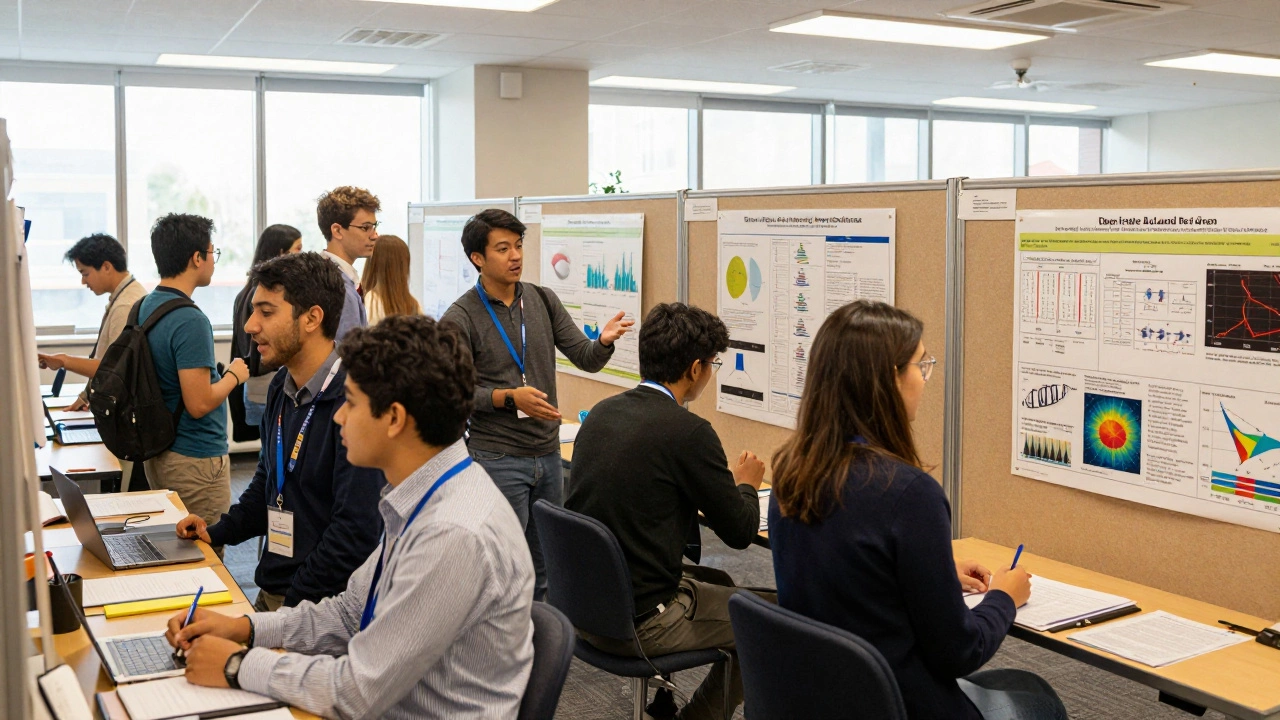
What Is a Science Conference? A Practical Guide for Researchers and Students
Dec, 2 2025
A science conference is where researchers share findings, get feedback, and build collaborations. Learn what happens at these events, who attends, and how to make the most of your first conference experience.
Read Article→
The Art of Scientific Sharing: Communicating Discoveries
Feb, 3 2025
Scientists share their work through various channels, ensuring that discoveries reach both fellow researchers and the broader public. By employing academic journals, conferences, and digital platforms, researchers foster collaboration and innovation. This article offers insights into the methods and challenges of scientific communication, highlighting the importance of peer review, open access, and the role of social media in broadening scientific engagement.
Read Article→
Mastering the 4 C's of Effective Teamwork for Scientific Collaboration
Jan, 21 2025
Teamwork in scientific collaboration relies on the 4 C's: Communication, Cooperation, Coordination, and Commitment. These elements form the foundation for achieving shared goals and fostering innovation. By enhancing communication, ensuring cooperation, maintaining coordination, and committing to common objectives, teams can drive significant advancements in their fields. Understanding and implementing these principles can empower teams to work more efficiently and effectively.
Read Article→
The True Nature of Collaboration: Beyond Mere Teamwork in Science
Jan, 16 2025
Collaboration in science often surpasses the conventional idea of simply working together. It involves blending skills, ideas, and unique insights from diverse fields to solve complex problems. Understanding the nuances of collaboration can unlock unprecedented discoveries. This article explores what collaboration truly means, its benefits, potential challenges, and tips for successful partnerships in scientific research.
Read Article→