What Is the Four-Dimensional Model of Collaboration in Scientific Research?
 Dec, 5 2025
Collaboration Health Check
Team Collaboration Assessment
Rate your team's collaboration across the four dimensions. Be honest. Your ratings will help identify areas to improve.
How well are team members organized? Do you have shared infrastructure?
How well do team members understand each other's thinking and expertise?
How strong is trust, respect, and psychological safety within the team?
How well are external systems and policies aligned with your team's work?
When scientists from different countries, disciplines, or institutions work together, it’s not just about sharing data or co-authoring papers. Real collaboration - the kind that leads to breakthroughs - needs structure. That’s where the four-dimensional model of collaboration comes in. Developed by researchers at the European Commission’s Joint Research Centre and later refined by science policy experts, this model breaks down what actually makes scientific teams work well. It’s not theory. It’s been used to evaluate major projects like the Human Genome Project, CERN’s particle colliders, and global climate modeling initiatives.
Dimension One: Structural Integration
Structural integration is about how teams are organized. Are people physically co-located? Do they share the same lab space, software tools, or data platforms? Or are they spread across continents, working in different time zones with mismatched systems?
High-performing collaborations in science don’t just rely on good intentions. They build shared infrastructure. For example, the Square Kilometre Array (SKA), a radio telescope project spanning South Africa and Australia, uses a unified data pipeline that lets researchers in London, Tokyo, and Cape Town access the same raw signals in real time. Without this level of structural alignment, even the brightest minds can’t sync up.
Teams that score high here have:
- Standardized data formats and metadata schemas
- Shared cloud storage or institutional repositories
- Common project management tools (like Jira or Notion) with access controls
- Regularly scheduled sync meetings across time zones
If your team is using five different file-naming conventions or three different versions of Python, you’re not collaborating - you’re just emailing each other.
Dimension Two: Cognitive Integration
This is where things get interesting. Cognitive integration means team members don’t just understand each other’s data - they understand each other’s thinking.
Imagine a biologist working with a data scientist on cancer genomics. The biologist thinks in terms of cell pathways and gene expression. The data scientist thinks in terms of statistical models and algorithmic bias. If they can’t translate between these languages, the project stalls.
Successful collaborations build bridges. They hold cross-training sessions. They create glossaries. They assign ‘translation champions’ - people who speak both technical dialects. At the Broad Institute, teams working on single-cell RNA sequencing started holding weekly ‘jargon jam’ meetings where each member had to explain their work using only analogies. It sounds silly, but it cut misunderstandings by 60% in six months.
Cognitive integration isn’t about everyone becoming an expert in everything. It’s about creating enough shared mental models to ask the right questions. If a physicist says ‘this signal is noisy,’ does the chemist know what that means in practical terms? If not, you’re missing a key dimension.
Dimension Three: Social Integration
Science is done by people. And people have personalities, biases, egos, and histories.
Social integration is the glue that holds teams together when things get tough. It’s about trust, respect, and psychological safety. A 2023 study of 214 international research teams found that teams with high social integration were 3.2 times more likely to publish in top-tier journals - even when their funding or technical resources were equal to less cohesive teams.
What builds social integration?
- Rotating leadership roles so no one feels sidelined
- Public recognition of contributions (not just authorship order)
- Virtual coffee chats or informal hangouts
- Clear conflict resolution protocols
One team working on pandemic response models in 2021 had a rule: no meeting ended without someone saying something positive about another member. That small habit kept morale high during months of 18-hour days. When someone made a mistake, the team didn’t blame - they asked, ‘What did we miss?’
Without social integration, even brilliant teams fracture under pressure. And in science, pressure is constant.

Dimension Four: Institutional Integration
Science doesn’t happen in a vacuum. It happens inside universities, funding agencies, patent offices, and government bodies - each with its own rules, incentives, and deadlines.
Institutional integration means aligning these external systems. Who owns the data? Who gets credit? Who pays for open-access publishing? Who files the patent? If these aren’t agreed upon upfront, disputes arise later - often after years of work.
Take the International Space Station. It’s a collaboration between NASA, ESA, Roscosmos, JAXA, and CSA. Each agency has different rules on intellectual property, publication timelines, and staff rotations. To make it work, they created a 1,200-page Memorandum of Understanding - one that gets updated every five years.
For smaller teams, institutional integration might mean:
- A written collaboration agreement signed before the project starts
- Clear authorship guidelines (like CRediT taxonomy)
- Agreed-upon timelines for deliverables and publications
- Shared understanding of funding restrictions (e.g., can you use grant money for travel to a partner’s lab?)
Teams that skip this step often end up in legal limbo. One 2022 case involved three universities co-developing a diagnostic tool. Because no one clarified who owned the IP, the project was frozen for 14 months. That’s two years of lost research.
How to Use the Model in Practice
You don’t need to be a policy expert to apply this. Here’s how to check your own team:
- Map your dimensions: Grab a whiteboard. Draw four boxes. Label them: Structural, Cognitive, Social, Institutional. For each, write down what’s working and what’s broken.
- Rate your team: On a scale of 1-5, how well does your team handle each dimension? Be honest. A 5 in Structural but a 2 in Social? That’s a red flag.
- Pick one weakness to fix: Don’t try to fix everything at once. Start with the dimension holding you back most. If no one talks outside meetings, focus on Social. If data keeps getting lost, fix Structural.
- Revisit quarterly: Teams change. New members join. Funding shifts. Reassess every three months.
There’s no perfect score. But teams that regularly check these four dimensions outperform those that don’t - by a wide margin.
What Happens When One Dimension Fails
Let’s say your team has perfect Structural and Cognitive integration. You share data. You understand each other’s methods. But no one trusts each other. Social integration is weak.
What happens? People withhold ideas. They avoid risky questions. They don’t challenge assumptions. Innovation dies.
Or suppose you have great Social and Cognitive ties, but your institution doesn’t recognize collaborative work for tenure. Researchers start leaving. The project collapses.
One dimension failing can drag down the whole system. That’s why this model isn’t just a checklist - it’s a warning system.
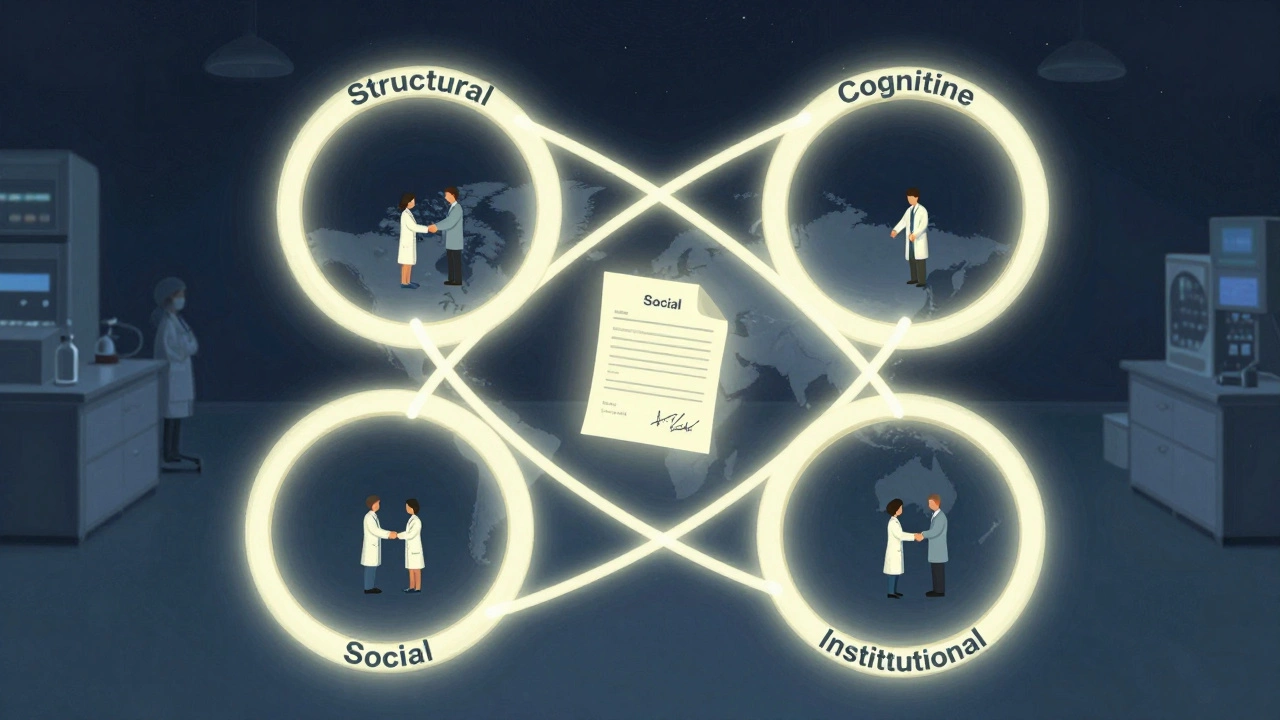
Real-World Examples
The Human Genome Project succeeded because all four dimensions were intentionally designed:
- Structural: Centralized data repository (GenBank) with strict upload standards
- Cognitive: Regular workshops to align sequencing protocols across labs
- Social: Public acknowledgment of every contributing lab, even small ones
- Institutional: Binding agreement among 20 countries on open-access data release
Contrast that with the Cold Fusion debacle of 1989. Two scientists claimed a breakthrough. But there was no Structural integration - no shared lab data. No Cognitive integration - other labs couldn’t replicate their methods. No Social integration - they refused to share details. No Institutional integration - they bypassed peer review. The result? A scientific scandal.
The difference between success and failure often comes down to how well you manage collaboration - not just the science.
Why This Matters Now
Today’s biggest challenges - climate modeling, pandemic preparedness, AI safety - can’t be solved by one lab, one country, or one discipline. We need large-scale, cross-border, interdisciplinary teams. And those teams will fail without this framework.
Funding agencies are starting to notice. The European Union’s Horizon Europe program now requires applicants to describe how they’ll manage all four dimensions. The NIH has added collaboration plans to grant applications. This isn’t optional anymore. It’s part of the evaluation criteria.
If you’re leading a research team - whether you’re a grad student or a professor - you’re not just a scientist. You’re a project manager, a diplomat, and a systems designer. The four-dimensional model gives you the map.
Is the four-dimensional model only for large international projects?
No. It works for any team - even a two-person lab partnership. A PhD student and their supervisor working across different departments still need shared data formats (Structural), mutual understanding of methods (Cognitive), trust and respect (Social), and clarity on who owns the work and how it gets published (Institutional). Size doesn’t matter. Alignment does.
Can this model be applied outside of science?
Absolutely. The same four dimensions apply to software development teams, nonprofit coalitions, and even family-run businesses. Any group trying to produce something complex together benefits from checking these four areas. Science just made them explicit.
What’s the difference between collaboration and cooperation?
Cooperation is when people do separate tasks and then combine results. Collaboration is when people co-create - they shape the problem, method, and outcome together. The four-dimensional model is designed for true collaboration, not just coordination.
Do I need special software to implement this model?
No. Tools help, but they’re not the point. You can use Google Docs, shared folders, and Zoom. What matters is the agreement: Do you have clear norms around communication, credit, and data? That’s what builds integration - not the software.
How long does it take to build full integration in a team?
It varies. Structural integration can be set up in weeks. Cognitive and Social take months - sometimes over a year. Institutional alignment often requires formal agreements that take legal review. Don’t rush it. Rushing leads to resentment and breakdowns later.
Next Steps for Your Team
Start small. Pick one dimension - maybe Social - and make one change this week. Have a 15-minute virtual coffee with someone you rarely talk to. Ask them: ‘What’s the one thing that makes your work harder?’ Listen. Don’t fix. Just listen.
Then next week, check your data storage. Are files labeled the same way across all team members? Fix one inconsistency.
Collaboration isn’t magic. It’s a practice. And like any skill, it improves with attention, feedback, and repetition.