Will Global Warming Cause an Ice Age?
 Feb, 27 2026
AMOC Impact Simulator
How Ocean Currents Work
The AMOC (Atlantic Meridional Overturning Circulation) acts like a giant conveyor belt. When freshwater from melting ice dilutes the ocean, it disrupts this circulation. This tool simulates how different melt rates affect the system.
AMOC Strength: 100%
Regional Temperature Change: -0.0°C
It sounds like a contradiction: how could a warming planet trigger an ice age? You’ve probably heard this idea floating around-maybe in a documentary, a social media post, or even a casual conversation. The truth is, it’s not as crazy as it sounds. Scientists have studied this very scenario for decades. And while global warming won’t cause an ice age in the way most people imagine, it could, under extreme conditions, trigger a chain reaction that leads to regional cooling. Here’s what actually happens.
How Climate Systems Work
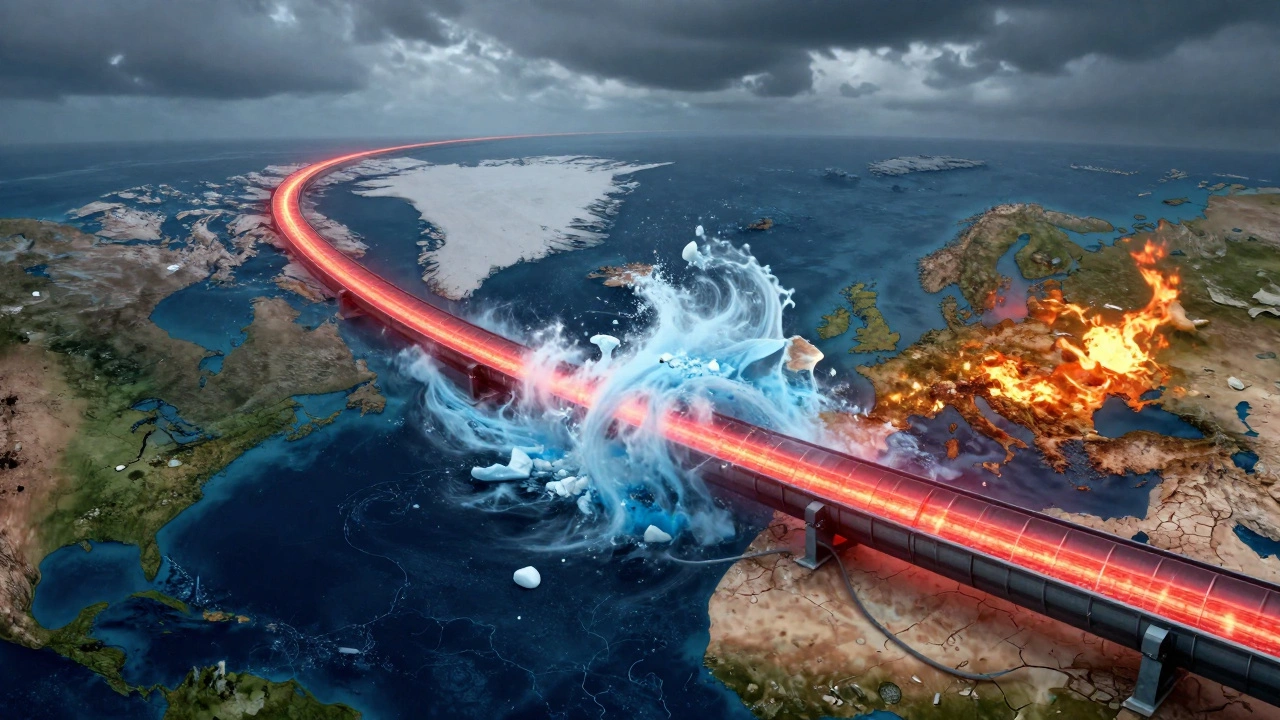
The Earth’s climate isn’t just about air temperature. It’s a complex machine made up of oceans, atmosphere, ice sheets, and ocean currents. One of the most important parts is the Atlantic Meridional Overturning Circulation, or AMOC. Think of it as a giant underwater conveyor belt. Warm water flows north from the tropics, releases heat into the air over Europe and North America, then sinks near Greenland because it gets colder and saltier. That sinking pulls more warm water up from the south, keeping the cycle going.
This system is why places like the UK and Norway have milder winters than Canada at the same latitude. Without the AMOC, those regions would be much colder. But this system is fragile. It depends on the density of seawater, which depends on temperature and salt content. Add too much freshwater-say, from melting ice sheets-and the water doesn’t sink anymore. The conveyor slows down or stops.
The Younger Dryas Event
This isn’t science fiction. It’s happened before. Around 12,800 years ago, during the last ice age, a massive ice sheet covering Canada suddenly melted. A huge amount of freshwater poured into the North Atlantic. The AMOC shut down. Temperatures in the Northern Hemisphere dropped by as much as 10°C in just a few decades. That cold snap lasted about 1,300 years. It’s called the Younger Dryas. Vegetation shifted. Animals went extinct. Humans had to adapt or move.
Today, Greenland’s ice sheet is melting faster than at any point in recorded history. In 2023 alone, it lost over 600 billion tons of ice. That’s enough to raise global sea levels by nearly 2 millimeters in one year. And while the total amount of freshwater entering the ocean is still small compared to the Younger Dryas event, the trend is clear: we’re adding freshwater faster than ever before.
Why Global Warming Won’t Cause a Global Ice Age
Let’s be clear: global warming will not cause a new ice age across the entire planet. The idea that a single cold snap could reverse decades of rising temperatures is a myth. The greenhouse effect from CO2 and other gases is still the dominant force shaping our climate. Even if the AMOC slowed dramatically, global temperatures would still rise-just not as fast in parts of Europe and eastern North America.
What could happen is a regional cooling effect. Imagine Europe’s winters getting colder and longer, while Africa, Australia, and the tropics continue to heat up. That’s not an ice age. It’s a climate disruption. And it would be just as dangerous.
What Scientists Are Seeing Now
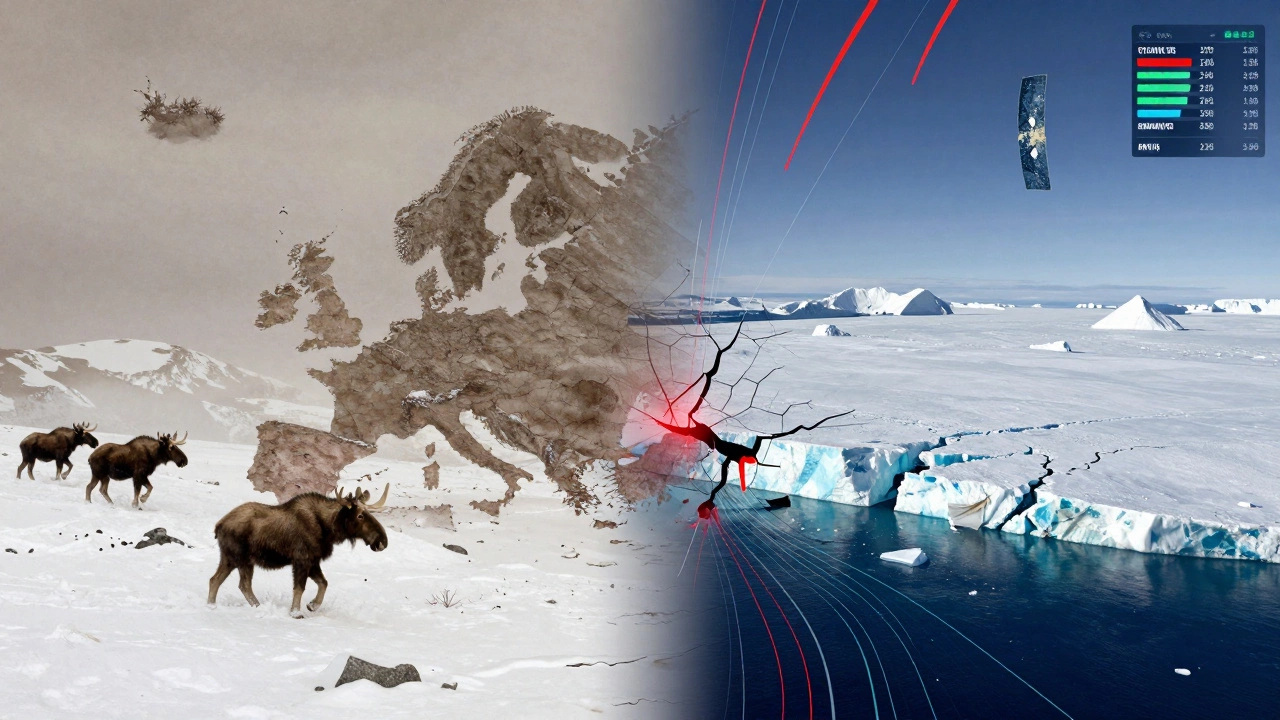
Recent studies, including one published in Nature Climate Change in 2024, show the AMOC is at its weakest point in over 1,600 years. Researchers used sediment cores, ocean temperature records, and satellite data to reconstruct its strength over centuries. The trend is unmistakable: it’s slowing. Some models suggest it could collapse by 2050 if emissions continue unchecked.
But here’s the catch: even in the worst-case scenario, the cooling effect wouldn’t be enough to offset global warming. The IPCC’s 2023 report states that under a high-emissions pathway (SSP5-8.5), global temperatures will still rise by 4.4°C by 2100-even if the AMOC shuts down. The regional chill would be like putting a blanket over a furnace. The room still gets hotter.
The Real Danger: Climate Instability
The real threat isn’t an ice age. It’s unpredictability. When one part of the climate system breaks, it doesn’t just stop working-it starts behaving erratically. A slowdown in the AMOC could:
- Disrupt rainfall patterns across Africa and South Asia, worsening droughts
- Reduce fish populations in the North Atlantic, hurting fisheries from Iceland to Canada
- Intensify storms along the U.S. East Coast by changing sea surface temperatures
- Shift jet streams, causing longer heatwaves in Europe and colder spells in the eastern U.S.
These aren’t distant possibilities. They’re already starting. In 2021, the North Atlantic saw record-low sea surface temperatures during summer-a sign of weakened circulation. In 2025, the UK experienced its coldest March in 15 years, even as global averages hit new highs. That’s not coincidence. It’s the climate system out of balance.
What Can Be Done?
The only way to prevent this kind of disruption is to stop adding greenhouse gases to the atmosphere. Every ton of CO2 we avoid emitting reduces the risk. The Paris Agreement goals aren’t just about keeping global warming below 2°C-they’re about avoiding tipping points like AMOC collapse.
Renewable energy, electric transport, and carbon removal technologies are critical. But so is policy. The UK’s Climate Change Committee recommends cutting emissions by 78% by 2035 compared to 1990 levels. That’s ambitious, but doable. Countries that act fast will avoid the worst outcomes. Those that delay will face a world of extreme weather, food shortages, and economic shocks.
Final Answer
No, global warming won’t cause an ice age. But it could trigger a sudden, regional cooling that makes parts of the world colder while the rest burns. That’s not a reset. It’s chaos. And it’s avoidable.
The science is clear: the melting ice is already weakening ocean currents. The question isn’t whether this will happen-it’s whether we’ll act before it’s too late.
Can global warming cause an ice age?
No, global warming cannot cause a full-scale ice age. Ice ages form over tens of thousands of years due to slow changes in Earth’s orbit and solar radiation. Today’s warming is happening too fast and is driven by greenhouse gases, not natural cycles. However, it could trigger a regional cooling event by disrupting ocean currents like the AMOC, which might make parts of Europe and North America colder for a time-but not enough to reverse global warming.
Has this happened before?
Yes. Around 12,800 years ago, during the last ice age, a massive influx of freshwater from melting glaciers shut down the Atlantic ocean current. This caused the Younger Dryas-a 1,300-year cold period in the Northern Hemisphere. Temperatures dropped sharply, ecosystems changed, and human societies had to adapt. It’s the best historical example of how freshwater from melting ice can disrupt climate patterns.
Is the AMOC slowing down today?
Yes. Multiple studies, including data from the RAPID array and satellite observations, show the AMOC is at its weakest point in over 1,600 years. Since the 1950s, it has weakened by about 15%. The main cause is freshwater from melting Greenland ice and increased rainfall in the North Atlantic, which reduces seawater density and prevents it from sinking.
Would a shutdown of the AMOC cool the whole planet?
No. A shutdown would only cool parts of the Northern Hemisphere-especially Europe and eastern North America. The rest of the world would continue warming. Global average temperatures would still rise because greenhouse gases trap heat everywhere. The cooling effect would be localized and temporary, while the warming from CO2 is global and long-lasting.
How soon could the AMOC collapse?
Models suggest it could collapse between 2030 and 2080, depending on emissions. Under high-emission scenarios (like RCP8.5), collapse becomes likely by 2050. Under low-emission scenarios, it may weaken but not collapse. The exact timing is uncertain, but the trend is clear: the more we emit, the faster it weakens.