Which degree is best for a data scientist?
 Dec, 1 2025
Degree Suitability Calculator
What best describes your primary interest?
How comfortable are you with mathematics?
What's your programming experience level?
How do you approach problem-solving?
What's most important in your work?
There’s no single "best" degree for a data scientist-but some degrees give you a much stronger start than others. If you’re thinking about jumping into data science, you’re probably wondering: should I go for computer science? Statistics? Mathematics? Or maybe something else entirely? The truth is, employers don’t care about the name on your diploma as much as what you can actually do. But your degree still matters-because it shapes how you think, what tools you learn, and how fast you can get up to speed.
What do hiring managers actually look for?
Look at job postings from companies like Amazon, Spotify, or NHS Digital in the UK. They rarely say "MSc in Data Science required." Instead, they list skills: Python, SQL, machine learning, statistical modeling, data visualization. And they almost always ask for a bachelor’s or master’s degree in a quantitative field. That’s your clue: they want people who can handle math, code, and real-world data-no fluff.
Here’s the breakdown of what matters most:
- Ability to clean messy data-real data is never perfect. You’ll spend 60-70% of your time fixing it.
- Understanding of statistics-not just running tests, but knowing when a result is meaningful or just noise.
- Programming fluency-Python and R are non-negotiable. SQL is just as important.
- Problem-solving mindset-can you turn a vague business question into a testable hypothesis?
Degrees help you build these skills systematically. But not all degrees do it equally well.
Top three degrees that actually work
Based on hiring trends from UK tech firms, finance, and public sector roles from 2023 to 2025, these three degrees consistently lead to the highest job placement rates:
1. Statistics
Statisticians are trained to ask the right questions before they even touch a dataset. They learn probability, experimental design, regression, and inference-exactly what you need to avoid false conclusions. A BSc in Statistics gives you a deep understanding of uncertainty, which is critical in data science. Many top data scientists in healthcare and government come from stats backgrounds.
Why it wins: You’ll know when a model is overfitting, why A/B tests fail, and how to interpret p-values correctly. These are the things that separate junior analysts from senior data scientists.
2. Computer Science
If you love building systems, writing clean code, and working with large-scale data pipelines, computer science is your path. CS degrees teach you algorithms, data structures, databases, and software engineering practices. You’ll learn how to scale models, deploy them in production, and work with cloud tools like AWS or Azure.
Why it wins: You won’t just analyze data-you’ll build the tools others use. Companies like Monzo and Revolut hire CS grads because they can turn models into real features, not just reports.
3. Mathematics
Math majors often have the strongest theoretical foundation. Linear algebra, calculus, optimization-these are the hidden engines behind machine learning. A BSc in Mathematics gives you the ability to understand why a neural network works, not just how to use it.
Why it wins: You’ll adapt faster when new techniques emerge. If you understand the math, you can learn PyTorch or TensorFlow on your own. Many PhD-level data scientists in AI research started with pure math.
What about Data Science degrees?
Universities now offer dozens of "Data Science" degrees. They sound perfect-until you look at the curriculum. Many are watered-down versions of stats or CS, with added Python tutorials and one semester of machine learning. Some are even marketed as "quick entry" programs with little math.
That’s not always bad. If you’re switching careers and already have experience in business or healthcare, a good MSc in Data Science can give you the right skills in 12 months. But if you’re starting from scratch, a traditional degree in stats, CS, or math will give you more depth and better long-term flexibility.
Look at the course modules. If it doesn’t include linear algebra, statistical inference, or database design-it’s probably not rigorous enough.

What degrees to avoid
Not every degree prepares you for data science. Here are three that often leave graduates underprepared:
- Business Administration-unless you’ve taken multiple stats and programming courses on the side, you’ll struggle with technical interviews.
- Psychology or Sociology-these teach research methods, but rarely cover coding or large-scale data systems. You’ll need to relearn half your skills.
- General Engineering-unless it’s electrical, mechanical, or chemical engineering with a strong computing focus, you’ll lack the data-specific tools.
That doesn’t mean people from these fields can’t become data scientists. Many do. But they usually spend 6-12 months learning Python, SQL, and statistics on their own-often through bootcamps or online courses.
Does a Master’s degree matter?
In the UK, about 65% of data science roles require at least a master’s degree, especially in finance, pharmaceuticals, or public sector roles. Entry-level positions in tech startups might accept a strong bachelor’s, but if you want to lead projects or move into AI research, a master’s is expected.
The best master’s degrees combine theory with real projects. Look for programs that include:
- A capstone project with real company data
- Internship or placement opportunities
- Access to computing clusters or cloud platforms
Universities like Imperial College London, University of Edinburgh, and University of Manchester offer strong programs that balance theory and practice. Avoid programs that only teach tools without explaining the math behind them.
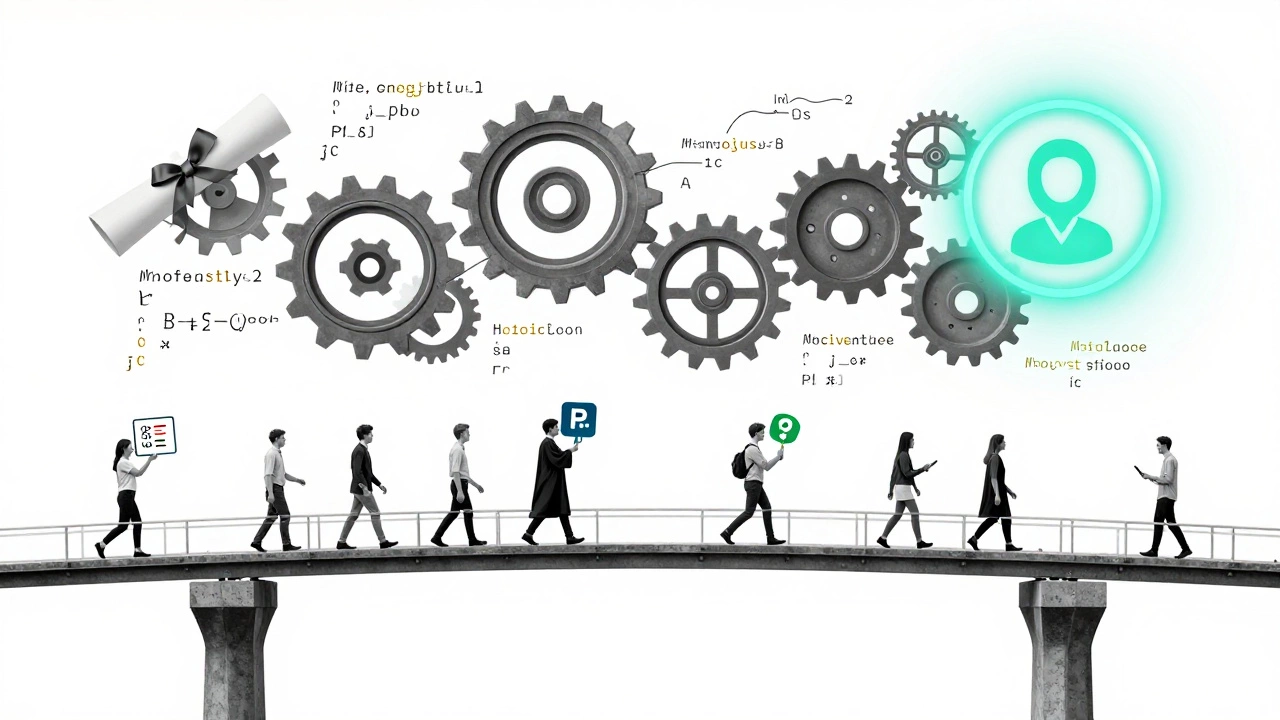
What if you already have a different degree?
You’re not locked out. Many data scientists started in physics, economics, or even history. The key is bridging the gap.
Here’s a realistic path if you’re coming from a non-technical background:
- Learn Python and SQL through free resources like Kaggle or DataCamp.
- Take an online statistics course-Coursera’s "Statistics with Python" by the University of Michigan is widely respected.
- Build three portfolio projects: one with public data (like NHS waiting times), one with your own data (like tracking your spending), and one that solves a small business problem.
- Apply for junior roles or internships labeled "Data Analyst" or "Research Assistant"-these are your foot in the door.
One former teacher in Liverpool switched to data science in 18 months by doing exactly this. She now works for a health tech startup analyzing patient outcomes.
What skills matter more than your degree?
Here’s the hard truth: your degree opens the door. But your portfolio keeps you inside.
Employers care more about what you’ve built than where you studied. A GitHub with clean, documented code and a LinkedIn profile showing real projects will get you further than a degree from a top university with no portfolio.
Build projects that show you can:
- Find patterns in messy data (e.g., predicting bus delays using public transport APIs)
- Communicate results clearly (e.g., a dashboard showing energy use in Liverpool homes)
- Ask the right questions (e.g., "Is this spike in hospital admissions due to pollution or seasonal flu?")
These are the things that make you stand out.
Final advice: Choose depth over labels
Don’t chase the "data science degree" just because it sounds right. Choose the degree that teaches you how to think like a data scientist: with logic, rigor, and curiosity.
If you love math and theory → go for Statistics or Mathematics.
If you love building systems and automation → go for Computer Science.
If you’re switching careers → pick the degree that gives you the strongest foundation in math and coding, then fill the gaps with projects.
The best data scientists aren’t the ones with the fanciest degrees. They’re the ones who never stopped asking "why?" and kept building until they got it right.
Can I become a data scientist without a degree?
Yes, but it’s harder. Most employers still require at least a bachelor’s degree, especially in the UK. Without one, you’ll need an exceptional portfolio-multiple real-world projects, contributions to open-source data tools, and strong recommendations. Bootcamps can help, but they’re not a substitute for formal training unless you’re already working in tech.
Is Python enough, or do I need to learn R too?
Python is the standard in industry and covers 90% of data science tasks. R is still used in academia and some healthcare or statistical roles, but you don’t need both. Learn Python thoroughly first-then pick up R only if your job or research requires it.
How long does it take to become a data scientist after getting a degree?
With a strong degree in stats, CS, or math, you can land an entry-level role in 3-6 months after graduation if you’ve built projects and practiced interviewing. Without a relevant degree, it usually takes 12-24 months of focused learning and portfolio building.
Do I need a PhD to work in data science?
No. Only about 10-15% of data science roles require a PhD-mostly in AI research, pharmaceuticals, or academia. For most industry roles, a master’s is enough. A PhD can be helpful if you want to lead model development teams, but it’s not necessary to start.
What’s the difference between a data analyst and a data scientist?
Data analysts focus on reporting and visualization-answering questions like "What happened?" Data scientists build predictive models and algorithms-answering "Why did it happen?" and "What will happen next?" Data scientists need stronger programming and math skills. Many start as analysts and move up.
Start with the right foundation. Build something real. Keep learning. That’s how you become a data scientist-not by picking the "best" degree, but by choosing the one that lets you grow.