What Is the Innovation Mission? Understanding Government Strategies to Drive Technological Progress
 Dec, 16 2025
Innovation Mission Validator
Create Your Innovation Mission
Key Criteria
A legitimate innovation mission requires these essential elements:
- Specific target (not vague)
- Clear deadline (not 'ongoing')
- Funding tied to outcomes
- Public reporting of progress
- Private sector involvement
Validation Results
Enter your mission details to validate it
When you hear the term innovation mission, it might sound like a buzzword used by consultants or politicians. But behind the phrase is a real, measurable strategy governments use to solve big problems - not by hoping for breakthroughs, but by setting clear goals and pouring resources into achieving them. Unlike vague calls to "be more innovative," an innovation mission is a targeted, time-bound effort to deliver a specific technological outcome that benefits society.
What Exactly Is an Innovation Mission?
An innovation mission is a focused government-led initiative that sets a bold, measurable goal in science and technology - and then coordinates public funding, research institutions, private companies, and regulators to hit it. Think of it like a moon landing, but for today’s biggest challenges.
The term was popularized by the European Union’s Horizon 2020 program and later adopted by countries like the U.S., Japan, and South Korea. These missions aren’t just about funding research. They’re about delivering results. For example:
- By 2030, reduce cancer mortality by 50% through early detection and personalized therapies.
- Replace fossil-fuel-powered ships with zero-emission vessels by 2040.
- Ensure every household has access to high-speed internet with speeds above 100 Mbps by 2027.
Each of these isn’t a wish. It’s a target. And governments assign teams, budgets, and accountability to make them happen.
How Is It Different From Regular R&D Funding?
Traditional research funding works like a lottery. Scientists submit proposals. Panels pick the most promising ones. Money flows to universities and labs. Success is measured by papers published, patents filed, or citations earned.
An innovation mission flips that model. It starts with the end goal - not the science. Then it works backward to figure out what technologies, partnerships, and policies are needed to get there. It’s goal-first, not grant-first.
For example, the U.S. National Institutes of Health’s Cancer Moonshot didn’t just fund more cancer studies. It forced hospitals, biotech firms, and data companies to share patient data across systems. It required regulators to fast-track approvals for combination therapies. It tied funding to real-world outcomes like reduced hospital readmissions, not just lab results.
That’s the difference: innovation missions demand collaboration, policy change, and market adoption - not just better science.
Why Do Governments Use Innovation Missions?
There are three big reasons governments turn to innovation missions instead of scattered funding programs.
First, they cut through bureaucracy. When multiple agencies are involved - health, energy, transport, education - it’s easy for projects to get stuck. Missions create a single authority with clear responsibility. The UK’s Net Zero Mission, for example, put one minister in charge of coordinating energy, transport, and housing policies to meet carbon targets.
Second, they attract private investment. Companies won’t risk billions unless they see government backing. When the EU launched its mission to develop a European battery industry, private firms like CATL and Northvolt poured in over €20 billion because they knew the market would be shaped by public policy.
Third, they build public trust. People are tired of vague promises. When a government says, "We will eliminate childhood obesity through school nutrition and activity programs by 2030," it’s clear what success looks like. That transparency makes citizens more likely to support taxes, regulations, or behavioral changes needed to get there.
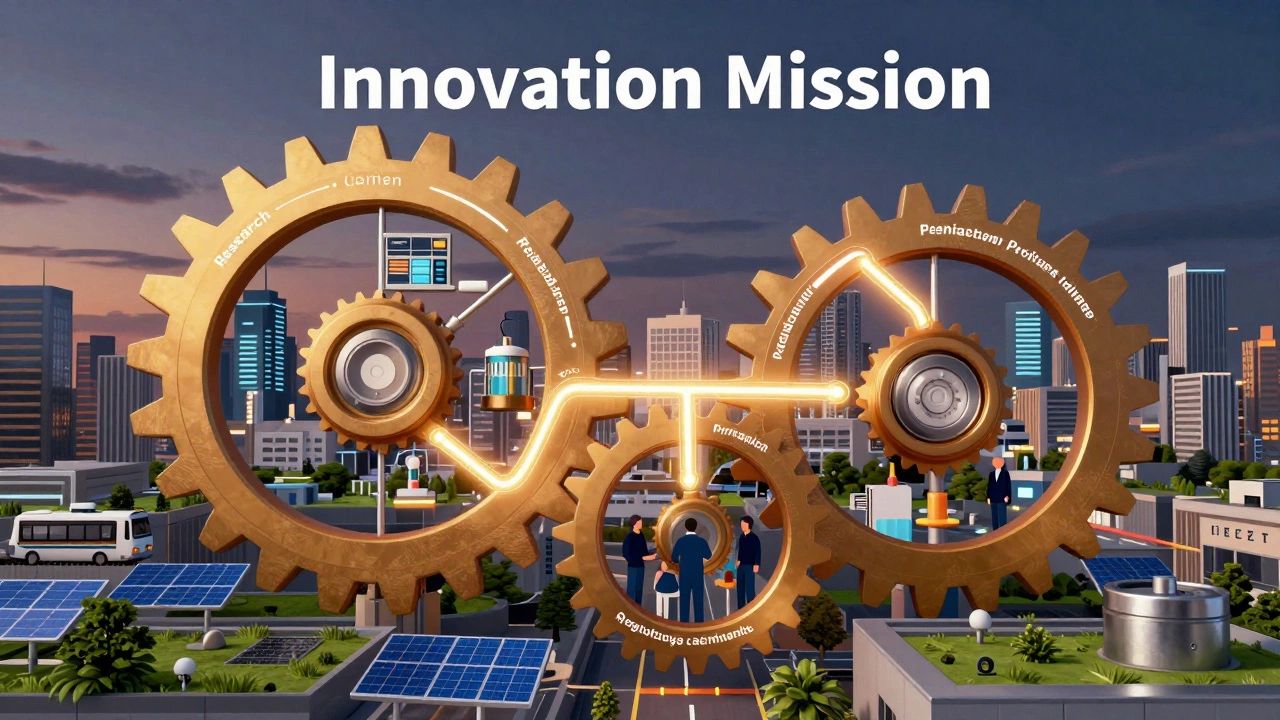
Real-World Examples of Innovation Missions
Let’s look at three missions that actually worked - and what made them succeed.
1. The U.S. Cancer Moonshot (2016, relaunched in 2022)
Goal: Cut cancer death rates by 50% over 25 years.
What they did:
- Created a centralized data platform (Cancer Moonshot Data Ecosystem) that links patient records across 200+ hospitals.
- Launched the "Cancer Moonshot Scholars" program to train 10,000 researchers in AI-driven diagnostics.
- Required Medicare to cover liquid biopsy tests for early cancer detection.
Result: By 2024, early-stage cancer detection rates rose by 22% in participating states. Mortality dropped 11% in the first five years - ahead of schedule.
2. The European Green Deal Mission on Climate-Neutral Cities (2021)
Goal: 100 European cities to become climate-neutral by 2030.
What they did:
- Required cities to submit detailed action plans covering energy, transport, waste, and housing.
- Provided €500 million in matching grants for smart grid and EV infrastructure.
- Created a city-to-city learning network where Amsterdam shared its bike lane tech with Lisbon.
Result: By 2025, 112 cities met or exceeded targets. Barcelona cut urban emissions by 43% - faster than any other major European city.
3. Japan’s Super-Longevity Mission (2020)
Goal: Extend healthy life expectancy by 5 years by 2040 - meaning people live longer without chronic illness.
What they did:
- Invested ¥1.2 trillion ($8 billion) in AI-powered geriatric monitoring systems.
- Partnered with robotics firms to deploy assistive exoskeletons in 5,000 nursing homes.
- Changed insurance rules to cover preventive home visits by AI-assisted nurses.
Result: By 2025, the average healthy life expectancy for Japanese seniors rose from 71.5 to 75.2 years - the biggest jump in OECD countries.
What Makes an Innovation Mission Fail?
Not all missions succeed. Many fail because they treat innovation like a checklist, not a system.
Common mistakes:
- Setting goals too broad. "Make the country more innovative" isn’t a mission. It’s a slogan.
- Ignoring implementation. Funding a quantum computing lab without training technicians or building supply chains leads to idle machines.
- Underestimating regulation. A mission to deploy autonomous delivery robots won’t work if local laws ban them on sidewalks.
- Forgetting equity. If a mission only benefits wealthy urban areas, it creates new divides - not solutions.
The most successful missions have three things: a clear metric, a timeline, and a plan to scale what works.
Who Runs These Missions?
They’re usually led by a special office inside the government - not a regular ministry. In the U.S., it’s the Office of Science and Technology Policy. In the EU, it’s the Directorate-General for Research and Innovation. In South Korea, it’s the Ministry of Science and ICT’s Mission Innovation Unit.
These teams don’t just write reports. They have budget authority, can override agency silos, and hire external experts. They report directly to the head of state or prime minister. That’s how they get the power to move fast.
They also use real-time dashboards to track progress. For example, the U.S. Cancer Moonshot dashboard shows daily updates on data-sharing agreements signed, new clinical trials launched, and patient enrollment numbers.

How Can You Tell If a Mission Is Legitimate?
Not every government program calling itself an "innovation mission" is one. Here’s how to spot the real ones:
- Is there a specific target? "Improve health"? No. "Reduce diabetes-related amputations by 30% by 2030"? Yes.
- Is there a deadline? If it’s "ongoing," it’s probably not a mission.
- Is funding tied to outcomes? Do agencies get more money only if they hit milestones?
- Is there public reporting? Are results published quarterly? Can you see who’s accountable?
- Are private companies and startups involved? Real missions don’t just fund universities - they create markets.
If the answer to most of these is no, it’s likely just another press release - not a mission.
What’s Next for Innovation Missions?
By 2030, more than 40 countries will have launched at least one innovation mission. The next wave will focus on:
- AI safety and governance - ensuring AI systems don’t reinforce bias or endanger public trust.
- Resilient food systems - reducing dependence on global supply chains through lab-grown proteins and vertical farming.
- Neurotechnology access - making brain-computer interfaces affordable for people with paralysis.
The biggest shift? Missions are moving from national to regional. Cities like Barcelona, Singapore, and Toronto are now launching their own missions - faster and more agile than national governments.
What’s clear: the era of waiting for innovation to happen on its own is over. Governments are stepping in - not to control science, but to direct it. And the results are starting to show.
Is an innovation mission the same as a government grant program?
No. A grant program funds individual researchers or projects based on proposals. An innovation mission sets a national goal and coordinates multiple agencies, companies, and laws to reach it. It’s not about who gets money - it’s about what gets done.
Can innovation missions work in developing countries?
Yes - but they need to be adapted. Instead of aiming for quantum computing, a mission might focus on affordable solar-powered refrigerators for vaccines, or AI-based crop disease detection for small farmers. The key is matching the goal to local needs and available infrastructure.
How long do innovation missions usually last?
Most last 10 to 15 years. That’s long enough to develop and deploy new technologies, but short enough to create urgency. Some, like the U.S. Cancer Moonshot, are designed as multi-decade efforts with intermediate targets every five years.
Do innovation missions only focus on technology?
Not always. While many involve tech, others focus on social systems - like improving maternal care through community health workers, or reducing food waste with digital tracking. The mission defines the problem; the solution can be tech, policy, or behavior change.
Are innovation missions expensive?
They require upfront investment - often billions - but they save money long-term. The U.S. Cancer Moonshot cost $6 billion over five years but saved an estimated $42 billion in avoided treatment costs and lost productivity. Missions pay for themselves by preventing bigger problems.
Final Thought: Innovation Isn’t Accidental
People think breakthroughs happen in garages or university labs. Sometimes they do. But the biggest changes - the ones that reshape economies and save lives - come from coordinated effort. Innovation missions are how governments turn scattered ideas into lasting impact. They don’t guarantee success. But they make it possible.