What is it called when scientists work together? A guide to scientific collaboration
 Aug, 11 2026
Scientific Collaboration Strategy Planner
Project Configuration
Strategy Overview
Configure your project details and click 'Generate Collaboration Strategy' to see recommendations.
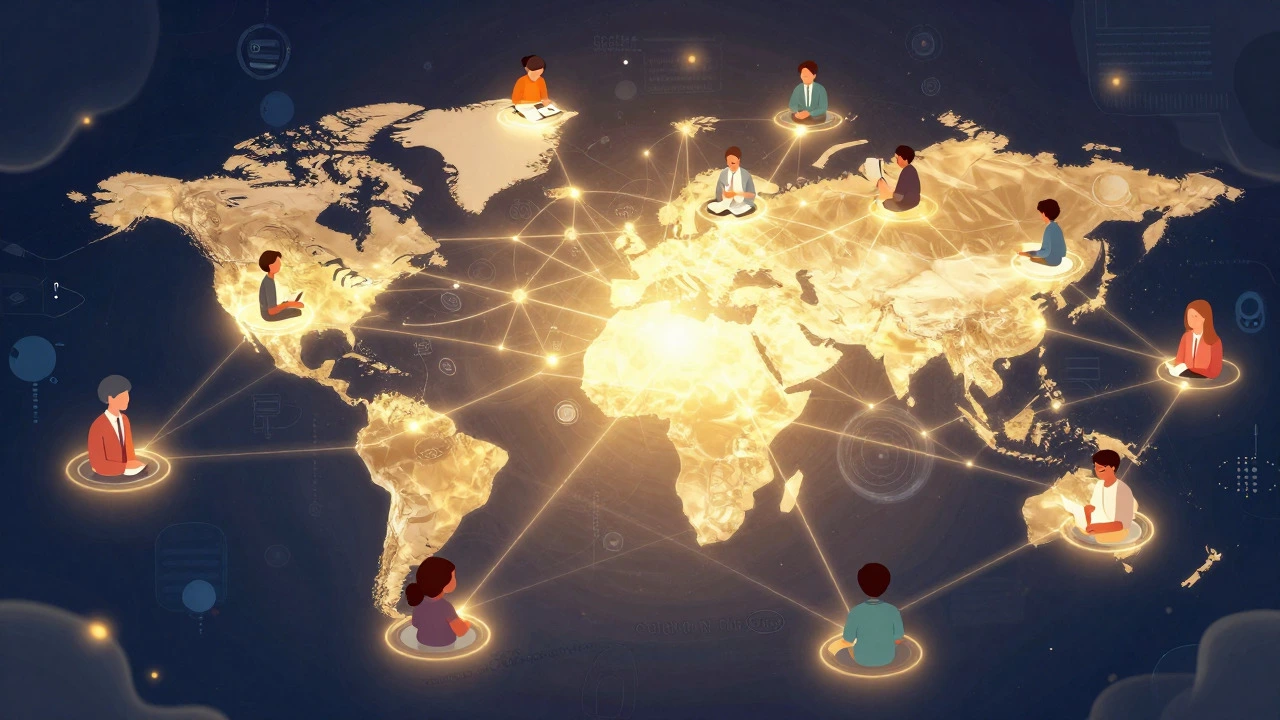
Ever wonder what happens when two researchers from different countries join forces to solve a climate crisis? Or when a biologist and a computer scientist team up to map the human genome? It’s not just "working together." In the world of academia and industry, this practice has a specific name: Scientific Collaboration is the process where two or more scientists or research teams work jointly on a project, sharing resources, expertise, and data to achieve a common goal.
This isn't just about splitting the workload. It’s about combining distinct perspectives to tackle problems that are too complex for any single person or lab to handle alone. From curing diseases to exploring Mars, modern breakthroughs rarely happen in isolation. They happen through networks.
The Evolution of Team Science
Gone are the days of the lone genius working in a dusty attic. Today, we live in the era of Team Science is a collaborative approach to research involving multiple individuals with diverse skills and backgrounds working toward a shared objective. This shift wasn’t accidental. As scientific questions became more intricate-think cancer genomics or global warming models-the need for multidisciplinary input grew exponentially.
In the mid-20th century, most papers had one or two authors. By the 2020s, it was common to see hundreds of names on a single study, particularly in particle physics or neuroscience. The Large Hadron Collider at CERN, for instance, relies on thousands of scientists across dozens of nations. This scale requires sophisticated coordination, moving beyond simple partnership to structured institutional alliances.
- Single-author studies: Rare today, mostly found in theoretical mathematics or early-stage conceptual proposals.
- Small team collaborations: Typical for specialized experiments within a single department.
- Large-scale consortia: Global networks like the Human Genome Project or ITER (International Thermonuclear Experimental Reactor).
Types of Scientific Partnerships
Not all collaborations look the same. Understanding the structure helps you navigate how credit is assigned and how work is divided. Here are the primary forms these partnerships take:
- Interdisciplinary Research: Combining methods from different fields. For example, using AI algorithms (Computer Science) to analyze medical images (Radiology). This creates new methodologies that neither field could develop alone.
- International Consortia: Groups formed across borders to pool funding and data. The European Space Agency (ESA) often partners with NASA for missions because no single agency can afford the cost or risk alone.
- Industry-Academia Partnerships: Universities provide basic research capabilities while companies offer commercialization pathways and real-world testing environments. Pfizer and BioNTech’s rapid development of mRNA vaccines is a prime example of this synergy.
- Open Science Initiatives: Projects where data and code are shared publicly, allowing anyone to contribute. GitHub repositories for bioinformatics tools often fall into this category, enabling global peer review before publication.
| Type | Primary Goal | Key Challenge | Example |
|---|---|---|---|
| Interdisciplinary | Innovate methodology | Jargon barriers | Bioinformatics |
| International | Share costs/data | Logistics/Language | CERN Experiments |
| Industry-Academia | Commercialize research | IP Rights | Pharma Trials |
| Open Science | Transparency/Speed | Data Quality Control | Preprint Servers |
Why Scientists Collaborate
You might ask, why bother? Why not just do your own thing? The reasons are practical and strategic. First, there’s the issue of resource access. High-end equipment like electron microscopes or supercomputers are expensive. Sharing access makes them viable for smaller labs.
Second, there’s expertise diversity. A chemist might understand molecular structures but lack the statistical power to analyze large datasets. Partnering with a data scientist bridges that gap. This cross-pollination often leads to unexpected discoveries. When physicists started collaborating with biologists, they developed cryo-electron microscopy, revolutionizing how we view cellular structures.
Third, there’s credibility and impact. Studies with multiple institutions behind them are often viewed as more robust. Peer reviewers trust results that have been validated by independent teams. Additionally, collaborative papers tend to receive higher citation rates, boosting the visibility of all involved parties.

The Challenges of Working Together
It’s not always smooth sailing. Collaborations come with friction. One major hurdle is communication breakdown. Scientists speak different "languages." A term like "binding" means something very different in chemistry versus sociology. Misunderstandings can lead to flawed experimental designs.
Another significant challenge is authorship disputes. Who gets first author? Who gets last? In many cultures, the first author is seen as the primary contributor, while the last author is the senior supervisor. Disagreements here can sour relationships and delay publications. Clear agreements at the start of a project are essential.
Then there’s the issue of intellectual property (IP). If a university and a company collaborate, who owns the patent? These legal complexities require careful negotiation before any data is exchanged. Without clear contracts, valuable innovations can get stuck in legal limbo.
Tools That Enable Modern Collaboration
Technology has transformed how scientists connect. In the past, collaboration meant mailing physical samples or letters. Today, digital platforms make real-time cooperation possible regardless of geography.
Cloud Computing is on-demand availability of computing resources like servers and storage over the internet. Platforms like AWS or Google Cloud allow researchers to run massive simulations without buying hardware. This democratizes access to high-performance computing.
Version Control Systems like Git are tools used to track changes in source code during software development. While originally for programmers, Git is now widely used in biology and social sciences to manage datasets and analysis scripts. It ensures everyone is working on the latest version and allows for easy rollback if errors occur.
Communication tools like Slack, Zoom, and Microsoft Teams have replaced endless email chains. They facilitate quick decision-making and informal brainstorming, which are crucial for maintaining momentum in distributed teams.
How to Start a Successful Collaboration
If you’re looking to initiate a partnership, start with clarity. Define the scope of the project clearly. What are the specific goals? What does success look like? Write this down.
Next, establish roles early. Who is responsible for data collection? Who handles writing? Who manages the budget? Ambiguity leads to resentment. Use a Contribution Graph or a similar tool to document each person’s input.
Finally, choose the right partner. Look for complementary skills, not just similar interests. If you’re strong in theory, find someone strong in experimentation. Trust is also vital. You’ll be sharing unpublished ideas and raw data. Ensure your potential collaborator has a reputation for integrity and confidentiality.
The Future of Scientific Networking
As we move further into the 2020s, collaboration is becoming even more critical. Grand challenges like climate change, pandemic preparedness, and sustainable energy require global solutions. No single nation or discipline can solve these alone.
We’re seeing a rise in citizen science, where non-professionals contribute data via apps. This expands the collaborative network beyond academia. We’re also seeing more preprint culture, where findings are shared immediately online, bypassing traditional slow publication cycles. This accelerates the feedback loop and encourages faster iterative improvement.
The future belongs to those who can build and maintain effective networks. Learning to collaborate isn’t just a soft skill; it’s a core competency for modern science.
What is the difference between collaboration and cooperation?
Cooperation involves working side-by-side on separate tasks towards a common goal, while collaboration involves working together interactively, integrating efforts and ideas throughout the process. In science, true collaboration usually implies joint problem-solving and shared ownership of outcomes.
How is authorship determined in large collaborations?
In large groups, authorship lists can be alphabetical or based on contribution levels defined by guidelines like the ICMJE (International Committee of Medical Journal Editors). Often, a steering committee decides the order, ensuring key contributors are recognized fairly.
Can students benefit from scientific collaboration?
Absolutely. Students gain exposure to diverse methodologies, learn communication skills, and build professional networks early in their careers. Collaborative projects often provide broader learning experiences than isolated thesis work.
What are the risks of international scientific collaboration?
Risks include data security issues, differing ethical standards, political tensions affecting funding, and logistical delays in shipping materials. Clear legal frameworks and secure data transfer protocols are necessary to mitigate these risks.
Is open science the same as collaboration?
Not exactly. Open science is a philosophy promoting transparency and accessibility of research outputs. Collaboration is the act of working together. However, open science facilitates collaboration by making data and methods available for others to use and build upon.