What Is Innovation Policy? A Clear Guide to How Governments Drive New Ideas
 Feb, 10 2026
Innovation Policy ROI Calculator
Calculate Potential Economic Returns
Based on OECD research showing innovation policy investments return $3 to $10 for every dollar invested
When you hear the word innovation, you might think of startups in Silicon Valley, smartphone upgrades, or electric cars. But behind every big idea that changes the world, there’s something less visible - and just as important - called innovation policy. It’s not about flashy products. It’s about the rules, money, and systems governments put in place to help new ideas grow. Without it, even the best inventions can die before they ever reach people.
What Exactly Is Innovation Policy?
Innovation policy is a set of government actions designed to encourage the creation, development, and use of new technologies, products, and services. It’s not one single law or program. It’s a mix of funding, regulations, education efforts, tax breaks, and public investments that all work together to create an environment where innovation can happen.
Think of it like gardening. You can’t just plant a seed and expect a tree to grow without water, sunlight, and soil care. Innovation policy is the soil, water, and fertilizer for ideas. It gives researchers time to experiment, startups access to capital, and businesses the legal clarity to bring new things to market.
How Does It Work in Practice?
There are four main ways governments support innovation:
- Funding research - Governments spend billions each year on science and technology labs. In the U.S., the National Science Foundation and the Department of Energy funded over $100 billion in R&D in 2024. Much of that goes to universities and national labs, where breakthroughs in AI, clean energy, and biotech often start.
- Tax incentives - Many countries offer tax credits for companies that spend money on research. For example, Canada’s Scientific Research and Experimental Development (SR&ED) program gives businesses up to 35% back on qualified R&D costs. This makes it cheaper for small firms to try risky ideas.
- Regulatory sandboxes - Instead of blocking new tech with old rules, some governments create testing zones. The UK’s Financial Conduct Authority lets fintech startups test apps like AI-driven loan systems without full compliance - as long as they’re monitored. This speeds up real-world testing.
- Public procurement - Governments buy new tech to solve public problems. When the U.S. Air Force bought drone systems from small companies to monitor wildfires, it didn’t just get better tools - it gave those companies their first big contract and proof their tech works.
Why Do Some Countries Succeed More Than Others?
Not all innovation policies are created equal. Countries like South Korea, Germany, and Singapore consistently rank high in global innovation indexes. Why? Because they don’t just throw money at science - they build ecosystems.
South Korea spends nearly 5% of its GDP on R&D - the highest in the world. But what really sets it apart is how it connects universities, big corporations like Samsung, and small startups through shared labs and fast-track patent systems. In 2023, Korean firms filed over 30,000 international patents - more than Japan and the UK combined.
In contrast, countries that treat innovation like a one-time grant or focus only on big companies often see short-term wins but long-term stagnation. Innovation needs many players - not just corporations, but universities, nonprofits, and even individual inventors.

Who Benefits From Innovation Policy?
It’s easy to assume only tech companies win. But innovation policy affects everyone.
- Workers - New industries create jobs. In the U.S., clean energy jobs grew 4% in 2024, even as other sectors slowed. Many of those jobs came from government-backed training programs.
- Patients - Medical breakthroughs like mRNA vaccines didn’t happen because Pfizer alone decided to act. They were built on decades of publicly funded research at universities and government labs.
- Small businesses - A farmer in Iowa using AI to reduce water waste didn’t build the software himself. He used a tool developed by a startup that got its first funding from a USDA innovation grant.
- Taxpayers - Every dollar spent on innovation policy returns $3 to $10 in economic value over time, according to OECD studies. That’s because new tech boosts productivity, cuts costs, and creates export opportunities.
What Happens When Innovation Policy Fails?
Bad policy doesn’t mean no innovation - it means innovation that’s slow, unfair, or stuck in one place.
For example, some countries offer tax breaks only to large corporations. That leaves startups without funding, and rural areas without access to new tech. Others create too many rules. In 2022, a Canadian biotech startup spent 18 months just getting approval to test a new diagnostic tool - by which time the market had moved on.
Another failure is short-term thinking. When governments change funding priorities every election cycle, researchers can’t plan long-term projects. A 5-year cancer study can’t be paused because a new minister wants to focus on AI.
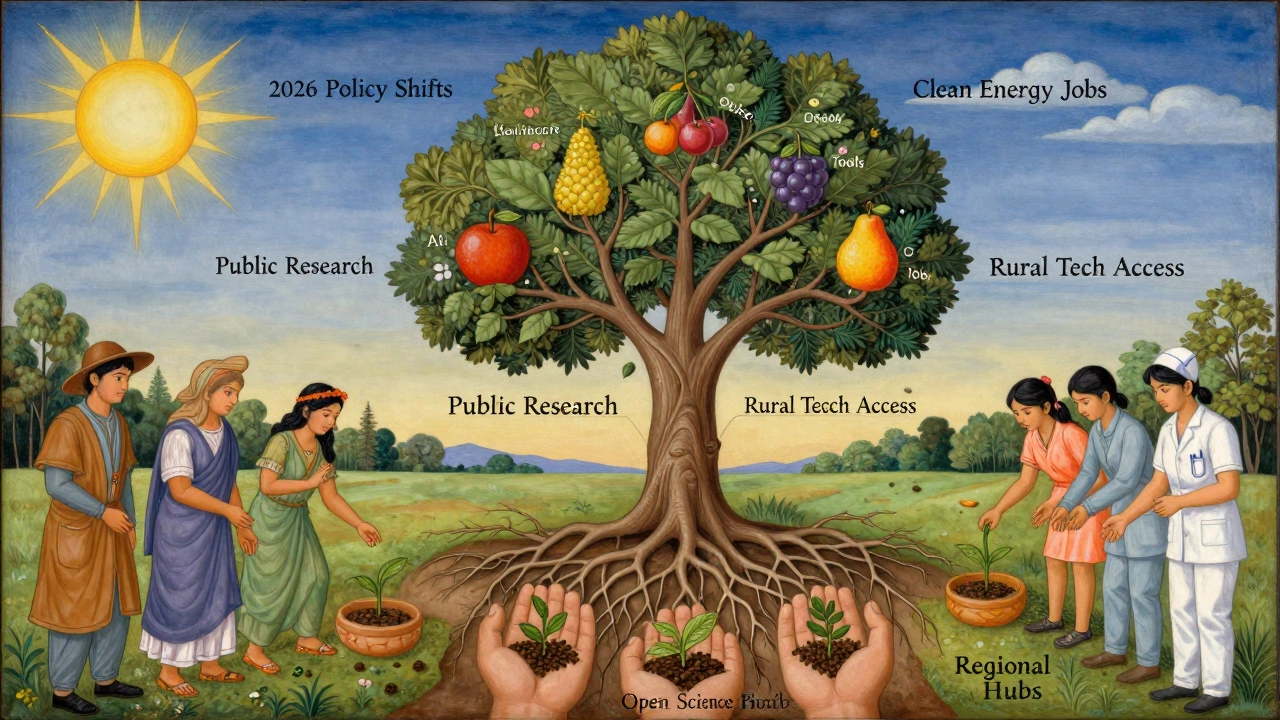
What’s New in 2026?
Innovation policy is evolving fast. Here’s what’s changing right now:
- AI governance frameworks - The EU and U.S. are drafting rules that don’t ban AI but set safety standards for public use - like in hiring, healthcare, and law enforcement.
- Regional innovation hubs - Instead of concentrating funds in big cities, countries like India and Brazil are setting up tech centers in smaller cities to spread opportunity.
- Green innovation mandates - The EU now requires all public infrastructure projects to use at least 30% locally developed sustainable tech.
- Open science laws - Governments are requiring publicly funded research to be published openly, so anyone - from a high school student in Nairobi to a startup in Manila - can build on it.
These aren’t just tweaks. They’re shifts in how we think about innovation - from something that happens in labs to something that must serve everyone.
What Can You Do?
You don’t need to be a policymaker to care about innovation policy. If you’re a teacher, you can push for STEM funding in your district. If you run a small business, you can apply for innovation grants. If you’re a voter, you can ask candidates: What’s your plan to make sure the next big idea doesn’t die in the lab?
Innovation doesn’t happen by accident. It happens because someone - often a government - decided to make it possible.
Is innovation policy only for high-tech industries?
No. Innovation policy supports all kinds of progress - from new farming techniques that reduce water use, to better public transit systems, to medical devices for rural clinics. Even in agriculture and healthcare, government grants and regulatory support help turn ideas into real solutions. The goal isn’t just tech for tech’s sake - it’s solving real problems with new tools.
Does innovation policy always lead to economic growth?
Not always - but it usually does when it’s well-designed. Studies from the OECD show that countries with stable, long-term innovation policies see 2-3% higher annual GDP growth than those without. The key is consistency. One-off funding spikes don’t work. What matters is a system that supports research, protects intellectual property, trains workers, and connects innovators to markets over decades.
How do innovation policies affect small businesses?
They can be a lifeline. Many small businesses can’t afford to fund R&D on their own. Innovation policies help by offering grants, tax credits, and access to public labs. For example, in Australia, the Small Business Innovation Research program gave over 1,200 startups $150 million in 2024. That money helped them test prototypes, hire engineers, and attract private investors - things they couldn’t have done alone.
Can innovation policy reduce inequality?
Yes - if designed that way. Historically, innovation benefits have gone to wealthy regions and big companies. But new policies are changing that. Programs in Canada, South Africa, and Indonesia now require funding applicants to show how they’ll include underrepresented groups - whether by hiring locally, training women in tech, or sharing patents openly. This turns innovation from a privilege into a tool for inclusion.
What’s the difference between innovation policy and science policy?
Science policy focuses on advancing knowledge - funding basic research, building labs, training scientists. Innovation policy is about turning that knowledge into real-world use. It includes patents, market access, business support, and regulations. Think of science policy as discovering a new drug. Innovation policy is what gets that drug approved, manufactured, and sold to patients.