What Exactly Is Space Debris? A Guide to Orbital Junk
 Apr, 14 2026
Space Debris Impact Simulator
Select a type of orbital debris to see its impact potential at an average LEO velocity of 7.8 km/s (approx. 17,500 mph).
Impact Analysis
Select an object above to analyze the danger.
Quick Look: The State of Our Orbit
- The Scale: Over 130 million pieces of debris smaller than 1 centimeter are currently orbiting Earth.
- The Speed: Most junk in Low Earth Orbit (LEO) moves at roughly 7.8 km per second.
- The Danger: Even a bolt or a frozen droplet of coolant can disable a multi-billion dollar telescope.
- The Goal: Moving toward "Zero Debris" policies to ensure we don't trap ourselves on Earth.
The Heavy Hitters: Large Scale Debris
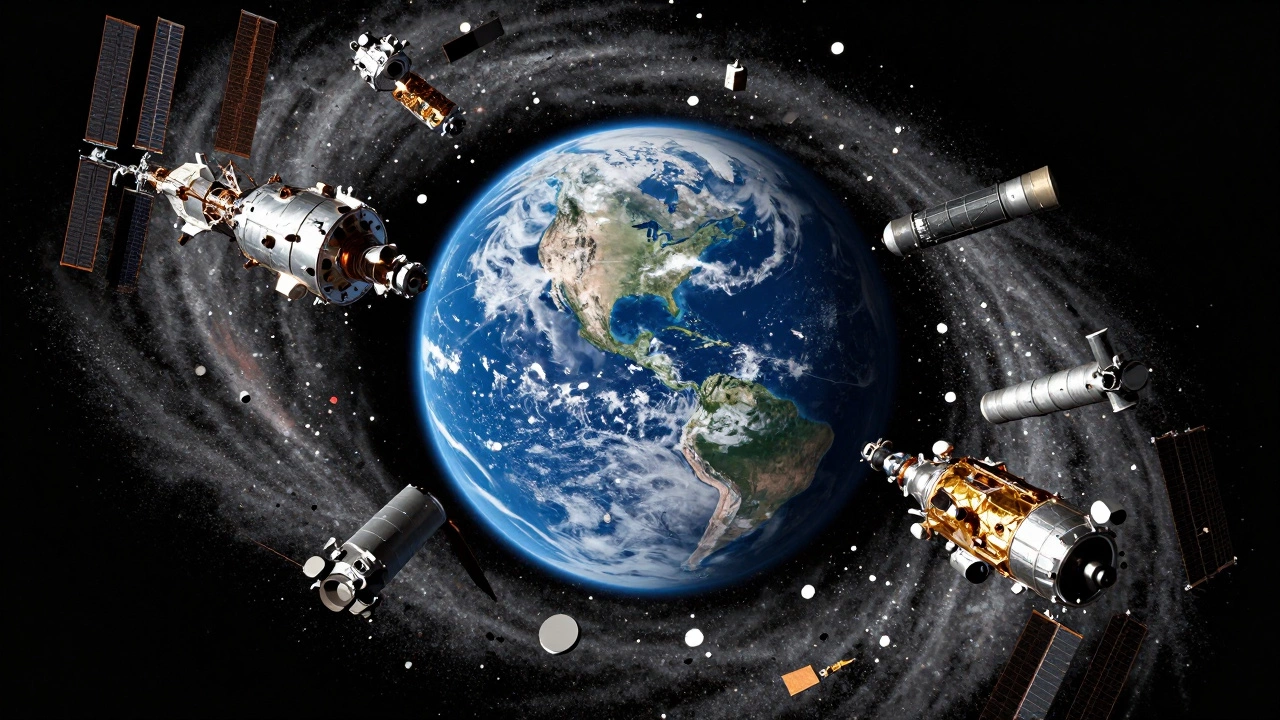
When most people think of space junk, they picture a dead satellite drifting in the dark. That's a big part of it. Dead Satellites is man-made objects launched into orbit that have exhausted their fuel or suffered electronic failure, leaving them unable to maneuver. These are the "school buses" of the debris world. If a communications satellite from the 1980s fails, it stays exactly where it was put, becoming a massive collision hazard for new missions.
Then you have the spent rocket stages. When a rocket launches a payload, it doesn't just vanish. The upper stages-the parts that pushed the satellite into its final orbit-often stay behind. These are massive aluminum cylinders that can weigh several tons. Because they are so large, radar systems can track them easily, but they are essentially ticking time bombs. If one of these hits another object, it doesn't just break; it shatters into thousands of smaller pieces.
The Invisible Danger: Small-Scale Fragments
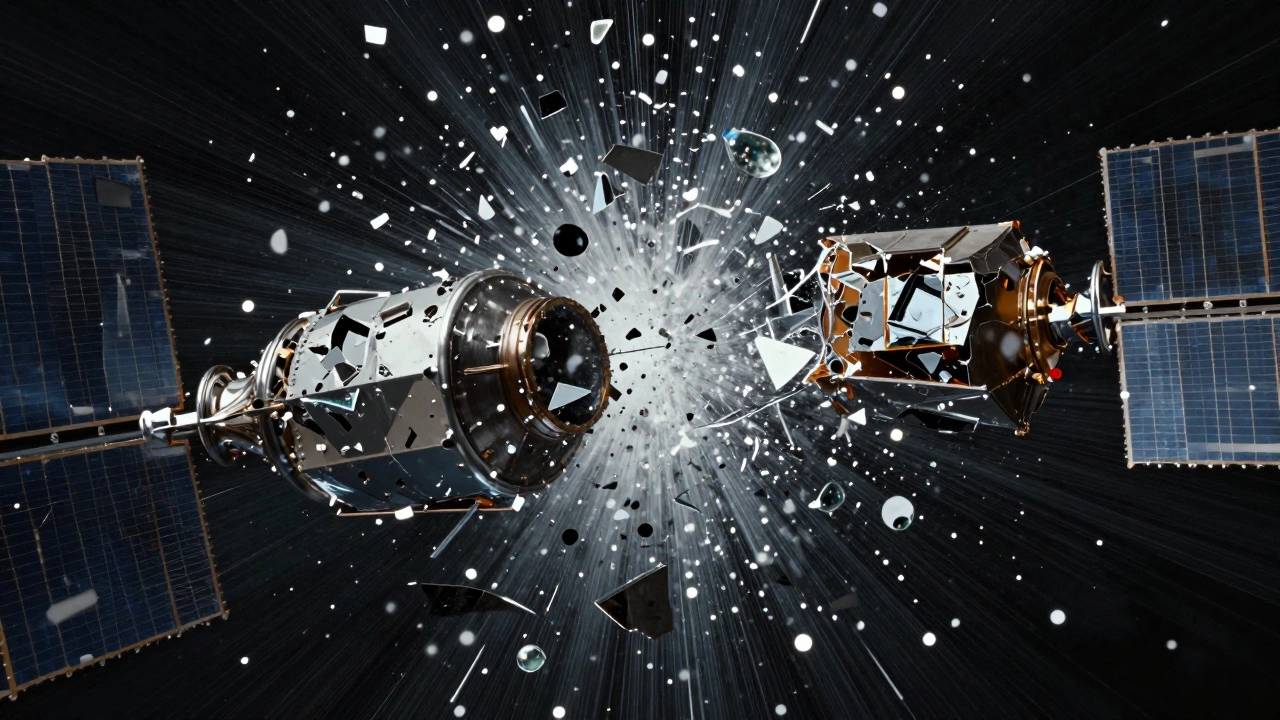
The scariest stuff isn't the big satellites; it's the things we can't see. This is where Fragmentation Debris comes in. Small shards created when two larger objects collide or when a rocket stage explodes due to leftover fuel. Think of it like a car crash in slow motion, but the shards keep flying forever. A single collision can create a cloud of thousands of pieces of metal, glass, and plastic.
You'd be surprised what actually counts as debris. Scientists have found frozen droplets of sodium-potassium coolant that leaked from old Soviet-era nuclear reactors in space. There are also flakes of paint that peel off satellites due to the extreme temperature swings in orbit. Because of the incredible orbital velocity, a paint chip can punch a hole right through a spacecraft's hull or crack a window on the International Space Station.
| Debris Type | Typical Size | Origin | Primary Risk |
|---|---|---|---|
| Spent Rocket Stages | 1 - 20 meters | Launch Missions | Catastrophic collisions |
| Defunct Satellites | 0.5 - 10 meters | End-of-life hardware | High-mass impact |
| Fragmentation Shards | 1 mm - 10 cm | Collisions/Explosions | Puncturing hulls |
| Micrometers | Erosion/Leaks | Optical surface damage |
The Nightmare Scenario: The Kessler Syndrome
There is a theoretical tipping point in orbital mechanics known as the Kessler Syndrome. A scenario proposed by NASA scientist Donald Kessler where the density of objects in Low Earth Orbit is high enough that one collision triggers a cascade of further collisions. Essentially, it's a domino effect. One piece of junk hits a satellite, creating more junk, which then hits another satellite, and so on.
If this happens, we reach a point where certain orbits become completely unusable. We wouldn't be able to launch new satellites because they'd be destroyed almost immediately. This would kill our GPS, weather forecasting, and global internet connectivity. It's not just a sci-fi movie plot; we're already seeing "near-misses" increasing every year. The rise of mega-constellations-thousands of small satellites launched by a few companies-has made the risk of a Kessler event much more real.
Where is the Junk Located?
Not all space is equally crowded. Most of the debris is concentrated in Low Earth Orbit (LEO), which is the area from the surface of Earth up to about 2,000 kilometers. This is where the International Space Station lives and where most imaging satellites orbit. Because it's the most "convenient" place to put things, it's also the most polluted.
Then there is the Geostationary Orbit (GEO), located about 35,786 kilometers away. Satellites here stay fixed over one spot on Earth, which is great for TV and weather. While there's less junk here than in LEO, the debris moves slower relative to the satellites, but the distance makes it nearly impossible to "clean up." Instead, operators move old GEO satellites into a "graveyard orbit"-a slightly higher loop where they can drift without hitting anything active.
How Do We Clean Up the Mess?
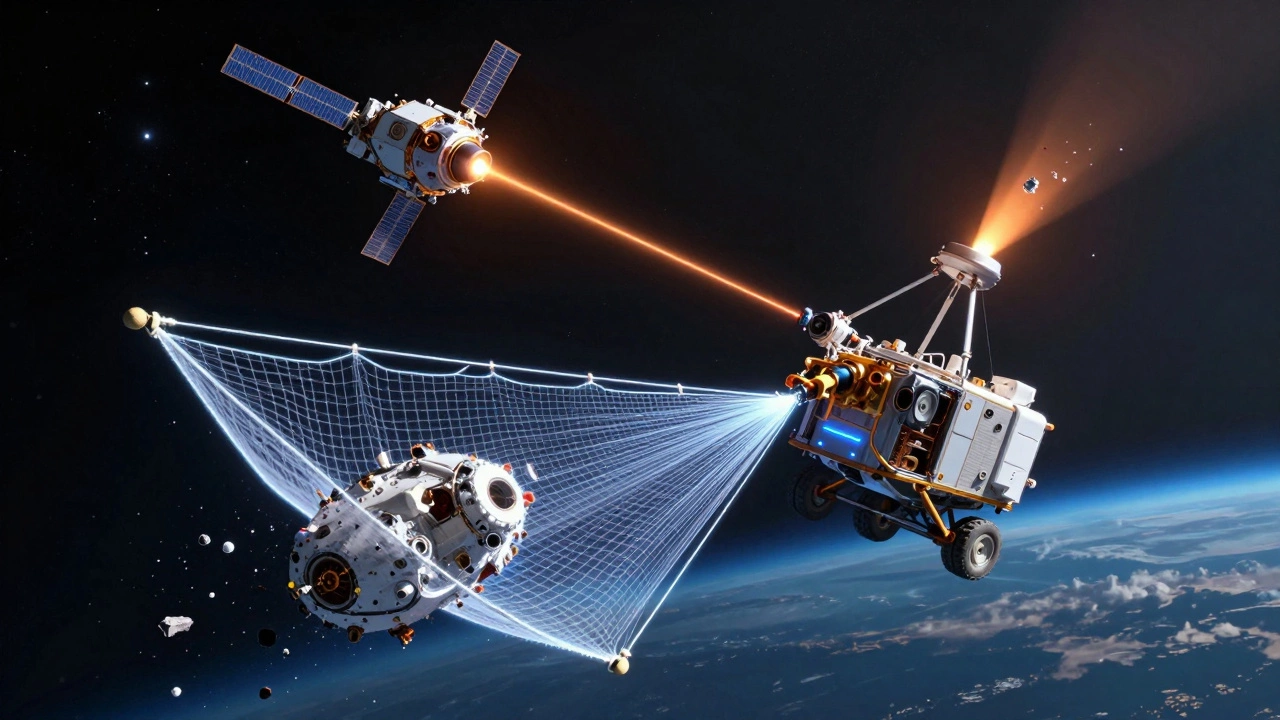
We can't exactly send a garbage truck into space. However, engineers are testing some wild ideas. One approach is the use of giant nets or harpoons to snag large dead satellites and pull them back down into the atmosphere, where they burn up upon reentry. Another idea involves using high-powered lasers to nudge small pieces of debris just enough to change their orbit, causing them to fall and burn up.
There are also "magnetic capture" systems. Some companies are developing satellites equipped with powerful magnets that can latch onto the metal frames of defunct spacecraft. The goal is to act as an orbital tow truck. But there's a diplomatic problem: who owns the junk? Under international law, a country still owns its space debris. You can't just go and grab a Russian or Chinese rocket stage without permission, even if it's a hazard to everyone.
Does space debris fall on people's heads?
Rarely. Most debris is either too small to survive the trip through the atmosphere (it burns up as a shooting star) or is tracked by agencies like USSPACECOM so they know where it will land. While a few large pieces hit the ocean or uninhabited land each year, the chance of an individual being hit is astronomically low.
Why can't we just use a giant vacuum?
Vacuum cleaners rely on air pressure to move particles. Space is a vacuum-there's no air to push the debris into a bag. To move something in space, you have to physically touch it or use forces like magnetism, gravity, or light pressure (lasers).
Are asteroids considered space debris?
No. Space debris, or orbital debris, specifically refers to man-made objects. Asteroids and comets are natural celestial bodies. While they can be dangerous, they aren't the result of human pollution.
What is a graveyard orbit?
It's a designated region of space above the Geostationary Orbit. When a satellite is about to run out of fuel, operators use the last bit of propellant to push it a few hundred kilometers higher, away from the active lanes, so it doesn't collide with functioning satellites.
How do satellites avoid junk?
Many modern satellites have thrusters for "collision avoidance maneuvers." When ground radar detects a piece of debris on a collision course, the operators fire the thrusters to nudge the satellite a few meters out of the way.
Moving Forward: The Path to Sustainable Space
The future of space exploration depends on how we handle this mess. We are seeing a shift toward "design for demise." This means building satellites out of materials that are guaranteed to burn up completely when they fall back to Earth, leaving nothing behind. We're also seeing stricter rules about "de-orbiting" satellites within five years of their mission ending.
If we don't get serious about orbital hygiene, we risk a future where the stars are visible, but the space between us and them is a wall of shrapnel. The technology to clean up space is getting better, but the real solution is simply stopping the leak. Every new launch must have a plan for how that object leaves the orbit, whether it's through a controlled crash into the ocean or a slow drift into the atmosphere.