What Companies Still Use Scientific Management Today?
 Feb, 20 2026
Productivity vs. Worker Satisfaction Calculator
Key Insight: Scientific management boosts productivity by 15%, but decreases worker satisfaction by 10%. This creates a productivity-satisfaction tradeoff.
When productivity gains exceed 25% and satisfaction drops below 15%, companies often experience increased turnover, which can negate efficiency gains.
The article mentions: "Studies show that while scientific management boosts output, it often tanks morale. Workers in highly monitored environments report lower job satisfaction—even when pay is higher."
Scientific management isn’t some dusty theory from the 1900s. It’s still alive-in factories, warehouses, call centers, and even hospitals. You might not hear the name scientific management used much anymore, but its DNA is everywhere in how work gets done. Fredrick Winslow Taylor didn’t just write a book; he built the blueprint for modern productivity. And guess what? Many companies still follow it, sometimes without even realizing it.
How Scientific Management Works in Practice
At its core, scientific management is about breaking work into tiny, repeatable steps and measuring every part of it. Taylor’s big idea? Find the single best way to do each task, train workers to do it exactly that way, and pay them based on output. No guesswork. No fluff. Just numbers.
Think about Amazon’s fulfillment centers. Workers wear scanners. Every movement is timed. Rest breaks are scheduled down to the minute. If you’re slower than the system, you get flagged. That’s not just efficiency-it’s Taylorism in action. The same logic runs in warehouses for Walmart, FedEx, and DHL. They don’t call it scientific management. They call it ‘operational excellence.’ But the math is the same.
Manufacturing: Where It Never Left
Automakers like Toyota and Ford still use scientific management principles, even if they’ve added lean and Six Sigma on top. Toyota’s production line? Every bolt, every weld, every lift is standardized. Workers don’t improvise. They follow scripts written by engineers who studied motion and time down to the tenth of a second.
And it works. Toyota’s assembly lines produce more cars with fewer errors than almost any other brand. Why? Because they didn’t throw out Taylor-they upgraded him. They took his focus on measurement and added continuous improvement. That’s not a rejection of scientific management. It’s its evolution.
Call Centers and Customer Service
Ever been on hold with a telecom company and heard, ‘Your call is important to us’ while the system tracks your every word? That’s scientific management too.
Companies like AT&T, Verizon, and even Amazon’s customer service teams use performance dashboards that monitor: call duration, hold time, resolution rate, and even tone of voice. Agents are ranked. Incentives are tied to metrics. There’s no room for ‘I think I did okay.’ It’s all about hitting targets. The same system is used in insurance claims processing, bank back offices, and airline reservation centers.
Some workers hate it. But companies keep it because it cuts costs and scales easily. A call center in Manila can handle 10,000 calls a day because every step was broken down, timed, and optimized.
Hospitals and Healthcare Systems
You wouldn’t expect a hospital to run like a factory. But many do. In the U.S., hospitals use time-and-motion studies to cut ER wait times. Surgeons are timed during procedures. Nurses are assigned tasks in 15-minute blocks. Even cleaning crews follow checklists with timestamps.
The Cleveland Clinic and Kaiser Permanente use digital systems that track how long patients spend in each room-from triage to discharge. If a patient waits longer than 20 minutes for a blood test, the system alerts managers. That’s not patient care as a human experience. It’s patient care as a process.
Why? Because delays cost money. And in healthcare, time is money. Scientific management doesn’t care if you’re treating a broken arm or a broken system. It just wants the process to be faster, cheaper, and repeatable.
Why It’s Still So Common
Why hasn’t scientific management died out? Three reasons:
- It’s measurable. Managers can see exactly who’s performing and who’s not. No debates. No opinions. Just data.
- It scales. You can train 10 people or 10,000 the same way. No need for creativity-just consistency.
- It reduces risk. If every worker does the same thing the same way, errors drop. Compliance goes up. Audits become easier.
Companies don’t need to be fancy. They need to be predictable. And scientific management delivers predictability like nothing else.
The Dark Side You Don’t Hear About
There’s a reason some workers dread this system. When every action is monitored, people feel like machines. Turnover is high in Amazon warehouses. Burnout is common in call centers. Nurses report emotional exhaustion because they’re treated as cogs, not caregivers.
Studies from the University of Manchester and Harvard Business School show that while scientific management boosts output, it often tanks morale. Workers in highly monitored environments report lower job satisfaction-even when pay is higher.
Companies know this. But they still use it because productivity gains outweigh the costs. For shareholders, it’s a win. For workers? Not always.
Modern Twists on an Old System
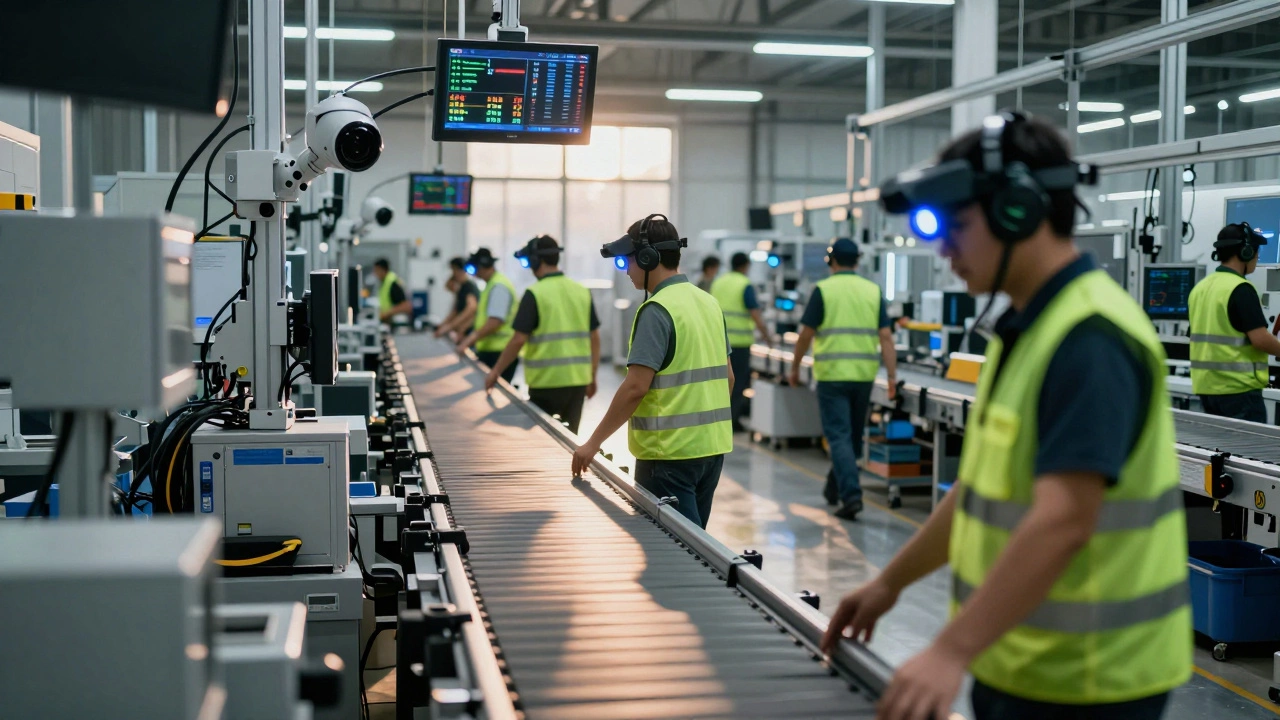
Today’s version of scientific management isn’t just stopwatches and clipboards. It’s AI-driven. Algorithms now predict how long a task should take. Sensors track worker movement. Wearables monitor stress levels. Some warehouses use augmented reality glasses to guide workers step-by-step through picking orders.
Uber and Lyft don’t manage drivers with managers-they manage them with ratings and surge pricing. That’s scientific management with an app. The worker doesn’t have a boss. The algorithm is the boss.
Even in tech, companies like Google and Microsoft use time-tracking tools for software engineers. Not to spy, but to optimize sprints. If a developer takes 4 hours to fix a bug that usually takes 2, the system flags it. Is it micromanagement? Or just data-driven improvement? It depends on who you ask.

Who’s Still Using It? The Real List
Here are real companies, right now, using scientific management principles:
- Amazon - Warehouse workflows timed to the second
- Walmart - Inventory restocking based on motion studies
- Toyota - Standardized assembly line procedures
- Verizon - Call center metrics tied to bonuses
- Cleveland Clinic - Patient flow tracked with digital timers
- DHL - Package sorting routes optimized by motion analysis
- Uber - Driver performance via algorithmic ratings
These aren’t exceptions. They’re the norm.
Is It Going Away?
No. Not anytime soon. As long as companies need to cut costs, scale quickly, and reduce errors, scientific management will stick around. The tools have changed. The language has changed. But the goal? Still the same: make work faster, cheaper, and more predictable.
Some companies try to soften it with ‘wellness programs’ or ‘employee feedback loops.’ But the core remains. Workers are still measured. Tasks are still broken down. Performance is still tied to numbers.
It’s not evil. It’s not magic. It’s just math. And math doesn’t care how you feel about it.
Is scientific management the same as Taylorism?
Yes. Scientific management and Taylorism are the same thing. Fredrick Winslow Taylor developed the system in the early 1900s, and it became known as Taylorism. Today, companies don’t use the term, but they still follow his methods: breaking tasks into steps, measuring performance, and standardizing procedures.
Do any companies use scientific management in creative fields?
Rarely, and when they do, it backfires. Creative work-like design, writing, or software development-thrives on flexibility and experimentation. Companies that try to time every creative task, like coding sprints or ad campaigns, often see a drop in innovation. Some tech firms use light versions for project tracking, but they avoid rigid measurement. The most successful creative teams reject strict scientific management.
Why do workers hate scientific management?
Because it treats people like machines. When every movement is tracked, every break is scheduled, and every mistake is penalized, workers feel powerless. Studies show that while output goes up, job satisfaction and mental health often go down. People don’t mind efficiency-but they do mind being controlled.
Can scientific management be ethical?
It can be, if it’s paired with fair pay, autonomy, and respect. Some companies use time-motion studies to reduce physical strain, not to punish workers. For example, a factory might redesign a workstation to cut back on back injuries. That’s scientific management used for safety, not control. The difference is intent: is the goal to help people, or to squeeze more out of them?
Is scientific management outdated in the age of AI?
Not at all. AI has made scientific management stronger. Algorithms can track thousands of data points in real time-far beyond what stopwatches ever could. Companies now use AI to predict bottlenecks, optimize routes, and even adjust pay based on performance. Scientific management didn’t die-it got smarter.
What Comes Next?
The future of work isn’t about abandoning systems like scientific management. It’s about asking: Who benefits?
If the goal is to make work safer, faster, and less tiring for the worker-then it’s progress. If the goal is to cut labor costs and increase profits with no regard for well-being-then it’s exploitation.
Companies aren’t choosing between old and new. They’re choosing between using science to serve people-or using people to serve science.