What Are the Challenges of Technology Transfer?
 Jan, 20 2026
Technology Transfer Funding Calculator
Input Your Project Details
Funding Gap Analysis
Estimated Funding Required
Key Challenges Ahead
Technology transfer isn’t just about moving a lab discovery into a factory. It’s about bridging two worlds that speak different languages, follow different rules, and measure success in completely different ways. You’ve got researchers chasing publishable results, and companies chasing profitable products. When these two collide, things don’t always go smoothly. In fact, most promising technologies never make it out of the lab - not because they don’t work, but because the path to real-world use is full of hidden traps.
Language and Culture Clash
Academics talk in terms of peer-reviewed journals, citations, and theoretical breakthroughs. Businesses talk in terms of market size, ROI, and time-to-revenue. When a university spins out a new cancer-detecting algorithm, the scientist might be thrilled it’s 98% accurate in controlled trials. The investor wants to know: Can we deploy this in five rural clinics next year? Will insurance pay for it? How do we train staff? The gap isn’t just technical - it’s cultural. One side values slow, rigorous validation. The other needs speed, scalability, and a clear path to profit.Funding Gaps Between Lab and Market
Research grants cover the cost of experiments, not product development. A prototype that works in a university lab might need $5 million to become a certified medical device. But venture capitalists won’t touch it until there’s regulatory approval, pilot data, and a sales pipeline. That’s the ‘valley of death’ - the funding gap between proof-of-concept and commercial viability. In the UK, only 12% of university inventions receive any follow-on funding after initial discovery. Most die there. Even when public funds exist - like Innovate UK grants - the application process is slow, bureaucratic, and often misses the window when the tech is ready to scale.Intellectual Property Battles
Who owns the invention? The university? The researcher? The government that funded it? Disputes over patents can stall transfer for years. In one case, a UK university held a patent on a low-cost water purification filter developed with EU funding. But the researcher had co-invented it while on sabbatical at a German institute. Both institutions claimed rights. The filter never reached communities in sub-Saharan Africa. Patent thickets - overlapping claims from multiple parties - are common in fields like biotech and AI. Licensing fees can be so high that small companies can’t afford them, killing the very innovation they were meant to spread.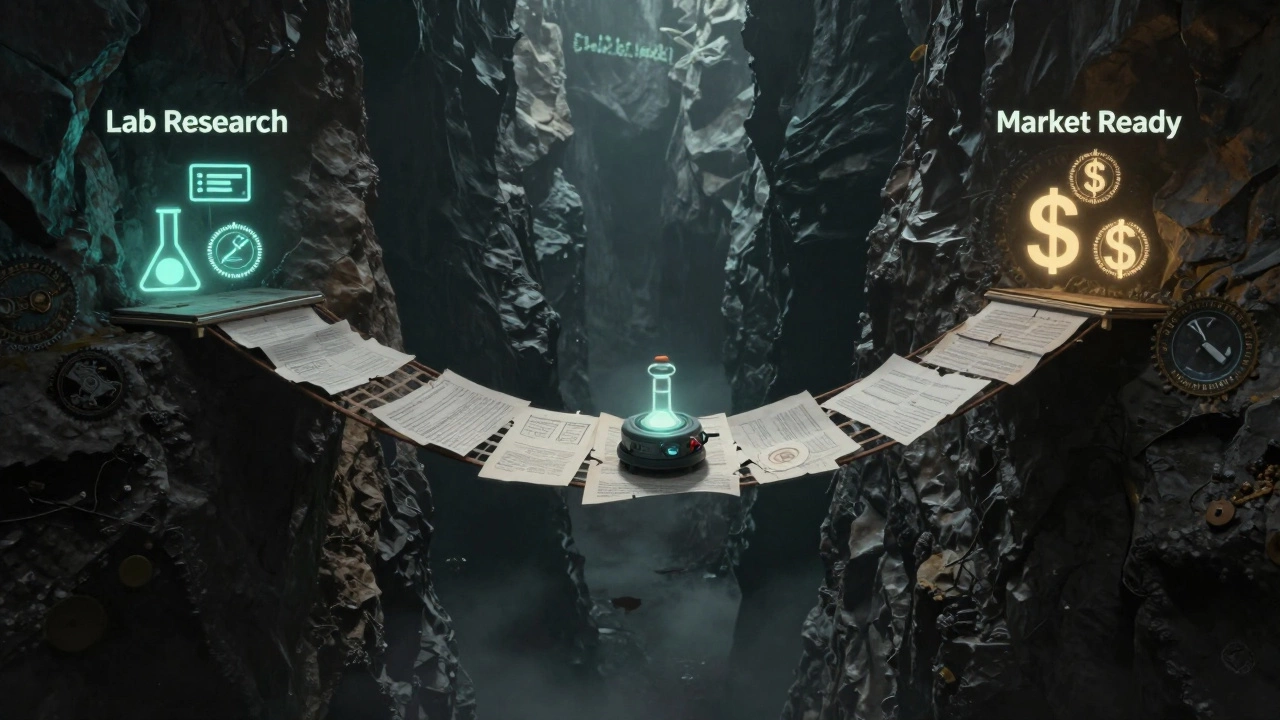
Lack of Commercialization Expertise
Most researchers are brilliant at science. Few are trained in business. They don’t know how to write a business plan, talk to regulators, or protect IP properly. University tech transfer offices are often understaffed and underfunded. In the US, the average tech transfer office handles 300+ inventions per year with just 5-8 staff. In the UK, many universities outsource this to third parties who prioritize easy wins - like software licenses - over complex hardware or medical devices that take years to commercialize. The result? High-potential tech gets ignored because it’s too hard to sell.Regulatory and Compliance Hurdles
Getting a new medical device, drug, or agricultural tech approved isn’t just paperwork - it’s a multi-year journey. The FDA, MHRA, or EU equivalents demand clinical trials, safety data, manufacturing standards, and post-market surveillance. A lab-scale bioreactor that works in a university setting might fail a GMP audit because the materials used aren’t certified for human use. A soil sensor that works in a controlled field trial might be rejected because it doesn’t meet CE marking requirements for outdoor electronics. These rules exist for good reason - safety matters - but they’re rarely designed with early-stage innovators in mind.Market Readiness and Adoption Resistance
Even if the tech is approved, people might not want to use it. Farmers in rural India might stick with traditional seeds because they trust local knowledge, not a new DNA-based crop. Hospitals might resist adopting AI diagnostics because staff fear being replaced. Public distrust in gene editing or AI tools can kill demand before it starts. Technology transfer fails not just because of technical flaws, but because of social, cultural, or psychological resistance. The most advanced tech in the world won’t change anything if no one believes in it - or fears it.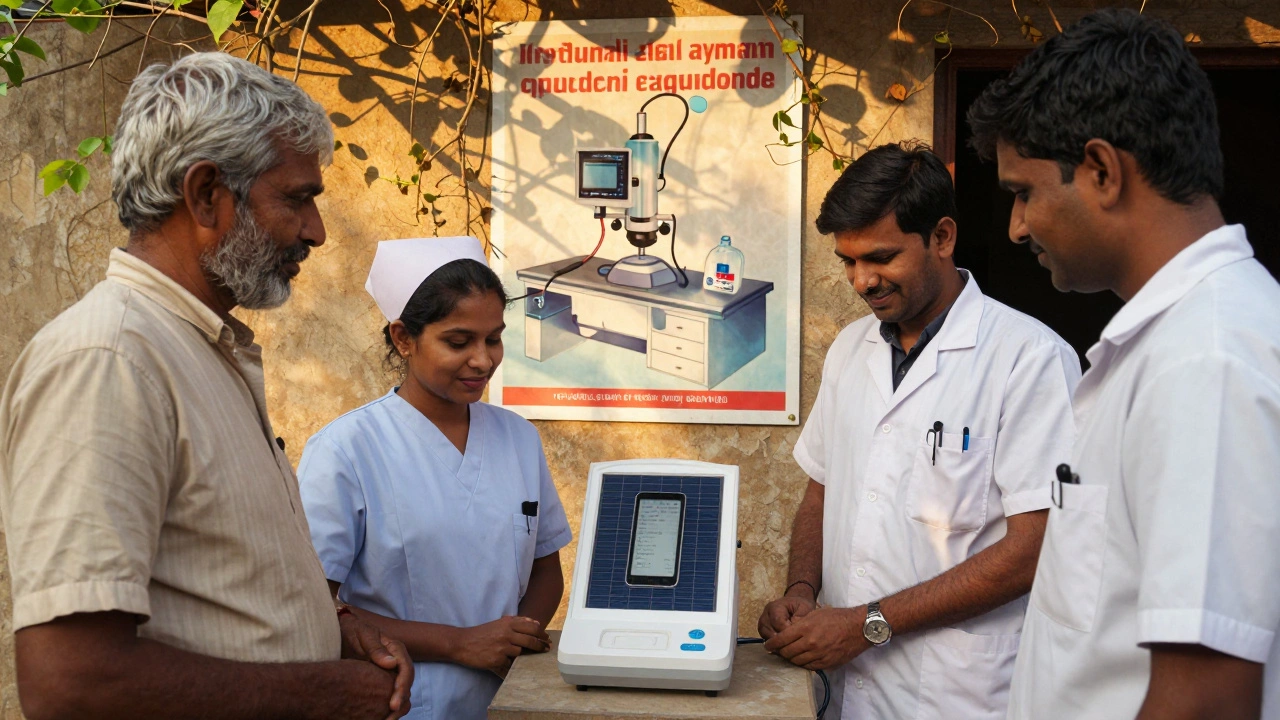
Geographic and Infrastructure Gaps
A breakthrough developed in Oxford might never reach a clinic in Lagos. Why? Lack of electricity, poor internet, no cold chain for storage, or no trained technicians to maintain equipment. Technology transfer often assumes a global infrastructure that doesn’t exist. A portable ultrasound device designed for low-resource settings might need a smartphone connection to function - but in parts of sub-Saharan Africa, 4G coverage is patchy. The same tech that works in Liverpool might be useless in Malawi. Yet most transfer programs are designed for wealthy economies, ignoring the needs of the global South.Short-Term Incentives Over Long-Term Impact
Universities reward professors for publishing papers, not for licensing patents. Tenure committees don’t care if your invention helped thousands of patients - they care how many citations you have. Researchers who spend time on tech transfer are often seen as “distracted” from real science. Meanwhile, companies want quick returns. This misalignment means innovation gets stuck. A 2023 study of 120 UK university spinouts found that those with faculty members who stayed involved beyond the first year were 3x more likely to survive past five years. But most researchers are pushed out after the initial patent filing, leaving the startup without its technical heart.What Actually Works?
Some places have cracked this. The Karolinska Institute in Sweden embeds business mentors directly into research labs. MIT’s Deshpande Center funds early-stage tech with seed grants and connects inventors with industry partners before the patent is even filed. In the UK, the NHS Innovation Accelerator pairs clinicians with startups to test devices in real hospitals - fast-tracking feedback and adoption. The common thread? They break down silos. They pay people to do the hard work of translation. They don’t treat tech transfer as an administrative chore - they treat it as a core mission.Technology transfer isn’t broken. It’s just poorly designed. The solutions aren’t new tools or bigger budgets - they’re cultural shifts. We need to reward researchers for impact, not just publications. We need to fund the messy middle. We need to listen to the end users - not just the inventors. Until then, most brilliant ideas will stay locked in labs, gathering dust while the world waits.
Why do most university inventions never reach the market?
Most university inventions fail to reach the market because they hit a funding gap between lab research and commercial development. Grants cover discovery, not scaling. Investors won’t step in until there’s regulatory approval, market validation, and a clear revenue model - all of which take years and millions of pounds. Without dedicated funding and commercialization support, even groundbreaking tech dies in the ‘valley of death’.
Is intellectual property the biggest barrier to technology transfer?
IP is a major barrier, but not always the biggest. Patent disputes, licensing fees, and overlapping claims can delay or kill transfers - especially in biotech and AI. But even when IP is clear, other issues like lack of business skills, regulatory delays, or market resistance often block progress. The real problem is systemic: too many players, too little coordination, and no one accountable for getting the tech to users.
Can technology transfer work in low-income countries?
Yes, but only if the tech is designed for the context. A device that needs high-speed internet or refrigeration won’t work in rural areas without those basics. Successful transfers in low-income settings involve local partners from day one - not just exporting Western tech. Examples include solar-powered diagnostic tools that work off mobile networks, or low-cost water filters made with locally available materials. The key is co-design, not just delivery.
What role do government policies play in technology transfer?
Government policy can either enable or block tech transfer. Clear IP rules, tax incentives for R&D investment, and public procurement programs that buy from startups can accelerate adoption. In contrast, slow bureaucracy, unclear regulations, or funding that only supports basic research (not application) creates bottlenecks. The UK’s Innovate UK program helps, but its grants are competitive and often too late for early-stage tech. Better policies focus on bridging the gap - not just funding discovery.
How can researchers improve their chances of successful tech transfer?
Researchers should start thinking like users early. Ask: Who will use this? What problem does it solve? What’s the cost? Get feedback from potential customers - not just other scientists. Work with your university’s tech transfer office from the start. Learn the basics of IP, licensing, and regulation. Don’t wait until the paper is published - start conversations with industry partners while the research is still in progress. The most successful transfers happen when science and business are built together, not after the fact.