What Are the Big Three in Bioinformatics?
 Dec, 19 2025
When you hear the word bioinformatics, you might think of computers crunching numbers in a lab. But it’s not just about algorithms or code. Bioinformatics is the bridge between biology and data-and without it, modern medicine, personalized treatments, and even crop engineering wouldn’t exist. At the heart of this field are three foundational pillars that every researcher, student, or industry professional needs to understand. These aren’t just tools or techniques-they’re the backbone of how we decode life at the molecular level. They’re called the Big Three in bioinformatics: DNA sequencing, genome analysis, and bioinformatics tools.
DNA Sequencing: The Starting Point of Everything
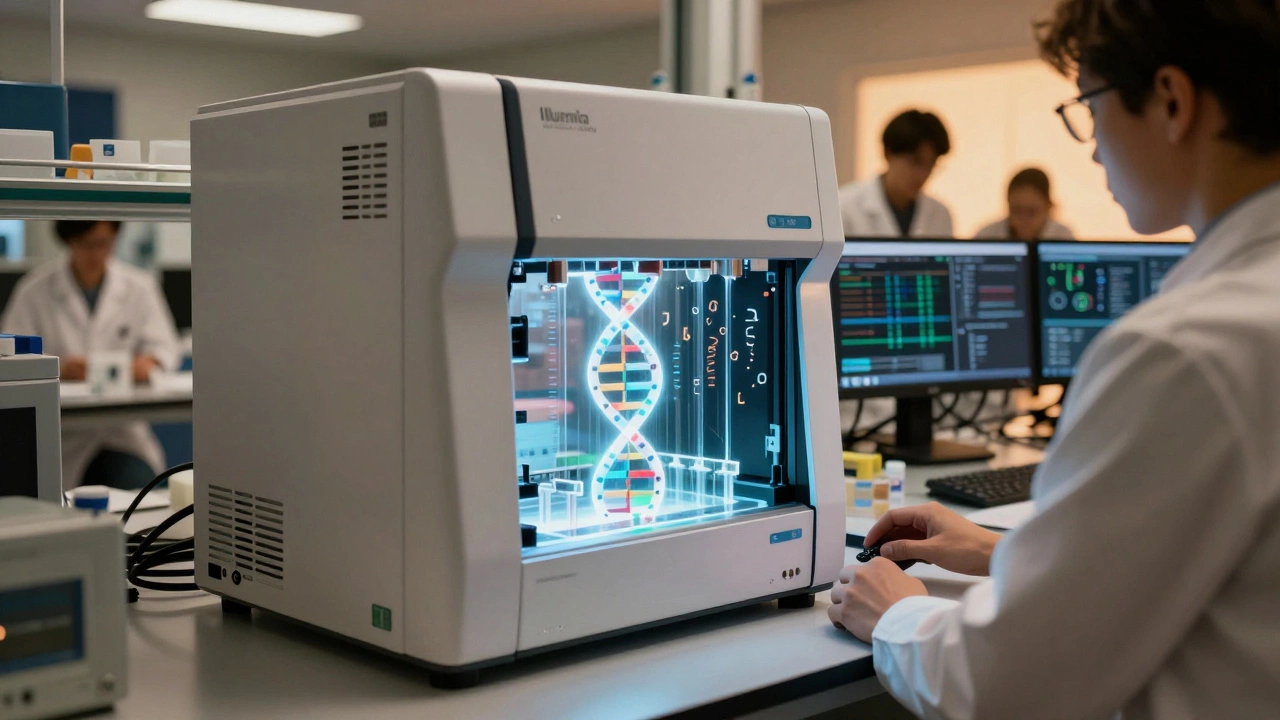
DNA sequencing is how we read the biological code inside every living thing. It’s the first step in bioinformatics. Without knowing the exact order of A’s, T’s, C’s, and G’s in a genome, nothing else matters. In the early 2000s, sequencing a single human genome took over a decade and cost nearly $3 billion. Today, thanks to next-generation sequencing (NGS) platforms like Illumina’s NovaSeq and Oxford Nanopore’s MinION, you can get a full human genome in under 24 hours for under $600.
This speed and affordability changed everything. Hospitals now sequence cancer tumors to find mutations that respond to specific drugs. Farmers sequence crop DNA to breed disease-resistant plants. Public health labs track virus variants in real time-like how scientists identified the Omicron variant in South Africa within days of its emergence.
Sequencing isn’t just about humans. Microbial sequencing helps us understand gut bacteria linked to diabetes. Environmental sequencing lets us monitor biodiversity by pulling DNA from soil or water samples. The data doesn’t just sit there-it feeds directly into the next two pillars of bioinformatics: genome analysis and bioinformatics tools.
Genome Analysis: Turning Raw Data into Meaning
Sequencing gives you a string of billions of letters. But what do they mean? That’s where genome analysis comes in. This is the process of interpreting those letters-finding genes, spotting mutations, comparing species, and linking patterns to traits or diseases.
Take the Human Genome Project. It gave us a reference map of human DNA. But that map alone didn’t cure cancer. It was genome analysis that showed us how a single change in the BRCA1 gene increases breast cancer risk by up to 70%. Or how a variant in the APOE gene raises Alzheimer’s risk. These aren’t guesses-they’re statistically proven associations found by analyzing thousands of genomes.
Genome analysis tools like BLAST let scientists compare a newly sequenced gene against millions of known sequences to find similarities. Tools like GATK help identify real mutations from sequencing errors. CRISPR gene-editing research depends entirely on accurate genome analysis to predict off-target effects. Even ancestry companies like 23andMe rely on this step to tell you where your ancestors came from.
And it’s not just humans. Scientists compare the genomes of elephants and mice to understand why elephants rarely get cancer. They analyze the genome of the tardigrade to figure out how it survives extreme radiation. Genome analysis turns raw data into biological insight-and it’s what makes bioinformatics more than just data storage.
Bioinformatics Tools: The Engine That Makes It All Work
Without tools, DNA sequencing and genome analysis would be impossible. These aren’t flashy apps you download from the App Store. They’re specialized software, databases, and pipelines built by scientists for scientists. And they’re everywhere in modern biology.
Take NCBI-the National Center for Biotechnology Information. It’s not just a website. It’s a massive public database holding over 100 billion DNA sequences from every organism ever sequenced. Researchers upload their data here. Others download it. It’s the shared library of life.
Then there’s Ensembl, which maps genes to chromosomes and predicts how mutations affect protein function. Or UCSC Genome Browser, which lets you zoom in on a single gene and see its regulatory regions, nearby SNPs, and conservation across species-all in one view.
For analysis, tools like Python and R are standard. Libraries like Biopython and Bioconductor let researchers write scripts that automate variant calling, alignment, or pathway analysis. Pipeline frameworks like Snakemake and Nextflow let teams chain together dozens of tools into repeatable workflows. One lab might use 20 different tools in sequence to go from raw sequencing reads to a published finding.
These tools aren’t optional. A researcher without access to them is like a doctor without a stethoscope. Even small labs now use cloud platforms like AWS or Google Cloud to run these tools at scale. The barrier to entry has dropped so much that high school students have published peer-reviewed papers using publicly available tools and datasets.

How the Big Three Work Together
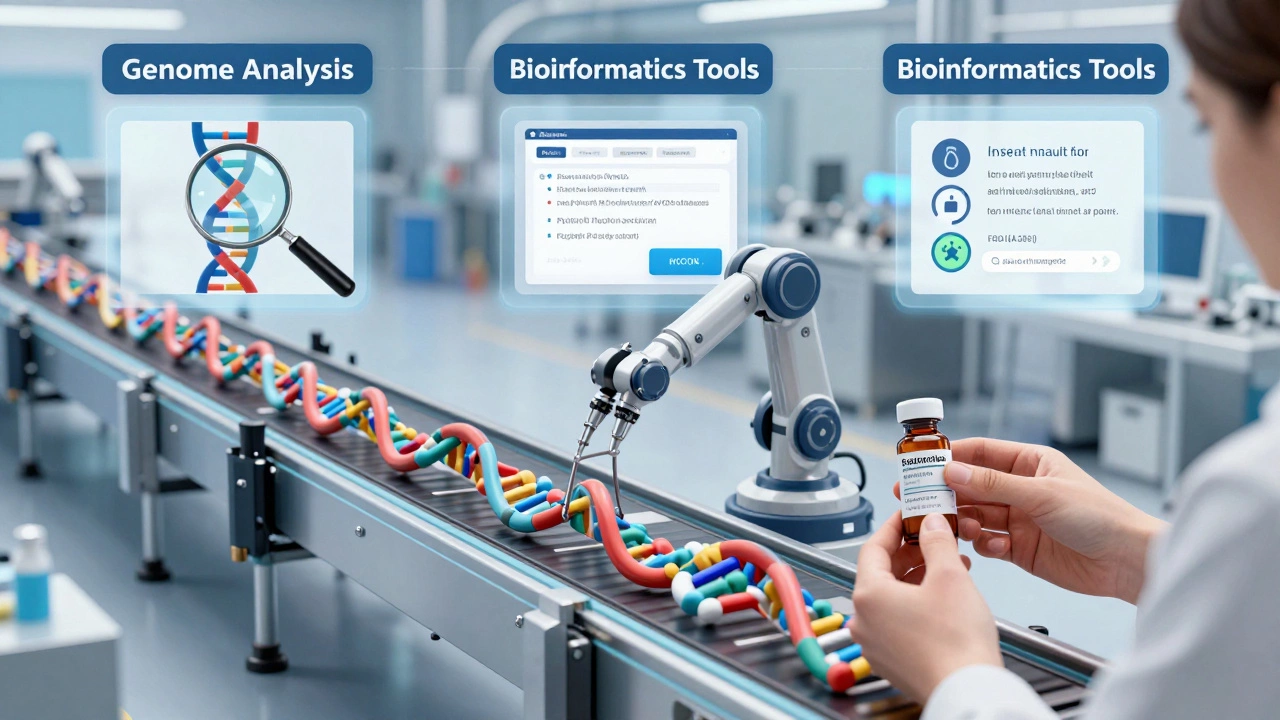
Think of the Big Three like a factory line. DNA sequencing is the raw material coming in-thousands of DNA fragments. Genome analysis is the quality control and assembly line-sorting, matching, and interpreting those fragments. Bioinformatics tools are the machines and robots running the whole operation.
Here’s a real-world example: A patient with rare epilepsy gets sequenced. The raw data goes into a bioinformatics pipeline (tool) that aligns the reads to the human reference genome. Then, genome analysis software scans for known epilepsy-linked mutations. If none are found, the system compares the patient’s genome to global databases (NCBI, gnomAD) to find rare variants. One variant in the SCN1A gene is flagged as likely pathogenic. The doctor prescribes a specific drug that works for that mutation. All of this happened in under two weeks.
That’s not science fiction. It’s happening in hospitals right now. And it only works because the Big Three are tightly connected. Break one link-say, poor sequencing quality-and the whole process fails. Use outdated tools, and you’ll miss critical mutations. Skip genome analysis, and you’re just staring at a pile of letters.
Why This Matters Beyond the Lab
The Big Three aren’t just for academic papers. They’re reshaping industries.
In agriculture, companies like Corteva use sequencing and genome analysis to develop drought-tolerant corn. In biotech, firms like Moderna and BioNTech relied on these tools to design mRNA vaccines in record time. Even forensic science uses DNA sequencing to solve cold cases with genetic genealogy.
And it’s growing. The global bioinformatics market is projected to hit $100 billion by 2030. Every new sequencing machine, every improved algorithm, every open-source tool adds to the momentum. What used to take years now takes days. What used to require a PhD in computational biology can now be done by a biology undergrad with access to free online courses and tools.
Understanding the Big Three isn’t about memorizing names. It’s about seeing how biology has become a data science. If you’re entering this field, you need to be comfortable with both pipettes and Python. If you’re a patient, investor, or policymaker, you need to understand that the future of medicine isn’t just in new drugs-it’s in how we read, interpret, and act on the code of life.
Common Misconceptions
Some people think bioinformatics is just “biology with computers.” That’s wrong. It’s not biology plus IT. It’s a new discipline born from the collision of both. You can’t be a good bioinformatician if you don’t understand biology. And you can’t be a good biologist anymore if you ignore data.
Another myth: “You need to be a programmer.” Not true. You need to know how to use tools, not write them from scratch. Most researchers use pre-built pipelines. You don’t need to code a BLAST algorithm-you just need to know when to run it and how to interpret the results.
And no, bioinformatics isn’t just for big labs. With cloud computing and open-source tools, even small clinics and startups can access the same power as Harvard or MIT. The tools are democratizing science.
What are the Big Three in bioinformatics?
The Big Three in bioinformatics are DNA sequencing, genome analysis, and bioinformatics tools. DNA sequencing reads the genetic code, genome analysis interprets what that code means, and bioinformatics tools are the software and databases that make both possible at scale.
Why is DNA sequencing considered the foundation of bioinformatics?
DNA sequencing provides the raw data-every A, T, C, and G in an organism’s genome. Without this data, there’s nothing to analyze. Advances in sequencing technology have made it fast and affordable, turning what was once a decade-long project into a routine lab procedure that fuels all downstream analysis.
How does genome analysis differ from DNA sequencing?
DNA sequencing reads the genetic code; genome analysis interprets it. Sequencing tells you the order of bases. Genome analysis finds genes, spots mutations, links variants to diseases, and compares genomes across species. It turns data into biological meaning.
What are some essential bioinformatics tools?
Essential tools include NCBI databases for sequence storage, Ensembl and UCSC Genome Browser for gene mapping, BLAST for sequence comparison, and programming environments like Python and R with Bioconductor/Biopython libraries. Pipeline tools like Snakemake and Nextflow automate complex workflows.
Can someone without a computer science background work in bioinformatics?
Yes. Many bioinformaticians come from biology, chemistry, or medicine. You don’t need to build software from scratch-you need to understand how to use existing tools, interpret results, and ask the right questions. Training in basic scripting and data interpretation is often enough to get started.
How has bioinformatics impacted medicine?
Bioinformatics enables precision medicine. Doctors now sequence tumor DNA to match patients with targeted therapies. Newborn screening uses genomic data to detect rare diseases early. Infectious disease outbreaks are tracked using real-time pathogen sequencing. These aren’t future possibilities-they’re current clinical practices.
Where to Go Next
If you’re new to bioinformatics, start with free resources: NCBI’s tutorials, the Broad Institute’s online courses, or the Galaxy Project for hands-on analysis without coding. If you’re already working in biology, consider learning one tool deeply-like how to run a variant caller or interpret a genome browser track. The field moves fast, but the Big Three remain constant. Master those, and you’ll always be able to keep up.