Understanding the 3 Main Types of Technology Transfer
 Apr, 21 2026
Tech Transfer Strategy Selector
Select the scenario that best describes your goals and current situation to find the recommended transfer path.
The Passive Path
"I want to stay in my lab, keep teaching, and receive a steady income without managing a company."
The Collaborative Path
"My tech is great, but I need industrial facilities, servers, or specialized expertise to scale it."
The Disruptive Path
"This invention will change an entire industry. I want full control and maximum potential reward."
Key Takeaways
- Licensing is the fastest way to move tech via legal agreements.
- Joint Ventures allow two companies to share the risk and reward.
- Spin-offs create entirely new companies to focus on a specific invention.
- The choice of transfer depends on how much risk the researcher is willing to take.
The First Path: Licensing Agreements
Licensing is probably the most common way we see tech move. Think of it like renting a house. The original inventor (the licensor) owns the "house" (the patent), and a company (the licensee) pays a fee to live in it and use it for their own business. In a typical licensing deal, the company pays a royalty-usually a percentage of the sales-back to the university or researcher. For example, if a university develops a new drug molecule and licenses it to a pharmaceutical giant like Pfizer, the university gets a cut of every pill sold without having to build their own factories. Why do people choose this? It's low risk for the inventor. They don't have to manage employees or worry about shipping logistics. They just provide the intellectual property and collect a check. However, the downside is that the inventor loses a lot of control. If the company decides to pivot or slow down development, the technology might just sit on a shelf.The Second Path: Joint Ventures
Sometimes, a project is too big or too risky for one party to handle alone. This is where a Joint Venture comes into play. Instead of just renting the tech, two or more organizations create a temporary partnership to develop it together. Imagine a software company that knows how to build great user interfaces but doesn't understand Artificial Intelligence. They team up with a university AI lab. They don't merge their whole companies; they just create a specific project entity. They share the costs of the servers, the salaries of the engineers, and eventually, the profits. This is a "middle ground" approach. It's more intimate than licensing but less permanent than a merger. The biggest challenge here is governance. Who makes the final call on the design? Who owns the new improvements made during the partnership? Because of these frictions, Joint Ventures require very detailed contracts to avoid legal battles later on.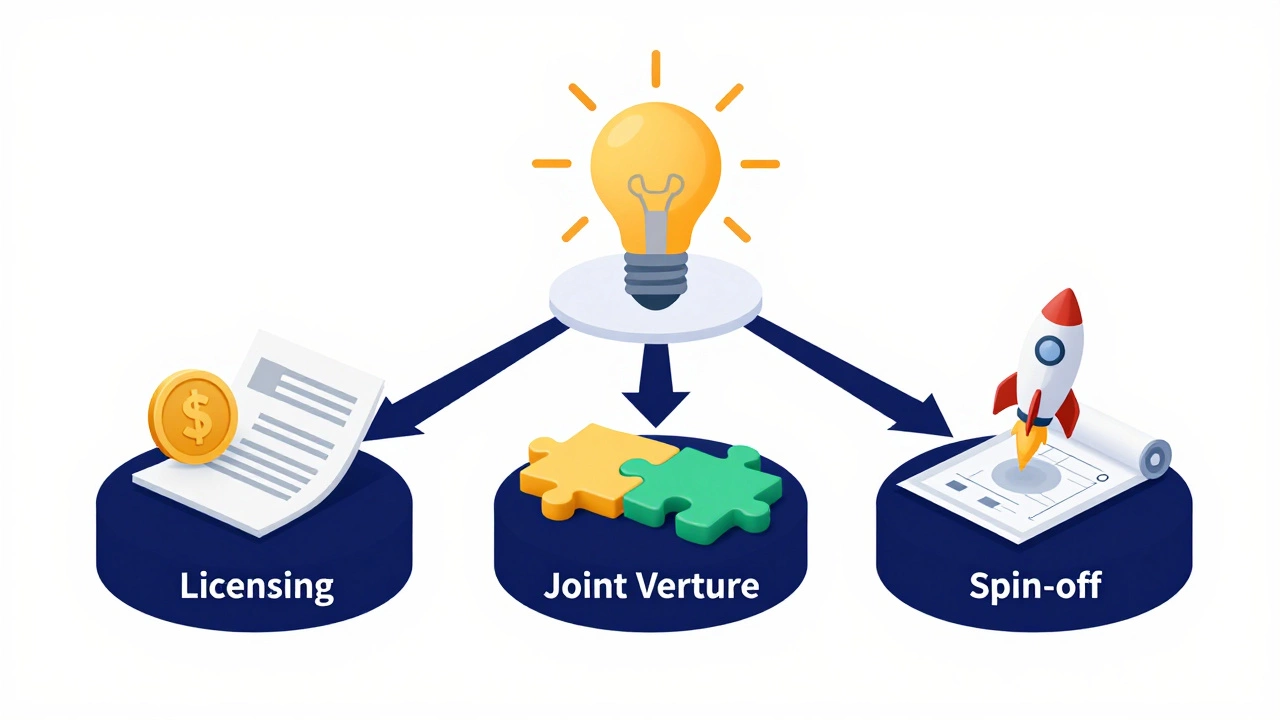
The Third Path: Spin-off Companies
When a discovery is truly disruptive, a licensing deal isn't enough, and a joint venture is too restrictive. The inventor decides to go all in and start a Spin-off Company. This is a brand new business entity created specifically to commercialize a piece of technology. This is the heart of Silicon Valley. Many of the most successful tech companies started as university spin-offs. The researchers often leave their academic posts or act as consultants, while venture capitalists provide the seed money to hire a professional CEO and a marketing team. Spin-offs are high-risk, high-reward. If the company fails, the original research might be lost or sold for pennies. But if it succeeds, the value created is astronomical compared to a small royalty check. The main hurdle here is the "valley of death"-that period where the tech is too advanced for a basic grant but not yet polished enough for a customer to buy it.| Feature | Licensing | Joint Venture | Spin-off |
|---|---|---|---|
| Risk Level | Low | Medium | High |
| Control | Low | Shared | High |
| Primary Reward | Royalties | Shared Profits | Equity/Ownership |
| Speed to Market | Fast | Moderate | Slow |
How to Choose the Right Method?
Picking the right transfer type isn't about the tech itself, but about the goals of the people involved. If you are a professor who wants to stay in the lab and keep teaching, licensing is your best bet. You get the money and the prestige without the stress of payroll. If you have a prototype that requires a massive industrial facility to scale-something you could never afford on your own-a Joint Venture with an established industry leader is the smartest move. You get their factories; they get your brainpower. But if you believe your invention will change an entire industry-like how CRISPR is changing gene editing-starting a spin-off is the only way to maintain the vision and capture the full value of the breakthrough.
Common Pitfalls in the Transfer Process
One of the biggest mistakes is ignoring the Intellectual Property (IP) audit. Many researchers start talking to companies before they have a filed patent. Once a discovery is made public in a journal or a presentation, it can become "prior art," making it nearly impossible to protect legally. This kills the value of the transfer instantly. Another issue is the "culture clash." Scientists speak the language of discovery, accuracy, and nuance. Business people speak the language of scalability, margins, and deadlines. A scientist might want to spend another two years perfecting a feature that a customer doesn't even care about. Successful transfers usually have a "translator"-a Technology Transfer Officer (TTO)-who can bridge this gap and keep both sides happy.The Role of Government and Policy
Governments often push these transfers through grants and laws. In the US, the Bayh-Dole Act of 1980 was a game-changer. It allowed universities to own the patents from federally funded research instead of the government owning them. This created a massive incentive for universities to actually move tech into the private sector because they could finally profit from it. Without these policies, we would see far fewer spin-offs. When the government provides a clear framework for who owns what, investors feel safer putting their money into risky new ventures. This creates a cycle where public money funds the basic science, and private money turns it into a product.What is the main difference between a license and a spin-off?
In licensing, the inventor sells the right to use the tech to an existing company for a fee. In a spin-off, the inventor (or a group) creates a brand new company from scratch to develop and sell the tech. Licensing is like renting out a room; a spin-off is like building a whole new hotel.
Can a technology be transferred more than once?
Yes. A university might spin off a company, and that company might later license a specific part of the technology to a larger partner. This is often called sub-licensing and is common in complex fields like biotechnology.
Why do some technology transfers fail?
Failure usually happens due to the "valley of death," where there is no funding to move from a prototype to a mass-produced product. Other reasons include poor IP protection, unrealistic pricing, or a lack of market demand for the invention.
What is a TTO?
A TTO is a Technology Transfer Office. These are specialized departments within universities or research institutes that help scientists find industry partners, file patents, and negotiate the legal terms of licenses or spin-offs.
Is a Joint Venture a permanent arrangement?
Usually, no. Joint Ventures are often project-based. Once the technology is developed and a product is launched, the partners may either dissolve the venture, or one partner may buy out the other's share.