Teamwork vs. Collaboration: What’s the Real Difference in Science?
 Jun, 9 2026
Teamwork vs. Collaboration Diagnostic Tool
Answer these three questions about your current project or task to identify the best approach.
Recommended Strategy:
You’ve probably heard these words thrown around in the same breath. "We need more teamwork," your manager says. "Let’s collaborate on this project," adds a colleague. They sound identical, right? Wrong. In fact, treating them as synonyms is one of the biggest mistakes leaders and researchers make today. Understanding the distinction isn’t just semantics; it’s the difference between a group that merely finishes tasks and a team that creates something entirely new.
Think about it. When you go to the gym with friends, you’re working together. You might spot each other on the bench press or share tips on form. That’s teamwork. But when a group of scientists from different countries combines their unique datasets to solve a climate model that no single person could crack alone? That’s collaboration, which is a process where individuals combine distinct expertise to create a unified outcome that exceeds the sum of individual efforts.
The Core Distinction: Coordination vs. Creation
At its heart, teamwork is about coordination. It’s efficient. It’s structured. Everyone knows their role, and the goal is to execute a known process effectively. If you’re assembling a car on a production line, you want teamwork. The steps are defined, the tools are standard, and the output is predictable. Teamwork relies on shared goals and clear division of labor.
Collaboration, on the other hand, is about creation. It’s messy. It’s iterative. It involves people with different skills, perspectives, and sometimes even conflicting ideas coming together to solve an undefined problem. In scientific research, which relies heavily on collaborative networks to validate findings and accelerate discovery, you don’t just follow a recipe. You experiment, fail, pivot, and synthesize new knowledge. Collaboration requires a high degree of trust and intellectual humility because no single person has all the answers.
| Aspect | Teamwork | Collaboration |
|---|---|---|
| Primary Goal | Efficiency and execution | Innovation and synthesis |
| Structure | Defined roles and hierarchy | Fluid roles and peer-to-peer interaction |
| Problem Type | Known solutions, complex processes | Unknown solutions, ambiguous problems |
| Interaction Style | Coordinated effort | Integrated effort |
| Risk Tolerance | Low (avoid errors) | High (encourage experimentation) |
Why This Matters in Scientific Research
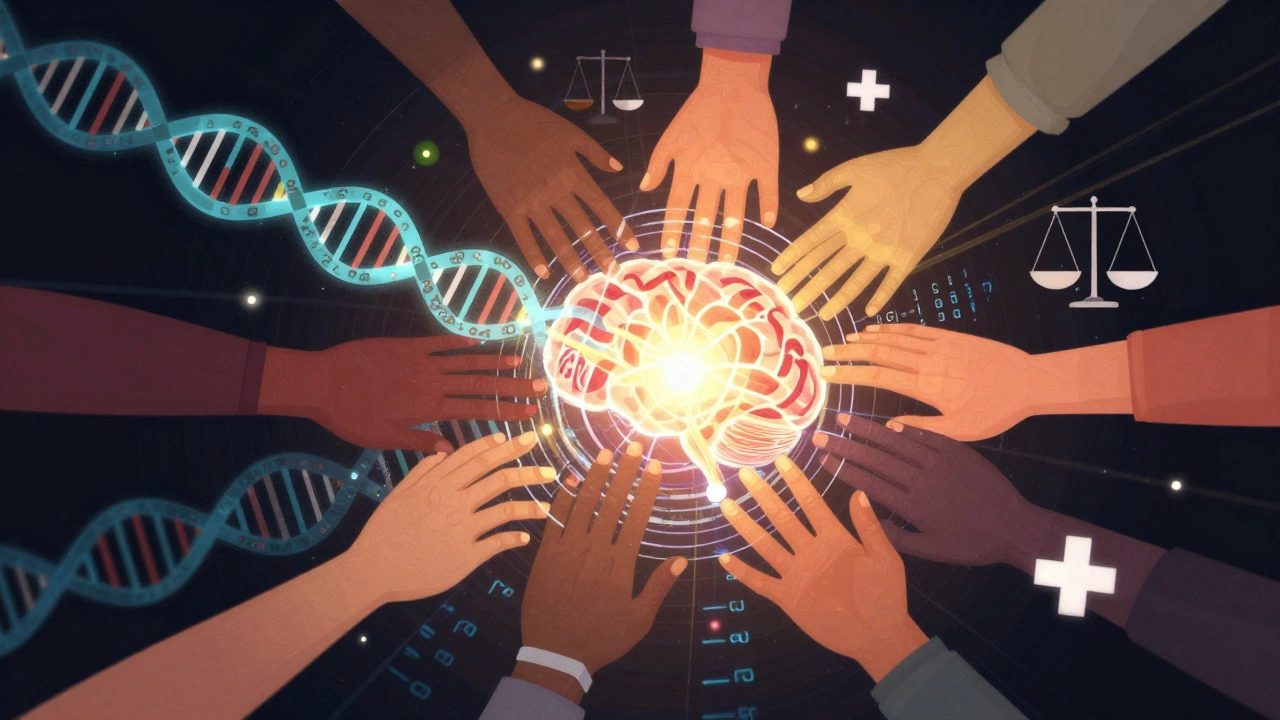
If you look at major breakthroughs in science, they rarely happen in isolation anymore. Take the Human Genome Project. It wasn’t just a team of biologists working in one lab. It was a global collaboration involving geneticists, computer scientists, ethicists, and funding bodies from multiple nations. Each group brought a completely different skill set. A biologist couldn’t have processed the data without the computer scientists. An ethicist couldn’t have framed the policy questions without understanding the biology. This is the power of collaboration: it bridges disciplinary silos.
However, within that massive collaboration, there were many instances of teamwork. The sequencing teams in specific labs had strict protocols. They needed to work together efficiently to produce accurate data. They didn’t need to reinvent the wheel every day; they needed to run the machine perfectly. Confusing these two modes leads to frustration. If you try to force a creative brainstorming session (collaboration) into a rigid checklist format (teamwork), you stifle innovation. Conversely, if you treat a routine data entry task like an open-ended creative workshop, you waste time and resources.
The Role of Trust and Communication
Both teamwork and collaboration require communication, but the nature of that communication differs significantly. In teamwork, communication is often transactional. "I’ve completed step A, passing it to you for step B." It’s clear, concise, and focused on status updates. Miscommunication here leads to delays or errors in execution.
In collaboration, communication is relational and exploratory. It involves asking questions like, "What do you think this anomaly means?" or "How does your perspective change our hypothesis?" This type of dialogue requires psychological safety. People need to feel safe enough to admit what they don’t know or to challenge a prevailing idea. Without this deep level of trust, collaboration devolves into superficial agreement, where everyone nods along but no real integration of ideas occurs.
Consider a medical research team developing a new drug. The chemists, pharmacologists, and clinical trial designers must collaborate early on. If the chemists design a molecule that is effective but impossible to manufacture at scale, the whole project fails. Early collaboration allows these diverse experts to integrate their constraints and opportunities. Later, during the manufacturing phase, the production staff needs strong teamwork to ensure consistent quality control. Both are essential, but they serve different purposes.

Common Pitfalls in Mixing the Two
One of the most common mistakes organizations make is labeling every group activity as "collaboration" when it’s actually just teamwork. This happens when managers use buzzwords without understanding the underlying dynamics. Calling a weekly status meeting a "collaborative forum" sets the wrong expectations. Employees expect deep discussion and creative input, but they receive a list of updates. This leads to disengagement.
Another pitfall is forcing collaboration on problems that only require teamwork. Not every problem needs a cross-functional brainstorming session. Sometimes, you just need a skilled technician to fix a broken instrument. Over-collaborating can lead to analysis paralysis, where too many opinions dilute decision-making. It’s important to diagnose the problem first. Is it a known issue with a known solution? Use teamwork. Is it a novel challenge requiring new insights? Use collaboration.
Also, beware of "fake collaboration," where decisions are made behind closed doors and then presented to the group for approval. This undermines trust and kills future willingness to engage in genuine collaborative efforts. True collaboration involves shared ownership of the outcome, not just consultation.
Building a Culture That Supports Both
To thrive, especially in fields like science and innovation, you need a culture that values both teamwork and collaboration. This means having the right tools and structures in place. For teamwork, you need clear processes, reliable project management software, and defined KPIs. For collaboration, you need spaces-both physical and digital-that encourage informal interaction and idea exchange. Think of platforms like Slack or specialized research networks where scientists can share preprints and discuss methodologies outside formal publications.
Leadership plays a crucial role here. Leaders must recognize when to switch modes. During a crisis, such as a public health emergency, rapid teamwork is critical to deploy vaccines or distribute resources. But to prevent the next pandemic, we need long-term collaboration across virology, sociology, and urban planning to understand disease vectors and social behaviors. Flexibility is key.
Finally, reward systems should reflect both modes. Teamwork is often rewarded through efficiency metrics and error rates. Collaboration should be rewarded through innovation metrics, such as new patents, published papers, or successful product launches that resulted from cross-disciplinary insights. Ignoring one side of this equation leads to imbalanced organizational health.
Can teamwork and collaboration happen at the same time?
Yes, absolutely. Most complex projects involve phases of both. For example, a software development team might collaborate intensely during the design phase to determine features and architecture. Once the plan is set, they switch to teamwork mode to write code, test, and debug according to the agreed-upon specifications. Recognizing when to shift between these modes is a key leadership skill.
Which is more important for scientific breakthroughs?
While teamwork ensures reliability and reproducibility, collaboration is generally more critical for breakthroughs. Breakthroughs often occur at the intersection of disciplines, requiring the synthesis of different viewpoints and expertise. However, without the teamwork to rigorously test and validate those new ideas, they remain unproven hypotheses.
How do I know if my team is collaborating or just working together?
Ask yourself if the final output is greater than the sum of individual contributions. If members simply did their part and handed it off, it’s teamwork. If members influenced each other’s thinking, adapted their approaches based on feedback, and created something none could have done alone, it’s collaboration. Look for evidence of integrated effort rather than just coordinated effort.
What tools facilitate better collaboration?
Tools that support asynchronous communication and shared document editing are vital. Platforms like Google Workspace, Microsoft Teams, or specialized research databases allow contributors to build on each other’s work in real-time. Additionally, visual collaboration tools like Miro or Mural help diverse groups map out complex ideas together, making abstract concepts tangible.
Is collaboration always better than teamwork?
No. Collaboration is resource-intensive and slower due to the need for negotiation and consensus-building. For routine tasks, strict deadlines, or highly standardized processes, teamwork is far more efficient and effective. Using collaboration when teamwork is needed leads to confusion and wasted effort. The best approach is to match the method to the task.