Population Health: What It Is, Why It Matters, and How Science Is Changing It
When we talk about population health, the study of health outcomes and patterns across entire groups of people, not just individuals. It’s not about treating one person’s diabetes—it’s about understanding why whole neighborhoods have higher rates of it, and what can be done to stop it before it starts. This isn’t just a medical idea. It’s a social one. It asks: Why do some communities live longer? Why do others face more asthma, heart disease, or mental health struggles? The answers aren’t in pill bottles. They’re in clean water, safe housing, good jobs, and access to healthy food.
Social determinants of health, the conditions in which people are born, grow, live, work, and age. These include things like income, education, neighborhood safety, and whether you can afford fresh vegetables or just cheap processed snacks. Health equity, the principle that everyone should have a fair chance to be healthy, no matter their background. These aren’t buzzwords—they’re the core of what makes population health work. In India, where rural clinics are miles away and urban slums lack sewage systems, these factors aren’t abstract. They’re daily realities. And when you connect those dots, you start seeing why a single hospital can’t fix a broken system. You need policy changes, community programs, better data, and local leaders who understand the problem from the inside.
That’s where science steps in. Researchers are mapping disease hotspots using satellite data and mobile surveys. They’re tracking how air pollution in Delhi affects children’s lung development. They’re testing whether giving free milk to school kids improves long-term growth. They’re asking: Who’s being left out? And how do we fix it? The posts you’ll find here don’t just describe problems—they show real projects, from village health workers using simple apps to track malnutrition, to scientists designing low-cost water filters for villages without piped water.
Population health isn’t about grand gestures. It’s about small, smart changes that add up. A clean stove. A bus route that gets workers to clinics. A school lunch that includes protein. These aren’t fancy tech solutions. They’re human ones. And they’re working—right now—in towns and villages across India. What you’ll read here isn’t theory. It’s what’s happening on the ground, in real time, with real results.
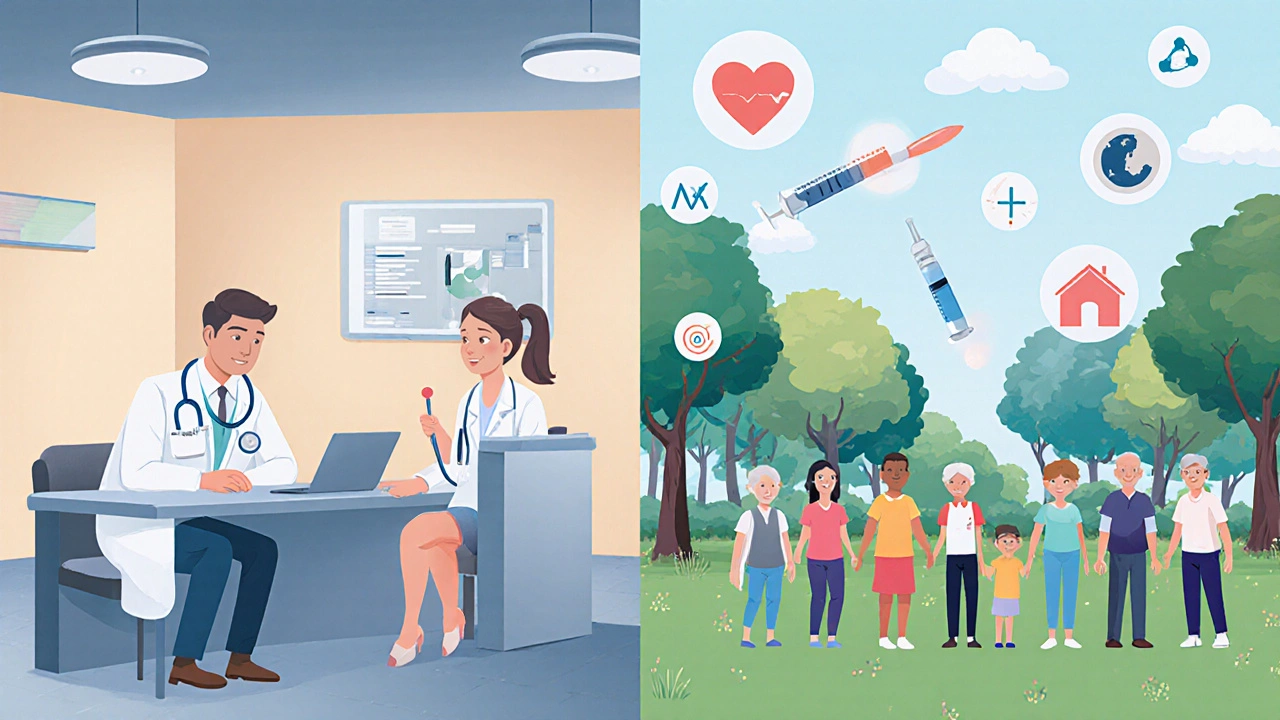
Public Health Approach to Healthcare Explained
Oct, 24 2025
Discover how the public health approach shifts focus from treating illness to preventing disease, promoting equity, and improving community health outcomes.
Read Article→