Python vs Java for Beginners: Which to Learn First?
 Sep, 1 2026
Python vs Java Career Path Finder
Answer these questions to get a personalized recommendation for your first programming language.
Your Recommended Starting Language
Imagine you have two tools in your garage. One is a Swiss Army knife that fits in your pocket and opens cans, cuts rope, and unscrews bolts instantly. The other is a heavy-duty industrial drill press that requires setup time but can bore precise holes through steel all day long. This is essentially the Python versus Java debate. If you are looking to break into tech, specifically aiming for data science, the answer isn't just about which language is "better." It's about which tool gets you from zero to employed fastest.
Most beginners get stuck in analysis paralysis. They spend weeks watching YouTube videos comparing syntax instead of writing code. Here is the hard truth: if your goal is data science, machine learning, or quick automation scripts, start with Python. If you want to build large-scale enterprise banking systems or Android apps (though Kotlin is taking over there), start with Java. But let's look at why this distinction matters so much for your career trajectory in 2026.
The Learning Curve Reality Check
When you write your first program in Java, you often end up typing ten lines of boilerplate code just to print "Hello World" on the screen. You need to declare a class, define a main method, and understand static contexts before seeing any output. It feels like filling out tax forms before you're allowed to buy groceries.
Python, on the other hand, lets you type `print("Hello World")` and hit enter. That’s it. The barrier to entry is significantly lower. For a beginner, this immediate feedback loop is crucial. It keeps dopamine levels high and frustration low. You aren't fighting the compiler; you're solving problems. According to recent developer surveys by Stack Overflow, Python consistently ranks as one of the most popular languages for beginners precisely because of its readability. It reads almost like English pseudocode. If you struggle with logic, Java’s strict structure might help you learn discipline. If you struggle with motivation, Python’s simplicity will keep you going.
Why Data Science Chose Python
You mentioned an interest in data science. This field has overwhelmingly adopted Python as its lingua franca. Why? Because data scientists don't just write code; they explore data. They need libraries that handle complex math without making them reinvent the wheel.
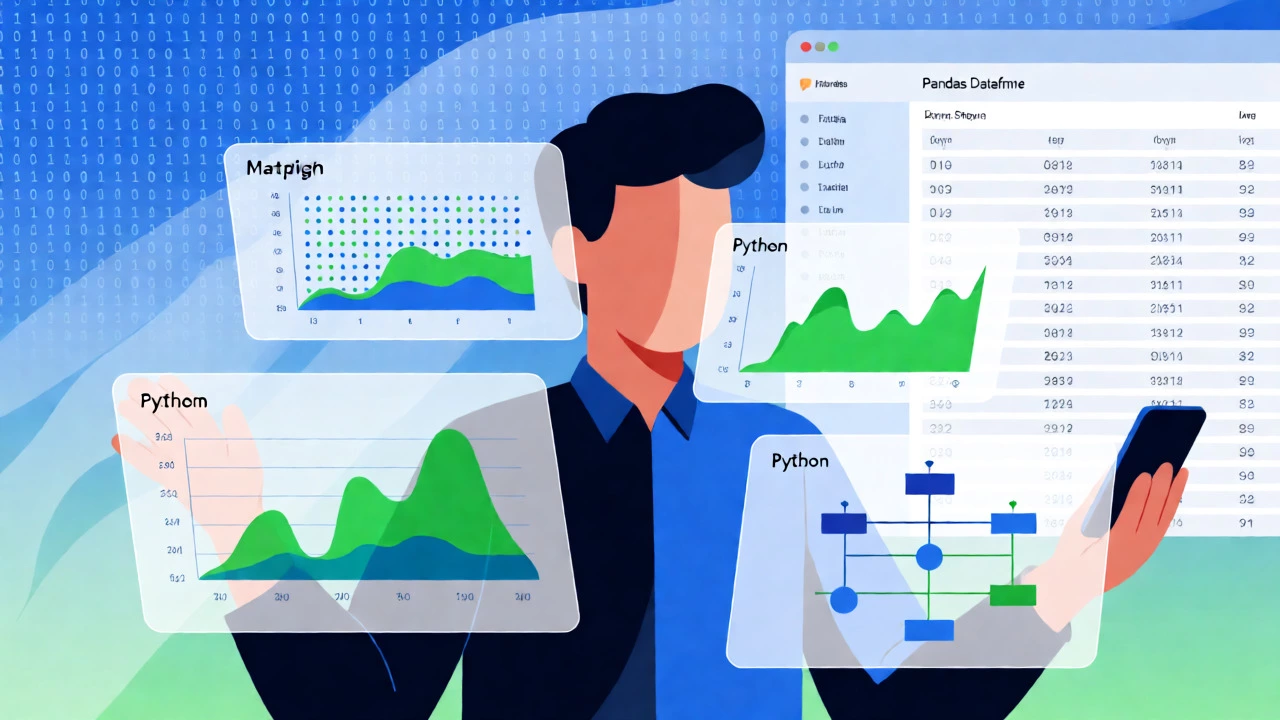
Consider the ecosystem. In Python, you have Pandas for data manipulation and NumPy for numerical computing. These tools allow you to load a massive CSV file, clean missing values, and plot a histogram in fewer than twenty lines of code. Try doing that in Java without pulling in several heavy dependencies and writing verbose object-oriented wrappers. It’s possible, but it’s painful.
| Feature | Python | Java |
|---|---|---|
| Data Analysis Libraries | Pandas, NumPy, SciPy | Weka, Apache Spark (JVM) |
| Machine Learning Frameworks | Scikit-learn, TensorFlow, PyTorch | DL4J, Weka |
| Visualization | Matplotlib, Seaborn, Plotly | JFreeChart (less integrated) |
| Setup Time | Minutes (pip install) | Hours (Maven/Gradle config) |
While Java is used in big data environments via Apache Spark, the actual coding interface for Spark is often accessed through Python (PySpark). This means even if the backend runs on Java/JVM, the data scientist writes Python. Learning Python gives you direct access to the tools you’ll use daily. Learning Java gives you access to the infrastructure behind those tools, which is valuable but less critical for an entry-level analyst role.
Job Market Signals in 2026
Let’s talk money and opportunities. If you scan job boards for "Junior Data Analyst," you will see Python listed in nearly every posting. Excel and SQL are also required, but Python is the differentiator that allows you to automate reports and build predictive models. Java jobs exist, but they are typically labeled "Software Engineer" or "Backend Developer." These roles require a deeper understanding of computer science fundamentals like memory management, multithreading, and design patterns.
Are these paths mutually exclusive? No. Many senior data engineers know both. They use Python for prototyping and exploration, then rewrite production pipelines in Java or Scala for performance. However, starting with Python doesn't lock you out of engineering roles later. Starting with Java might make the transition to data science feel clunky initially because you’re used to rigid structures rather than flexible scripting.
The Case for Starting with Java
So, when should you ignore the Python hype and pick Java? There are specific scenarios where Java is the superior teacher:
- You want rigorous CS foundations: Java forces you to think about types, objects, and inheritance from day one. This mental model transfers well to C++, C#, and other statically typed languages.
- You aim for enterprise software: Banks, insurance companies, and large retailers run on Java. If you want stability and work in traditional corporate IT, Java is safer.
- Performance matters critically: While Python is fast enough for most tasks, compiled Java generally executes faster for CPU-intensive loops. If you are building real-time trading algorithms or high-frequency transaction systems, Java’s speed advantage becomes relevant.
However, note that modern Python implementations (like PyPy) and optimized libraries (using C/C++ under the hood) have narrowed the performance gap significantly. For 95% of beginner projects, Python’s execution speed is irrelevant compared to developer productivity.

A Practical Roadmap for Your First Year
If you decide to go with Python for data science, here is how to structure your learning so you don’t drown in tutorials:
- Weeks 1-4: Syntax Basics. Learn variables, loops, functions, and lists. Don’t worry about classes yet. Write small scripts that rename files or scrape simple websites.
- Weeks 5-8: Data Manipulation. Dive into Pandas. Load datasets from Kaggle. Practice filtering rows, grouping data, and handling null values. This is 70% of a data scientist’s job.
- Weeks 9-12: Visualization & Basic ML. Use Matplotlib to chart your findings. Then try Scikit-learn to build a simple linear regression model predicting house prices.
- Month 4+: Projects. Stop following tutorials. Build something unique. Analyze your own Spotify listening history or predict local weather trends.
If you choose Java, expect a longer ramp-up. Spend the first month mastering Object-Oriented Programming concepts. Then move to Spring Boot for web applications. You won’t touch data science libraries until you are comfortable with JVM architecture.
Common Pitfalls to Avoid
One major mistake beginners make is trying to learn both simultaneously. You cannot effectively learn two different paradigms at once. You will confuse Java’s semicolons with Python’s indentation and mix up their respective standard libraries. Pick one. Stick with it for six months. Once you are comfortable, adding the second language is easy because you already understand programming logic.
Another trap is ignoring SQL. Whether you choose Python or Java, you must learn SQL. Data lives in databases. Python connects to databases, but SQL queries the data. Mastering SQL alongside Python makes you infinitely more hireable than knowing Python alone.
Is Python harder to debug than Java?
It depends on the error. Python errors are often runtime errors because it is dynamically typed. You might not realize a variable is a string instead of a number until the code crashes during execution. Java catches many of these mistakes at compile time, forcing you to fix them before running the code. However, Python’s tracebacks are usually clearer and shorter, making debugging easier for simple scripts.
Can I switch from Python to Java later?
Yes, absolutely. Many developers start with Python for ease of use and later learn Java for system-level programming. The core concepts-loops, conditionals, functions-are universal. The hardest part is adjusting to Java’s verbosity and strict typing rules. Having Python experience actually helps you appreciate Java’s structure when you eventually need it for large-scale applications.
Does Java have good data science libraries?
Java has libraries like DL4J (DeepLearning4J) and Weka, but they are not as widely adopted or community-supported as Python’s Pandas, Scikit-learn, or TensorFlow. Most new research papers release code in Python first. If you want to stay on the cutting edge of AI and ML, Python is the default choice. Java is mostly used for deploying models built elsewhere or processing massive streams of data.
Which language pays better for beginners?
In the short term, Java developers often command slightly higher starting salaries because the skill set is perceived as more rigorous and enterprise-ready. However, Python skills are in such high demand for data roles that the salary gap is closing rapidly. By mid-career, specialization matters more than the initial language. A skilled Python data engineer often earns as much as a Java backend engineer.
Do I need to know C++ to learn Python or Java?
No. Neither Python nor Java requires prior knowledge of C++. Both languages abstract away manual memory management, which is the hardest part of C++. You can start directly with Python or Java as your first programming language. In fact, starting with Python is recommended for absolute beginners because it handles memory allocation automatically, letting you focus on logic.