Is AI an Example of Biotechnology? Clarifying the Difference and Overlap
 Nov, 17 2025
People often mix up AI and biotechnology because both sound futuristic and show up in headlines about breakthroughs in health, farming, and labs. But asking if AI is an example of biotechnology is like asking if a hammer is a type of wood. One tool helps build the other - they’re not the same thing.
What Is Biotechnology?
Biotechnology is the use of living systems - cells, DNA, enzymes, bacteria - to make or modify products. It’s not just about test tubes and petri dishes anymore. Today, it includes gene editing with CRISPR, lab-grown meat, bioengineered insulin, and crops that resist pests without pesticides. The core of biotech is biology in action: taking something alive and changing it to serve a human need.
For example, companies like Moderna used biotech to create mRNA vaccines by programming human cells to produce spike proteins that train the immune system. That’s biology working at the molecular level. Another example is engineered bacteria that clean oil spills by breaking down hydrocarbons. These are biological processes, controlled and optimized by science.
What Is Artificial Intelligence?
AI is software that learns from data to make decisions, recognize patterns, or predict outcomes. It doesn’t need cells or DNA. It runs on processors, uses algorithms, and depends on numbers - not living tissue. When you use a voice assistant, get a recommendation on Netflix, or see a self-driving car avoid a pedestrian, that’s AI at work.
AI doesn’t grow, breathe, or reproduce. It doesn’t respond to antibiotics. It can’t evolve through natural selection. It’s a mathematical model trained on massive datasets. Even the most advanced AI models, like those used in drug discovery, are still just code running on servers. They simulate, calculate, and suggest - they don’t perform biological functions.
Where AI and Biotech Overlap
Here’s where confusion starts: AI is being used in biotechnology. But that doesn’t make AI a form of biotech. Think of it like using a calculator to do long division. The calculator isn’t math - it just helps you do math faster.
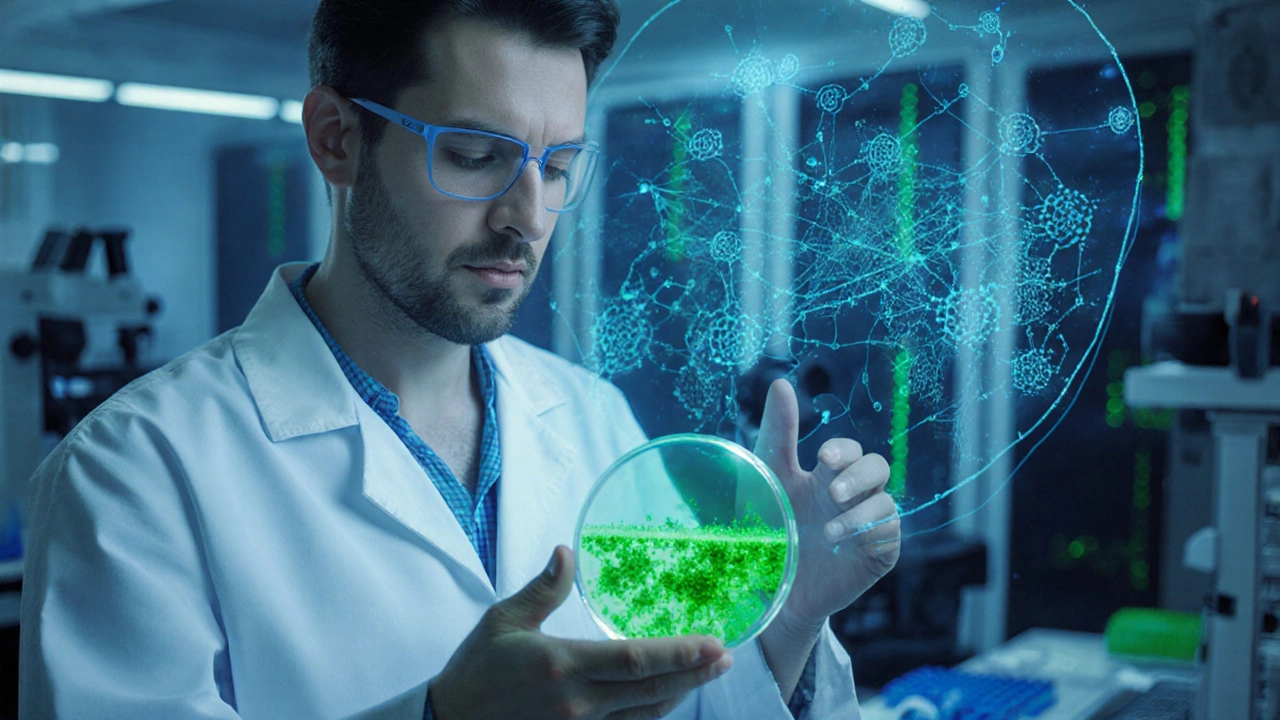
Today, AI helps biotech researchers analyze DNA sequences thousands of times faster than humans. DeepMind’s AlphaFold can predict how proteins fold - a problem that took decades to solve manually. That’s AI supporting biotech, not replacing it. Similarly, AI models scan thousands of chemical compounds to find ones that might treat cancer. But the actual drug? That’s still made in a lab using biological processes.
Another example: synthetic biology startups use AI to design new genetic circuits. They feed AI data on how genes interact, and the AI suggests combinations that might make bacteria produce biofuels. The AI doesn’t create the bacteria - it just designs the blueprint. The living organism still has to be built, grown, and tested in real biological systems.
Why the Confusion?
The confusion comes from language. When news outlets say “AI discovered a new cancer treatment,” they’re simplifying. What really happened is: AI analyzed data and pointed scientists toward a molecule that might work. The molecule itself? Still a chemical compound. The biological test? Done in a petri dish. The AI didn’t touch the sample.
Also, both fields are booming. Biotech is making personalized medicine possible. AI is making drug discovery faster. They’re often discussed together in the same article, on the same panel, or in the same startup pitch deck. That proximity makes people assume they’re the same category.
It’s like saying “electricity is a type of engine” because electric cars use both. They’re deeply connected, but fundamentally different.
Key Differences at a Glance
| Aspect | Artificial Intelligence | Biotechnology |
|---|---|---|
| Base Material | Data, code, silicon chips | Cells, DNA, proteins, living organisms |
| Primary Function | Pattern recognition, prediction, automation | Modifying or using biological systems |
| Requires Living Tissue? | No | Yes |
| Can It Reproduce? | No (unless cloned as code) | Yes (cells divide, organisms breed) |
| Example Application | Chatbots, facial recognition, recommendation engines | CRISPR gene therapy, bioengineered insulin, GMO crops |
Can AI Ever Become Biotechnology?
Not unless it becomes alive. Right now, AI has no metabolism, no cells, no genetic code. Even if you embed AI into a robot that can grow tissue or edit genes, the AI is still the controller - not the biological component.
Some researchers are exploring “biological AI” - systems made from living neurons grown in labs that learn like neural networks. These are called brain organoids or neuromorphic biocomputers. But even these are hybrids: the learning part is biological, the structure is designed by engineers. They’re not pure AI, and they’re not pure biotech - they’re a new category altogether.
For now, AI remains a tool. Biotech remains a science. One helps the other. Neither becomes the other.
Real-World Impact: Why This Matters
Mixing up AI and biotech can lead to bad policy, misallocated funding, or public misunderstanding. If regulators treat AI-driven drug discovery like a biological product, they might impose unnecessary safety rules on the software. If scientists assume AI can replace lab work, they might skip critical validation steps.
Take the case of a startup claiming its AI “created a new biotech therapy.” Investors might rush in, thinking they’re funding a biological breakthrough. But if the AI only suggested a molecule - and no one’s tested it in cells yet - the company is years away from real results. That’s misleading.
On the flip side, ignoring AI’s role in biotech is just as dangerous. Companies using AI to predict protein structures or optimize fermentation yields are already cutting R&D time by 60%. That’s not hype - it’s measurable progress.
The smart approach? Use AI to accelerate biotech. Don’t call it biotech.
What Should You Call It?
If you’re using AI to analyze biological data, you’re doing AI-assisted biotechnology. If you’re building living systems that learn, you’re in synthetic biology. If you’re writing code that predicts gene expression, you’re in computational biology.
These are all valid fields - just not the same thing. Precision in language matters, especially when lives and billions of dollars are on the line.
Is AI a type of biotechnology?
No. AI is software that processes data and makes decisions. Biotechnology uses living organisms or biological systems to solve problems. AI can help biotech - like a calculator helps math - but it’s not part of the biological process itself.
Can AI replace biotech labs?
Not yet. AI can predict which molecules might work or speed up gene analysis, but actual lab work - growing cells, testing toxicity, running clinical trials - still requires physical biological systems. AI is a powerful assistant, not a substitute.
Are AI-driven drug discoveries considered biotech products?
The drug itself is a biotech product if it’s made from biological material. The AI that found it is a tool. Regulatory agencies like the FDA review the drug’s safety, not the AI model that suggested it - unless the AI is part of the manufacturing process.
Does AI count as synthetic biology?
No. Synthetic biology involves designing and building new biological parts or systems - like inserting genes into bacteria. AI might help design those genes, but the act of building and testing them is synthetic biology. The AI is the designer, not the builder.
What’s the difference between bioinformatics and biotechnology?
Bioinformatics is the use of computers to analyze biological data - like DNA sequences. It’s a subset of computational biology. Biotechnology uses biological systems to create products. Bioinformatics supports biotech, but it’s not biotech unless it’s directly changing or using living organisms.
Final Takeaway
AI isn’t biotechnology. But it’s becoming its most powerful ally. The real innovation isn’t in calling AI biotech - it’s in using AI to unlock what biology can do. The future belongs to scientists who understand both: the code and the cell.