Is 1 Hour in Space Equal to 7 Years on Earth?
 Jan, 13 2026
Time Dilation Calculator
Ever heard that one hour in space equals seven years on Earth? It sounds like something out of a sci-fi movie - maybe Interstellar or a YouTube video with dramatic music and glowing stars. But is it true? The short answer: no. Not even close. But the reason why people think it is? That’s where things get real interesting.
Where Does This Idea Come From?
This myth usually pops up after someone watches Interstellar, where astronauts spend a few hours on a planet near a black hole and return to find decades have passed on Earth. That scene isn’t made up - it’s based on Einstein’s theory of general relativity. Time really does slow down near massive objects like black holes. But the movie took creative liberty. The planet in Interstellar orbited Gargantua, a supermassive black hole with gravity so extreme that one hour there equaled seven years outside. That’s not something you’d find near Mars, the ISS, or even near any known star.
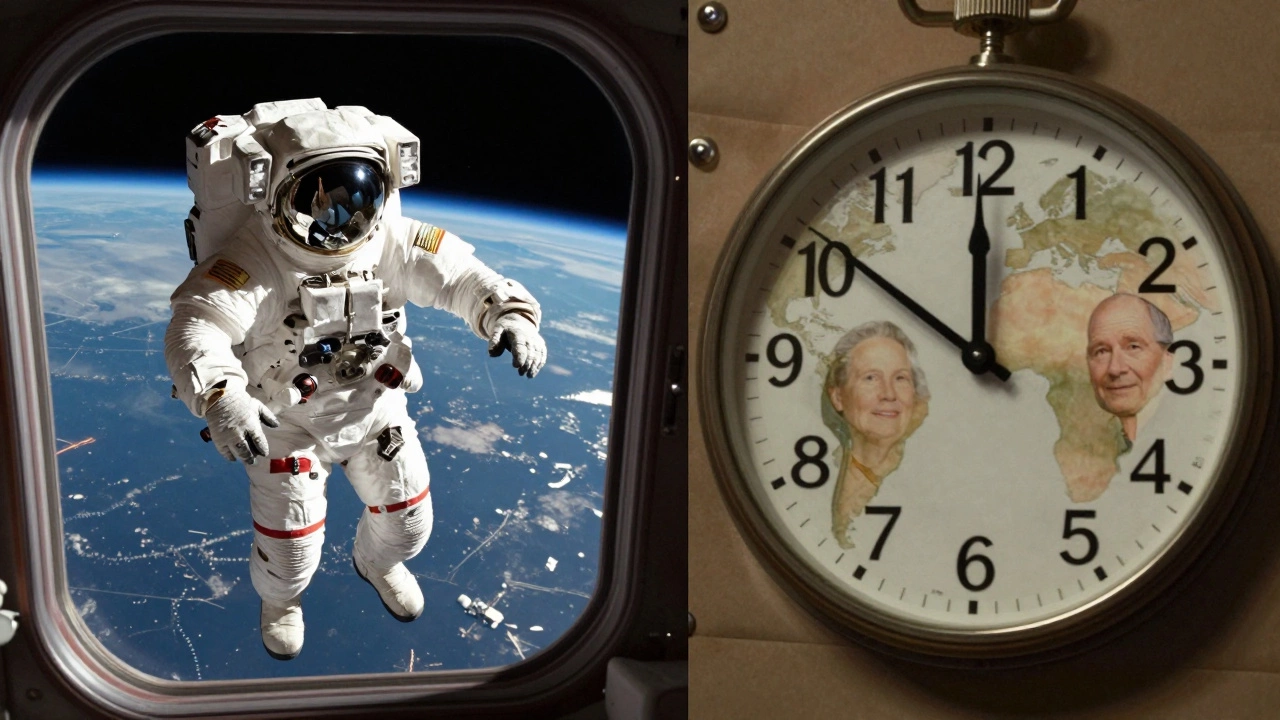
The truth is, time dilation - the difference in how fast time passes for different observers - is real. But the effect is tiny unless you’re dealing with extreme gravity or speeds close to the speed of light. For astronauts on the International Space Station, orbiting at 28,000 km/h, time actually moves slower than on Earth - but only by about 0.007 seconds after six months. That’s less than a blink. Not enough to notice, let alone turn an hour into seven years.
How Time Dilation Actually Works
Albert Einstein showed us two things: time isn’t fixed, and gravity bends it. The stronger the gravity, the slower time ticks. The faster you move, the slower time ticks too. These aren’t theories - they’re proven. GPS satellites have to account for both effects every day. If they didn’t, your phone’s map would be off by over 10 kilometers within a single day.
On Earth, gravity pulls us down with a force we barely notice. But near a black hole? Gravity is so intense it warps space-time like a bowling ball on a trampoline. Clocks there would crawl. But black holes aren’t scattered around like parking meters. They’re rare, distant, and deadly. The closest known one, Gaia BH1, is over 1,500 light-years away. You can’t just fly there for a quick coffee and come back to find your grandkids retired.
Even if you could get close to a black hole, surviving the tidal forces - the difference in gravity between your head and feet - would be impossible. You’d be stretched into a strand of atoms before you even got close to the time dilation sweet spot. So while the science behind the idea is solid, the scenario isn’t practical.
Real-Time Differences in Space Missions
Let’s look at actual space travelers. Scott Kelly spent 340 days on the ISS. His twin brother Mark stayed on Earth. After Scott returned, scientists measured a difference in their biological aging. Scott was about 5 milliseconds younger than Mark. That’s five-thousandths of a second. Not enough to matter in human terms.
Even the Apollo astronauts, who traveled farther from Earth than anyone else, experienced time dilation of less than a millisecond. No one came back older or younger in any noticeable way. The human body doesn’t age differently because of space travel - at least not yet.
Future missions to Mars might change that. A round trip to Mars could take two to three years. At the speeds we can currently achieve, the time dilation effect would still be under a second. But if we ever build ships that travel at 90% the speed of light? Then things change. At that speed, one year for the crew could equal over two years on Earth. But we’re talking about technology that doesn’t exist yet - and energy requirements that dwarf the entire world’s power output.
Why the Myth Persists
Why do so many people believe one hour equals seven years in space? Because it sounds cool. It’s a simple, dramatic way to make relativity feel tangible. It’s easier to remember than equations like t' = t√(1 - v²/c²). Pop culture loves big numbers and emotional stakes. A movie needs tension. A YouTube video needs clicks. So they exaggerate.
Also, people confuse time dilation with something else: communication delay. When NASA sends a signal to Mars, it takes between 4 and 24 minutes to get there. That’s not time slowing down - that’s just distance. If you video call someone on Mars, you’ll wait minutes for them to respond. But they’re not aging slower. They’re just far away.
Another source of confusion? The word “time.” People think of time as a universal clock ticking the same for everyone. But Einstein proved that’s not true. Time is personal. It depends on your speed and gravity. That’s hard to wrap your head around. So instead, people invent shortcuts - like “an hour in space = seven years on Earth.” It’s wrong, but it feels right.
What Actually Happens to Astronauts in Space?
If time dilation isn’t the issue, what is? Astronauts face real biological challenges: muscle loss, bone density drop, radiation exposure, fluid shifts, and disrupted sleep cycles. These are the things that affect their health - not aging faster or slower. A year in space can weaken bones as much as 10 years of aging on Earth. But that’s not time dilation. That’s microgravity.
Studies from NASA’s Twins Study and the European Space Agency’s long-duration missions show that astronauts return with changes in gene expression, immune system function, and even gut bacteria. None of these are caused by relativistic time effects. They’re caused by living in a machine, far from Earth’s natural environment.
So if you’re worried about aging in space, focus on radiation shielding, exercise routines, and nutrition - not the myth that you’ll skip ahead in years.
Can We Ever Experience Extreme Time Dilation?
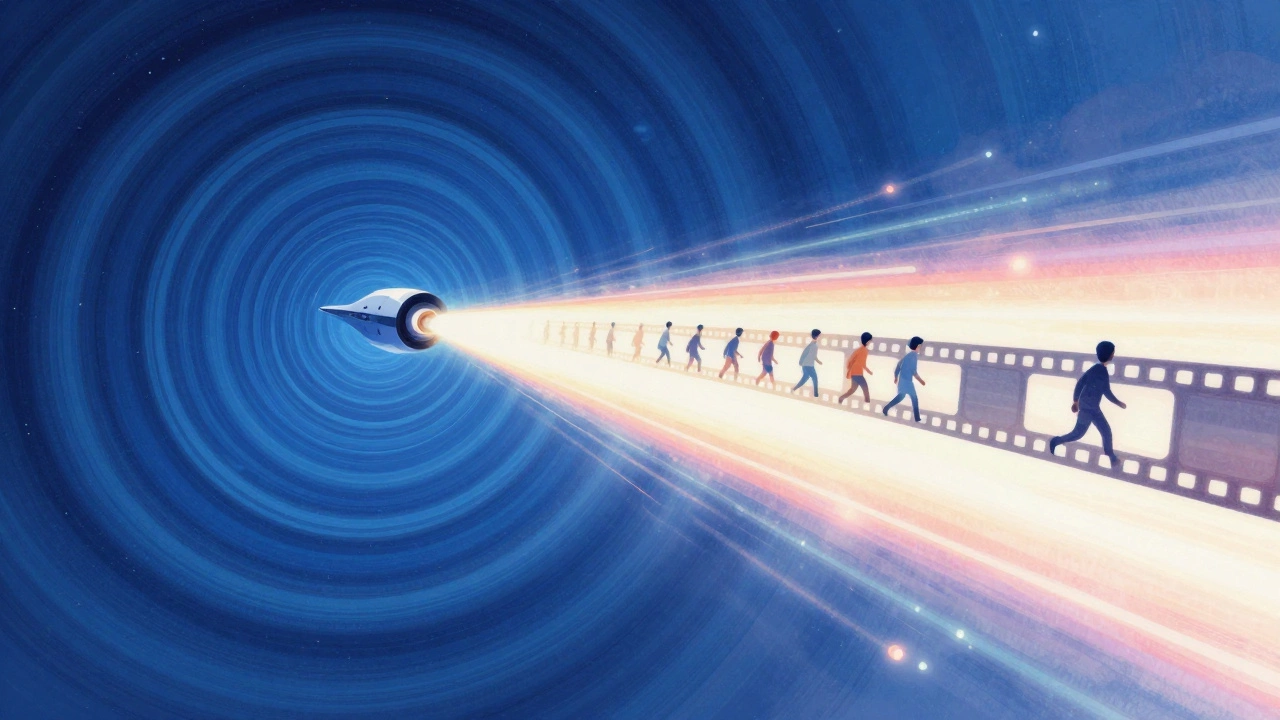
Technically, yes - but not with current technology. To get one hour to equal seven years (61,320 hours), you’d need to travel at 99.999999% the speed of light. Or orbit a black hole with a mass over a billion times that of the Sun. Neither is feasible.
Even if we could, the energy needed to accelerate a ship to that speed would require more fuel than exists on Earth. The radiation from interstellar dust at those speeds would vaporize the ship. And the black hole? You’d need to survive its event horizon, which no known material can do.
So while the physics allows it, the engineering and survival challenges make it science fiction for the foreseeable future. We’re talking centuries, if not millennia, away from anything like that.
What Should You Believe?
You don’t need to believe in time dilation to understand it. It’s real. It’s measured. It’s used in everyday technology. But the idea that astronauts age years while spending hours in orbit? That’s a myth dressed up as science. It’s not helpful. It’s misleading. And it distracts from the real wonders of space travel.
What’s more amazing? That time slows down near a black hole - yes. Or that humans can live for months in a metal tube floating in vacuum, orbiting Earth at 17,500 miles per hour, and still come back alive? That’s the real miracle.
So next time someone says, “One hour in space equals seven years on Earth,” you can say: “That’s only true if you’re hanging out near a black hole - which, by the way, would kill you in a fraction of a second.”
Is time dilation real, or just a movie trick?
Time dilation is real and has been proven by experiments since the 1970s. Atomic clocks flown on airplanes, GPS satellites, and particle accelerators all confirm it. The effect is tiny under normal conditions but becomes extreme near black holes or at near-light speeds. Movies like Interstellar use real physics - but stretch it for drama.
Do astronauts age slower in space?
Technically, yes - but only by milliseconds. Astronauts on the ISS age slower than people on Earth due to their speed, but the difference is so small it’s meaningless for human life. After six months in space, an astronaut is about 0.007 seconds younger. That’s less than the blink of an eye. No one comes back looking younger.
Can you travel to the future using time dilation?
In theory, yes. If you could travel close to the speed of light, you could return to Earth thousands of years in the future while aging only a few years. But we don’t have the technology to do this. The energy, materials, and life support needed are far beyond what we can build today. It’s not impossible - just not possible now.
Why doesn’t GPS use time dilation to send messages faster?
GPS doesn’t use time dilation to send messages faster - it uses it to correct timing errors. Satellites move fast and experience weaker gravity than Earth’s surface. Their clocks run faster by about 38 microseconds per day. Without correcting for this, GPS locations would drift by over 10 km daily. The system adjusts for relativity, but it doesn’t change how fast signals travel. Light speed is still the limit.
Is the 1-hour-to-7-years rule true for any planet?
No. No known planet, moon, or star causes time to slow down that much. Even Jupiter, the most massive planet in our solar system, only causes a time dilation of about 2 microseconds per year - far less than a second. The only place where such extreme dilation could happen is near a black hole - and even then, surviving there is impossible.