How Will the World Be in 3000? Climate, Cities, and Survival in a Changed Earth
 Mar, 4 2026
By the year 3000, the world won’t look like anything from history books. Not because of flying cars or robot butlers, but because of what we did - or didn’t do - to the planet in the next few centuries. The climate crisis isn’t a distant threat. It’s a slow-motion rewrite of Earth’s rules. And by 3000, those rules will have already reshaped every part of human life.
Earth’s Temperature Has Already Broken the 4°C Barrier
By 2150, global average temperatures crossed 4°C above pre-industrial levels. That wasn’t a prediction. That was the result of decades of delayed action. Ice sheets vanished. Sea levels rose over 7 meters. Coastal cities like Miami, Shanghai, and Mumbai vanished beneath the waves. Millions moved inland. The planet’s heat didn’t just make summers unbearable - it rewrote weather patterns forever. Monsoons became erratic. Droughts lasted years. Rainfall patterns shifted so drastically that farming in the American Midwest and the Sahel became nearly impossible.
By 3000, the average global temperature hovered between 4.5°C and 5°C. The Arctic was ice-free year-round. The Amazon had turned into a dry savanna. The oceans were 20% more acidic than in 2020. Coral reefs? Gone. Marine life had collapsed. Fish stocks were 90% lower than in 2000. The only thriving fisheries were in deep, cold waters near the poles - and even those were managed by AI-driven aquaculture systems.
Cities Are Underground or Floating
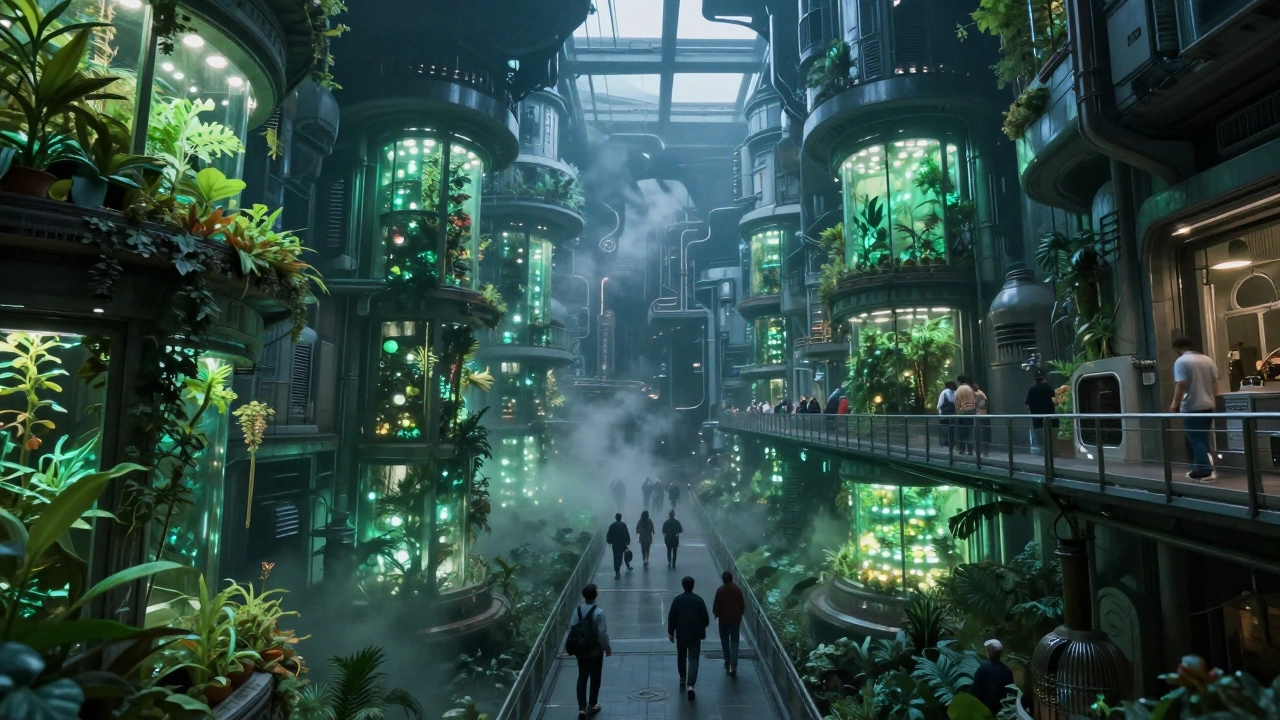
Surface cities? Mostly abandoned. Too hot. Too flooded. Too unstable. By 2200, the last major surface metropolis, New York, was officially decommissioned. Its population moved underground. Now, in 3000, the largest human settlements are subterranean megacities - carved into bedrock or built inside sealed geodesic domes. These aren’t dystopian tunnels. They’re climate-controlled, solar-powered, and self-sustaining. Air is filtered through engineered algae. Water is recycled 17 times before being reused. Food is grown in vertical farms using LED-lit hydroponics.
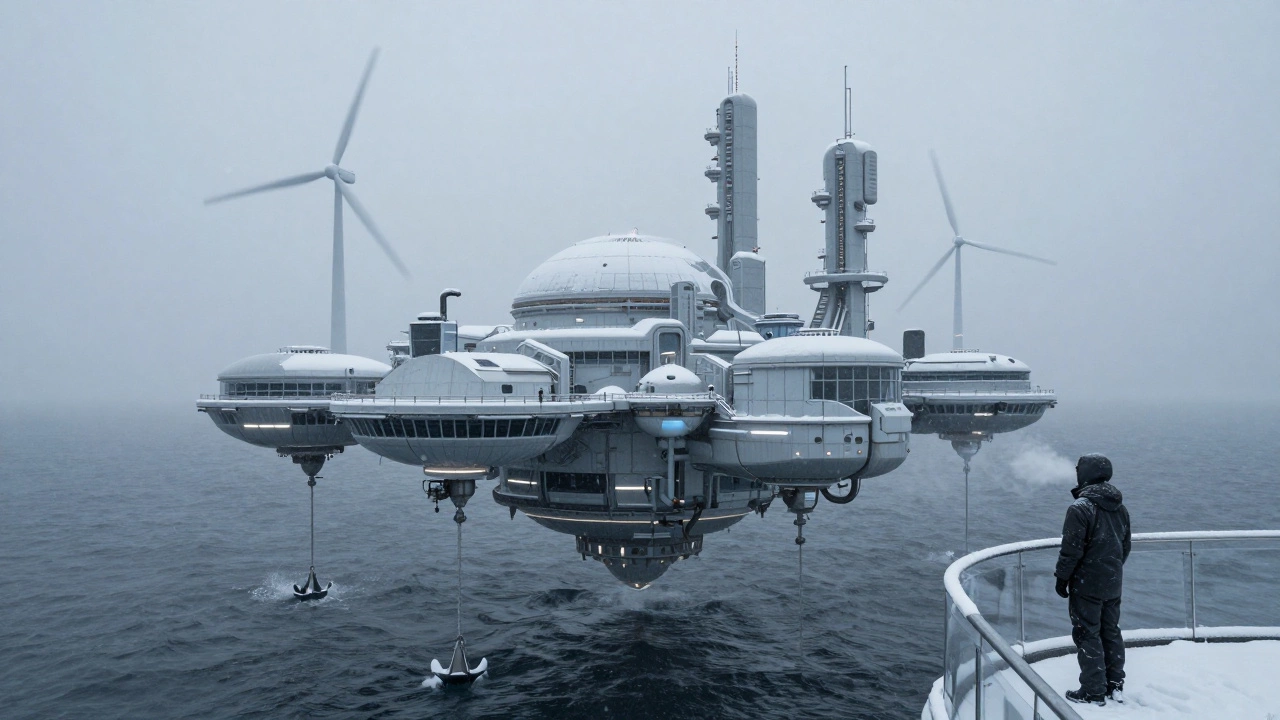
Some human populations live on floating platforms anchored in the high latitudes. The Arctic Circle now hosts the largest floating city: Neoterra is a self-sustaining floating city built on modular, buoyant platforms in the North Atlantic. It’s home to 8 million people, powered entirely by offshore wind and tidal energy. It’s also the last place on Earth where natural snowfall still occurs.
Human Biology Has Changed - Slowly
Genetic adaptation didn’t happen overnight. But over 1,000 years, human populations in equatorial regions developed thicker skin, higher sweat efficiency, and altered circadian rhythms to cope with constant heat. Babies born in 3000 in regions like the Sahel or Southeast Asia have slightly higher body mass indices and lower surface-area-to-volume ratios - evolutionary tweaks to reduce heat absorption.
Gene editing played a role too. By 2300, CRISPR-based therapies were routine. Parents could select traits to improve heat tolerance, reduce susceptibility to airborne pathogens, or enhance oxygen efficiency in low-pressure environments. This didn’t create superhumans. It created a more resilient baseline. The global population stabilized around 3 billion - half of what it was in 2050 - not because of war or famine, but because people chose to have fewer children. Survival became more about quality than quantity.
Energy Is Everywhere - and Invisible
Fossil fuels? Erased. By 2250, every country had banned oil and gas extraction. The last coal plant shut down in 2218. Today, energy comes from three sources: fusion, solar, and geothermal.
Fusion power is a commercialized nuclear fusion technology that uses helium-3 extracted from lunar regolith and deuterium from seawater to generate clean, continuous energy. Reactors are small, modular, and buried underground. They power entire cities without emissions. Solar panels? They’re no longer on rooftops. They’re woven into roads, windows, and even clothing. Buildings generate their own power. Cities don’t have power grids - they have energy webs.
Geothermal taps into the Earth’s heat. Iceland and Kenya led the way in 2100, but by 3000, every tectonically active region had deep-drilled heat exchangers. The Earth itself became a battery.
Food Is Made, Not Grown
Traditional agriculture is a relic. Soil erosion, saltwater intrusion, and extreme heat made large-scale farming unsustainable. Today, most food is lab-grown. Cultured meat is protein grown from animal cells in bioreactors, indistinguishable from livestock meat but using 95% less water and land. Vegetables are grown in sealed, nutrient-rich aerosol chambers. Protein bars are the norm - but they’re not bland. AI-designed flavor profiles mimic steak, fish, cheese, even truffles.
Wild food is rare. Only in protected zones - like the Canadian Shield or the Himalayan highlands - do forests still exist. They’re managed by autonomous drones that monitor biodiversity, pollination, and carbon capture. These zones aren’t parks. They’re climate repair stations.
Politics Is Global - and Centralized
The nation-state is gone. By 2350, borders had dissolved under the weight of climate migration. No country could handle 500 million climate refugees on its own. The Global Climate Accord is a binding international treaty established in 2280 that governs resource allocation, migration, energy, and environmental restoration across all human settlements. It’s not perfect. But it’s the only thing preventing war over water, arable land, and energy.
There’s no president of Earth. But there’s a Council of 12 - one representative from each major biome zone: Arctic, Temperate, Tropical, Desert, Oceanic, Alpine, etc. They don’t vote on laws. They allocate resources. Food, water, energy, housing - all distributed by AI models that track real-time need, population density, and environmental capacity.
The Natural World Is Quiet - But Not Dead
Animals? Many are gone. The great whales, elephants, tigers - all extinct. But not all. In the deep ocean, new species evolved in the dark, cold trenches. In the high mountains, hardy rodents and insects adapted to thin air and fluctuating temperatures. Reptiles thrived in the heat. Insects? They’re everywhere - and they’re engineered.
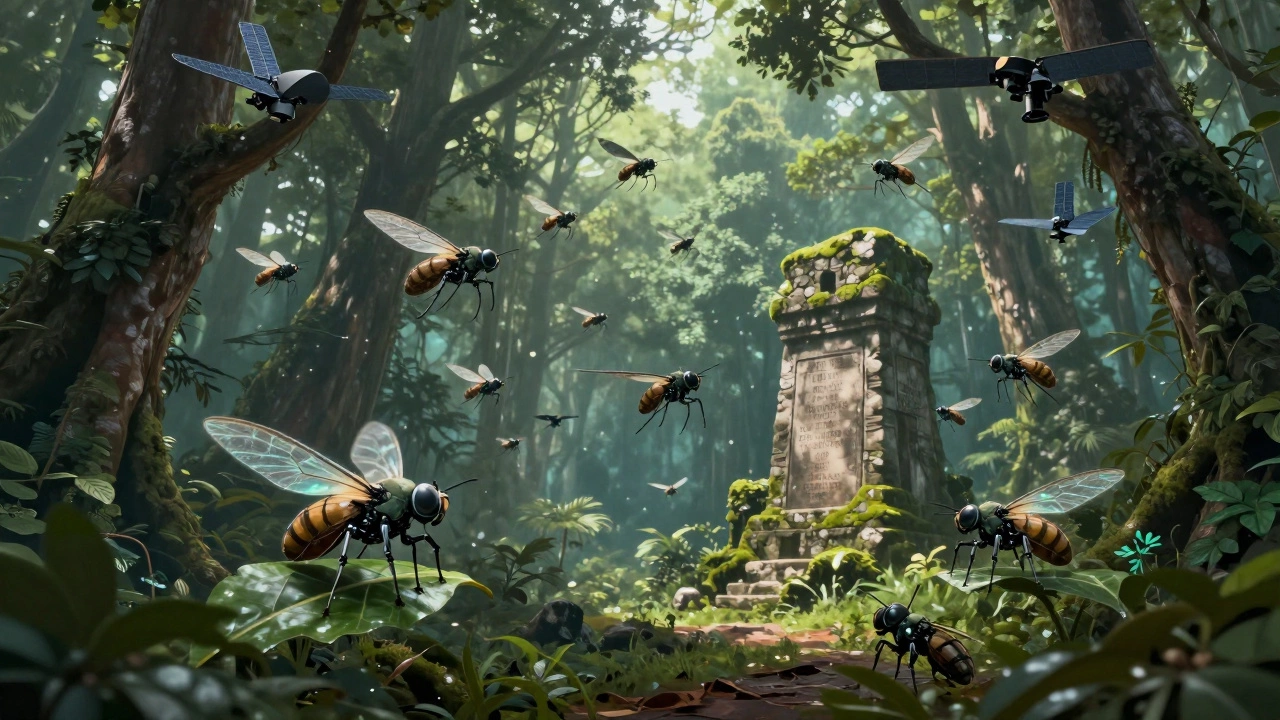
By 2400, scientists released synthetic pollinators - tiny drones shaped like bees - to replace the lost insect populations. They’re now the most common living machines on Earth. They’re not robots. They’re biohybrids: living tissue fused with nanotech. They pollinate crops, clean airborne pollutants, and even detect methane leaks.
Forests? Only 12% of their original cover remains. But they’re growing again - slowly - in places where humans have left them alone. The Congo Basin is the largest intact forest left. It’s now a UNESCO-protected biosphere, monitored by satellite and drone. It’s also the last place where you can hear a real bird sing.
What’s Left of Culture?
Art, music, literature - they’re not gone. They’ve changed. Stories are no longer about conquest or exploration. They’re about resilience. About loss. About what we chose to save.
Music is composed using sound from nature - wind through underground tunnels, water dripping in aquifers, the hum of fusion reactors. Literature is written in bioluminescent ink on recycled polymer paper. Children learn history not from books, but from immersive holograms that show the world before the heat.
There’s no nostalgia. There’s no longing for the past. People in 3000 don’t dream of beaches or forests. They dream of clean air. Of quiet. Of a sky that doesn’t burn.
It’s Not Too Late - But It Was Almost Too Late
The world in 3000 isn’t a nightmare. It’s a compromise. Humans didn’t win. They didn’t conquer nature. They adapted. They survived. They rebuilt - not on the ruins of the old world, but alongside what was left.
If you’re reading this in 2026, you’re not just a witness. You’re a participant. The choices you make today - what you buy, who you vote for, how you travel, what you demand from leaders - will echo in the silence of a world that forgot how to snow.
The future isn’t written. But the first page is already turning.
Will humans still live on Earth in 3000?
Yes - but not in the way we imagine. Most humans live in underground cities, floating platforms, or high-altitude zones. Surface living is limited to controlled, climate-stabilized zones. The majority of the population lives in regions that were once uninhabitable - like the Arctic or Sahel - because they’ve been engineered to support life. Earth is still home. But it’s a home that had to be rebuilt.
Is there still fossil fuel use in 3000?
No. Fossil fuels were banned globally by 2250. The last oil rig was decommissioned in 2212. All energy comes from fusion, solar, and geothermal sources. Fossil fuels are now museum pieces - studied in history modules, not used for power. Their legacy is in the climate systems we’re still repairing.
How did humanity avoid collapse?
It wasn’t one solution. It was a combination: rapid decarbonization after 2080, mass migration planning, AI-managed resource distribution, global governance under the Climate Accord, and a cultural shift toward sufficiency. People stopped equating progress with consumption. Survival became the new metric. And that change - more than any technology - made the difference.
Are there still animals in 3000?
Many species are extinct - especially large mammals and coral-dependent fish. But new life emerged. Insects, microbes, and deep-sea organisms adapted. Synthetic pollinators and engineered microbes now perform roles once held by nature. Some species were saved through cryo-preserved embryos and reintroduced into protected zones. The biodiversity of 3000 is different - not richer, but more resilient.
What happened to the oceans?
The oceans are warmer, more acidic, and 7 meters higher. Coral reefs are gone. Most fish populations collapsed. But in the deep ocean, new ecosystems formed. Hydrothermal vents became biodiversity hotspots. Autonomous cleaning drones now filter microplastics and restore pH balance in coastal zones. Ocean life is sparse - but not dead. And it’s being actively restored.