How to Become a Healthcare Research Analyst Without a Degree in 2026
 Aug, 25 2026
Healthcare Research Analyst Readiness Score
Answer the following questions honestly to calculate your readiness score. This tool helps identify gaps in your profile based on the non-degree pathway requirements.
1. Technical Proficiency
2. Portfolio & Experience
Your Healthcare Analyst Profile Report
Key Insights:
Most job listings for Healthcare Research Analyst is a professional role that involves interpreting clinical data, monitoring trial outcomes, and supporting evidence-based decision-making in medical settings. typically list a bachelor’s or master’s degree as a requirement. But here is the reality: many organizations hire based on competence, not just credentials. If you have the right skills, portfolio, and persistence, you can break into this field without a traditional university degree. The key is understanding what employers actually value versus what they merely check off on a form.
The Reality of Entry-Level Requirements
Let’s be honest about the landscape. Large pharmaceutical companies and major academic hospitals often have rigid HR policies. They might require a degree in statistics, biology, or health informatics because it simplifies their hiring process. However, smaller biotech startups, contract research organizations (CROs), and private health tech firms are more flexible. They care about whether you can clean messy data, spot trends, and explain findings clearly.
If you lack a degree, you face two main hurdles:
- Automated Screening: Many online applications use software that filters out candidates without specific keywords like "Bachelor's" or "Master's." You may need to apply directly via email or LinkedIn rather than through standard portals.
- Credibility Gap: Hiring managers might question your foundational knowledge. You must prove you understand concepts like randomization, blinding, and statistical significance without relying on a diploma to vouch for you.
Essential Skills That Replace a Degree
Since you don’t have a piece of paper proving your education, your skills become your resume. In healthcare research, technical proficiency is non-negotiable. Here is what you need to master:
- Data Analysis Tools: Proficiency in Python or R is increasingly preferred over Excel alone. You should know how to handle missing data, perform regression analyses, and visualize results using libraries like Pandas or ggplot2.
- Statistical Literacy: You don’t need to be a statistician, but you must understand p-values, confidence intervals, and effect sizes. Misinterpreting these can lead to flawed conclusions in clinical trials.
- Electronic Health Records (EHR): Familiarity with systems like Epic or Cerner helps. Understanding how patient data is structured in these databases makes you valuable for real-world evidence studies.
- Regulatory Knowledge: Basic understanding of Good Clinical Practice (GCP) and FDA or MHRA guidelines shows you respect the compliance side of research.
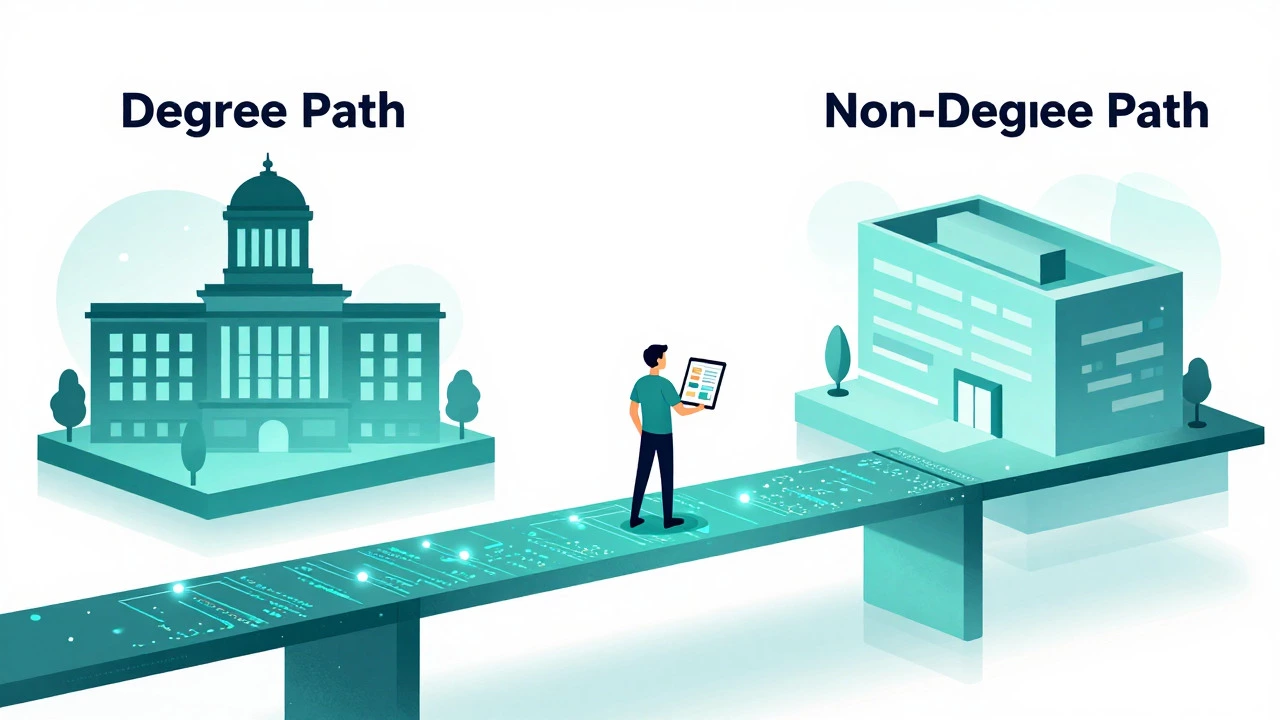
| Feature | Traditional Degree Path | Non-Degree / Self-Taught Path |
|---|---|---|
| Time to Entry | 4-7 years (Undergrad + Grad) | 1-3 years (Certifications + Portfolio) |
| Cost | High (£20k-£50k+) | Moderate (£1k-£5k for courses/certs) |
| Networking | Built-in via university alumni | Must be actively built via conferences/LinkedIn |
| Hiring Bias | Lower initial bias | Higher scrutiny; requires stronger proof of skill |
| Flexibility | Structured curriculum | Customizable to specific niche interests |
Building a Credible Portfolio
Your portfolio is your new degree. Instead of listing courses you took, show work you’ve done. Recruiters want to see tangible output. How do you create this without a job?
Start with public datasets. The UK Biobank offers access to millions of participant records for approved researchers, but even smaller public datasets from Kaggle or government health departments are great starting points. Pick a topic-say, the correlation between sleep patterns and cardiovascular risk-and run a full analysis. Write up your findings in a blog post or GitHub repository. Include code, charts, and a clear conclusion.
Here is a simple structure for your portfolio project:
- Problem Statement: What question are you answering?
- Data Source: Where did the data come from? How did you clean it?
- Methodology: What statistical tests did you use and why?
- Visualization: Clear, readable graphs that tell a story.
- Conclusion: What does this mean for healthcare practice?
Having three to five such projects demonstrates consistency and depth. It proves you can take raw data and turn it into actionable insight, which is exactly what a research analyst does daily.
Certifications That Matter
While certifications aren’t degrees, they signal commitment and verified knowledge. Choose ones recognized by industry leaders. For example, the Society for Clinical Research Associates (SCRA) offers certificates that cover regulatory affairs and trial management. Similarly, Coursera and edX offer specialized tracks in biostatistics and health informatics from top universities. These don’t give you a degree, but they add weight to your application.
Look for certifications that include practical assessments. A certificate saying you "completed a course" is less impressive than one stating you passed a rigorous exam or completed a capstone project. Employers trust verified skills more than self-reported learning.
Navigating the Job Market Without Credentials
Applying for jobs without a degree requires a different strategy. Don’t spray and pray. Target roles where skills matter more than titles. Look for positions labeled "Data Associate," "Research Assistant," or "Clinical Data Coordinator." These roles often serve as foot-in-the-door opportunities. Once inside, you can move laterally into analyst positions.
Networking is your best friend here. Attend local meetups, webinars, or conferences related to health data science. In Liverpool, for instance, there are active communities around digital health and AI in medicine. Connect with professionals on LinkedIn. Send personalized messages explaining your interest in their work and asking for brief advice, not jobs. Referrals bypass the automated filters that reject non-degree holders.

Common Pitfalls to Avoid
Many aspiring analysts make mistakes that hold them back. Avoid these traps:
- Over-Reliance on Online Courses: Taking ten courses without applying the skills leads to "tutorial hell." Build projects instead.
- Ignoring Soft Skills: Research isn’t just math. You need to communicate complex ideas to non-technical stakeholders. Practice writing clear summaries and presenting findings.
- Undervaluing Domain Knowledge:** Knowing Python is useless if you don’t understand what a "primary endpoint" is in a clinical trial. Study the basics of pharmacology and epidemiology.
Frequently Asked Questions
Do I need a master's degree to be a senior research analyst?
Not necessarily. While many senior roles prefer advanced degrees, experience and demonstrated expertise can compensate. If you have 5-7 years of strong performance and a robust portfolio, a master's is rarely a hard blocker for promotion.
Which programming language is better for healthcare research: Python or R?
Both are excellent. R has a slight edge in academic biostatistics due to its extensive package library for statistical testing. Python is more versatile for data engineering and machine learning tasks. Learn both if possible, but start with the one most common in your target industry.
Can I get hired at a large pharma company without a degree?
It is difficult but possible. Large firms have strict HR protocols. Your best bet is to network internally or apply for contract/temporary roles first. Demonstrating value during a contract period can lead to a permanent offer, bypassing some initial screening barriers.
What is the average salary for a healthcare research analyst without a degree?
Salaries vary by location and experience. In the UK, entry-level roles without a degree might start around £25,000 - £30,000. With 3-5 years of experience and strong skills, you can reach £40,000 - £50,000. This is comparable to degree holders at similar experience levels.
Are online bootcamps worth it for breaking into this field?
Yes, if they focus on practical projects and provide career support. Look for bootcamps that guarantee interview preparation and have strong industry partnerships. Avoid generic coding bootcamps unless they have a specific track for data science in healthcare.