How Expensive Is Nanotechnology? A Breakdown of Costs, Funding, and ROI
 Jul, 17 2026
Nanotech Startup Cost Estimator
Use this tool to estimate the initial investment required to launch a nanotech facility. Costs vary significantly based on cleanroom standards, specialized instrumentation, and personnel.
Estimated Startup Requirements
| Cost Category | Estimated Range |
|---|---|
| Cleanroom Construction | - |
| Specialized Equipment | - |
| Personnel (Year 1) | - |
| Raw Materials | - |
Note: These figures are estimates based on industry averages. Actual costs can vary by location, specific regulatory requirements, and market conditions. Many startups mitigate these risks by utilizing university shared facilities.
You’ve probably heard that Nanotechnology is the manipulation of matter on an atomic, molecular, and supramolecular scale will solve everything from cancer to climate change. But there’s a catch: it’s not cheap. In fact, the question isn’t just “how expensive is it?” but “expensive for whom, and at what stage?”
If you’re a startup founder looking to inject gold nanoparticles into a drug delivery system, your costs look very different than if you’re a government agency funding a national nanofabrication center. The price tag varies wildly depending on whether you are talking about research and development (R&D), raw materials, or mass production.
The Hidden Cost of R&D and Infrastructure
Before you can sell a single nanotech product, you need to build the lab that creates it. This is where the initial burn rate hits hardest. Unlike traditional chemistry labs, a nanotech facility requires ultra-clean environments. We aren't just talking about wiping down tables; we are talking about ISO Class 5 cleanrooms where even a speck of dust can ruin a batch of quantum dots.
Setting up a basic nanofabrication lab can cost between $500,000 and $2 million. Why so much?
- Cleanroom Construction: Building a Class 1000 cleanroom costs roughly $300-$500 per square foot. That’s significantly more than standard office space.
- Specialized Equipment: You need tools like Atomic Force Microscopes (AFM) or Scanning Electron Microscopes (SEM). A high-end SEM alone can set you back $100,000 to $300,000. Add in lithography machines, and you are quickly approaching seven figures.
- Talent Acquisition: Skilled nanotechnologists and materials scientists command high salaries. In major hubs, senior researchers often earn over $150,000 annually, plus benefits.
This infrastructure cost is a barrier to entry. It means small players often rely on shared facilities or university partnerships, which adds administrative overhead and scheduling delays to the cost equation.
Raw Materials: The Price of Precision
Once the lab is built, you need materials. At the nanoscale, purity is everything. Impurities that would be negligible in bulk materials can disrupt the electronic or optical properties of nanomaterials.
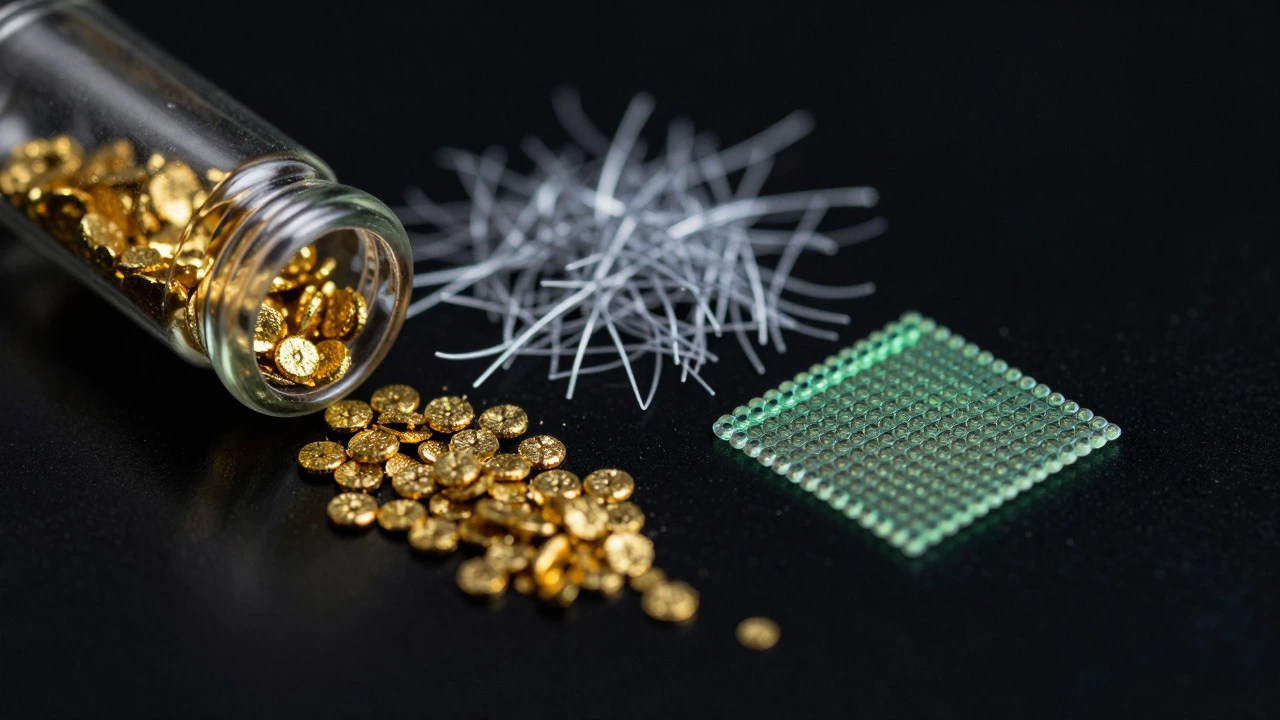
Consider carbon nanotubes (CNTs). High-purity, single-walled CNTs used in electronics can cost upwards of $1,000 per gram when purchased in small quantities for research. As volumes increase, this price drops, but it remains steep compared to standard graphite. Similarly, gold nanoparticles used in medical diagnostics vary in price based on size and coating complexity. A vial of specific-sized gold nanoparticles might cost $200-$500 for a few milligrams.
| Material | Typical Use Case | Approximate Cost (Small Batch) |
|---|---|---|
| Carbon Nanotubes (Single-Walled) | Electronics, Composites | $500 - $1,500 / gram |
| Gold Nanoparticles | Biosensors, Drug Delivery | $200 - $600 / vial (mg scale) |
| Silicon Quantum Dots | LEDs, Imaging | $100 - $400 / gram |
| Titanium Dioxide Nanoparticles | Sunscreen, Self-Cleaning Coatings | $50 - $150 / kg |
Note the disparity. Titanium dioxide is cheaper because it is produced in larger volumes for consumer goods like sunscreen. Carbon nanotubes remain expensive due to complex synthesis and purification processes. This volume-price relationship is critical for understanding how nanotech scales.
Manufacturing Challenges: From Lab to Line
Making nanomaterials in a flask is one thing. Making them consistently in a factory is another. This transition, known as scale-up, is notoriously difficult and costly. In nanotechnology, "batch-to-batch" consistency is vital. If your nanoparticles vary slightly in size, their properties change. This leads to high rejection rates during early manufacturing phases.
Regulatory compliance also drives up costs. Agencies like the FDA (in the US) and EMA (in Europe) require extensive toxicological testing for new nanomaterials. Proving that a new nanoparticle won’t accumulate in organs or cause unintended immune responses can take years and millions of dollars in clinical trials.
For example, developing a nanomedicine often costs between $1 billion and $2 billion from discovery to market approval. While this is similar to traditional pharmaceuticals, the added complexity of characterizing nano-properties makes the process slower and riskier.
Funding Sources: Who Pays the Bill?
Given these high costs, who actually funds nanotechnology? The answer is a mix of public and private capital.
Government agencies play a huge role. In the United States, the National Nanotechnology Initiative (NNI) has coordinated billions of dollars in funding across multiple departments since its inception. In 2025, the NNI budget exceeded $2 billion, supporting basic research and infrastructure. Similar initiatives exist in the EU through Horizon Europe and in China through various state-led science programs.
Private venture capital (VC) has become more cautious. After a boom in the early 2010s, many nanotech startups failed to commercialize. Today, VCs prefer later-stage companies with proven prototypes rather than early-stage R&D bets. This shift means founders must secure more personal capital or angel investment before attracting institutional money.
Corporate R&D budgets also contribute. Large tech firms like Intel and Samsung invest heavily in nanolithography for chip manufacturing. For them, nanotech isn't a side project; it's core to their survival. Their spending runs into tens of billions annually, dwarfing most academic budgets.

Return on Investment: Is It Worth It?
Despite the high upfront costs, the potential ROI for nanotechnology is significant. Markets using nanomaterials are projected to reach over $200 billion by 2030. Sectors like energy storage (better batteries), healthcare (targeted drug delivery), and electronics (smaller, faster chips) drive this growth.
However, not all nanotech applications are profitable. Some niche uses, such as self-cleaning fabrics, have struggled to justify the premium price consumers are unwilling to pay. Success depends on solving a real problem better than existing alternatives. If your nanotech solution doesn't offer a clear performance boost or cost reduction, it will likely fail in the market.
Key factors influencing ROI include:
- Scalability: Can you produce the material at low cost?
- Regulatory Pathway: Is the approval process clear and manageable?
- Market Demand: Do customers actually want the enhanced feature?
Future Trends: Will Costs Go Down?
Yes, but slowly. As production methods improve, costs for established nanomaterials like titanium dioxide and silver nanoparticles continue to drop. New techniques, such as green synthesis using plant extracts instead of harsh chemicals, may reduce both environmental impact and processing costs.
Additionally, AI-driven materials discovery is speeding up the R&D phase. By predicting which nanostructures will work best, researchers can skip trial-and-error experiments, saving time and money. However, the fundamental physics of working at the atomic scale ensures that nanotechnology will always carry a premium compared to bulk materials.
In short, nanotechnology is expensive because it demands precision, purity, and patience. But for those who can navigate the financial hurdles, the rewards are transformative.
How much does it cost to start a nanotech company?
Starting a nanotech company typically requires $500,000 to $2 million initially, covering cleanroom setup, specialized equipment like electron microscopes, and hiring skilled researchers. Many startups begin by renting space in university incubators to reduce these costs.
Are nanomaterials more expensive than regular materials?
Yes, generally. High-purity nanomaterials like carbon nanotubes can cost thousands of times more per gram than their bulk counterparts due to complex synthesis and purification needs. However, prices drop significantly as production scales up.
Who funds nanotechnology research?
Funding comes from government agencies (like the US National Nanotechnology Initiative), corporate R&D departments (especially in tech and pharma), and increasingly cautious venture capital firms focused on late-stage commercialization.
Why is scaling nanotech production so difficult?
Scaling is hard because maintaining consistent particle size and shape is crucial for performance. Small variations in manufacturing conditions can lead to batches with different properties, resulting in high waste and rework costs.
Is nanotechnology becoming cheaper over time?
Yes, for mature applications like sunscreens and coatings. Advances in manufacturing efficiency and new synthesis methods are gradually lowering costs, though high-end applications in medicine and electronics remain expensive.