Examples of Interprofessional Collaboration in Healthcare and Research
 Sep, 8 2026
Interprofessional Collaboration Simulator
Select a scenario below to see which professionals are required for optimal outcomes. Toggle roles on or off to observe the impact on the final result.
Hospital Discharge Team
Configure the care team by toggling the inclusion of each professional. Observe how missing expertise affects the outcome.
| Professional Role | Include? |
|---|
You might think science happens in isolation-a lone researcher staring at a microscope or a doctor writing prescriptions alone. But the reality is far messier and more collaborative. Interprofessional collaboration is the process where professionals from different disciplines work together to solve complex problems that no single field can handle alone. It’s not just about being nice to your colleagues; it’s about combining distinct expertise to achieve outcomes that are greater than the sum of their parts.
If you’ve ever wondered how a patient survives a complex surgery or how a new vaccine gets developed, you’re looking at interprofessional collaboration in action. This article breaks down concrete examples across healthcare and scientific research, showing you exactly who talks to whom, why they do it, and what happens when they get it right (or wrong).
The Core Idea: Why Mix Disciplines?
Why bother bringing a pharmacist into a doctor’s conversation? Or pairing a data scientist with a biologist? Because modern problems don’t respect disciplinary boundaries. A heart attack isn’t just a medical event; it’s also a logistical challenge for nurses, a financial issue for insurance agents, and a psychological hurdle for the patient. Solving it requires a team.
Healthcare teams rely on clinical collaboration to reduce errors and improve patient safety. According to the World Health Organization, effective teamwork can significantly lower mortality rates in critical care settings. When doctors, nurses, pharmacists, and social workers align their goals, patients recover faster and make fewer mistakes after discharge.
In research, the logic is similar. You can’t build a climate model without meteorologists, computer scientists, and ecologists talking to each other. If they work in silos, the model misses key variables. Collaboration fills those gaps.
Example 1: The Hospital Discharge Team
Imagine an elderly patient named Arthur who has been hospitalized for pneumonia. He’s ready to leave, but sending him home alone is risky. Here’s where interprofessional collaboration kicks in.
- The Doctor: Determines Arthur is medically stable but still needs oxygen therapy.
- The Nurse: Assesses Arthur’s ability to manage his own medications and notes he struggles with dexterity due to arthritis.
- The Pharmacist: Reviews his medication list, spots a dangerous interaction between his blood thinner and a new antibiotic, and suggests a switch.
- The Social Worker: Checks if Arthur has support at home. Realizes he lives alone and arranges for a home health aide.
- The Physical Therapist: Creates a simple exercise plan to prevent muscle loss during recovery.
Without this huddle, Arthur might go home with the wrong meds, forget to use his inhaler correctly, or fall because he’s too weak. The discharge planning process is a classic example of coordinated care involving multiple specialties. Each professional contributes a piece of the puzzle. If the pharmacist didn’t speak up, Arthur could have suffered a bleed. If the social worker wasn’t involved, he might have been readmitted within days.
Example 2: Cancer Care Tumor Boards
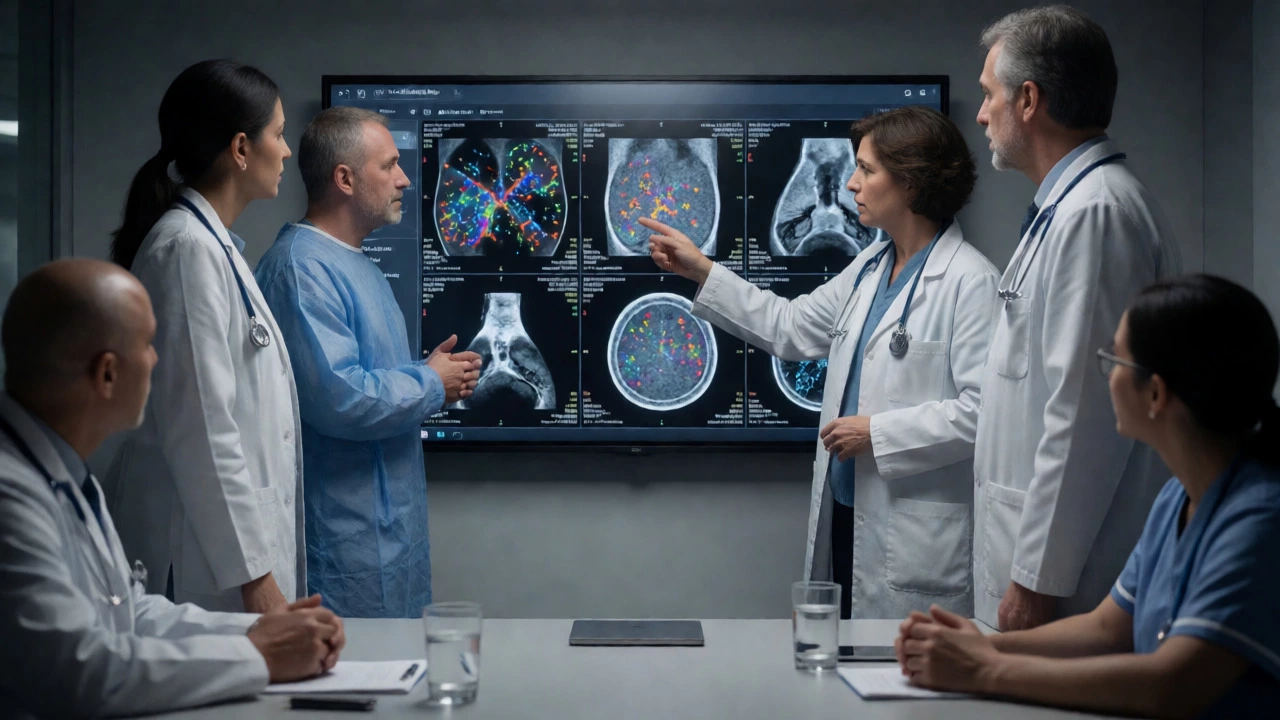
Cancer treatment is rarely straightforward. Should a patient have surgery first? Or chemotherapy? Or radiation? Deciding this isn’t left to one surgeon. Instead, hospitals hold Multidisciplinary Tumor Boards (MDTs), where specialists debate the best path forward for specific cases.
| Professional | Primary Contribution | Decision Impact |
|---|---|---|
| Oncologic Surgeon | Evaluates surgical feasibility and risks | Determines if tumor removal is possible |
| Medical Oncologist | Assesses systemic therapy options (chemo/immunotherapy) | Recommends drug protocols |
| Radiation Oncologist | Plans targeted radiation delivery | Decides timing and dosage of radiation |
| Pathologist | Analyzes tissue samples for genetic markers | Identifies specific cancer subtypes |
| Nurse Specialist | Provides insight into patient quality of life and side effects | Balances aggressive treatment vs. comfort |
In these meetings, the pathologist might find a genetic marker that makes the cancer responsive to a new immunotherapy drug. The oncologist then adjusts the plan. Without the pathologist’s input, the surgeon might remove the tumor unnecessarily, or the oncologist might prescribe a chemo regimen that doesn’t target the specific mutation. This is scientific collaboration saving lives through shared knowledge.
Example 3: Vaccine Development Pipelines
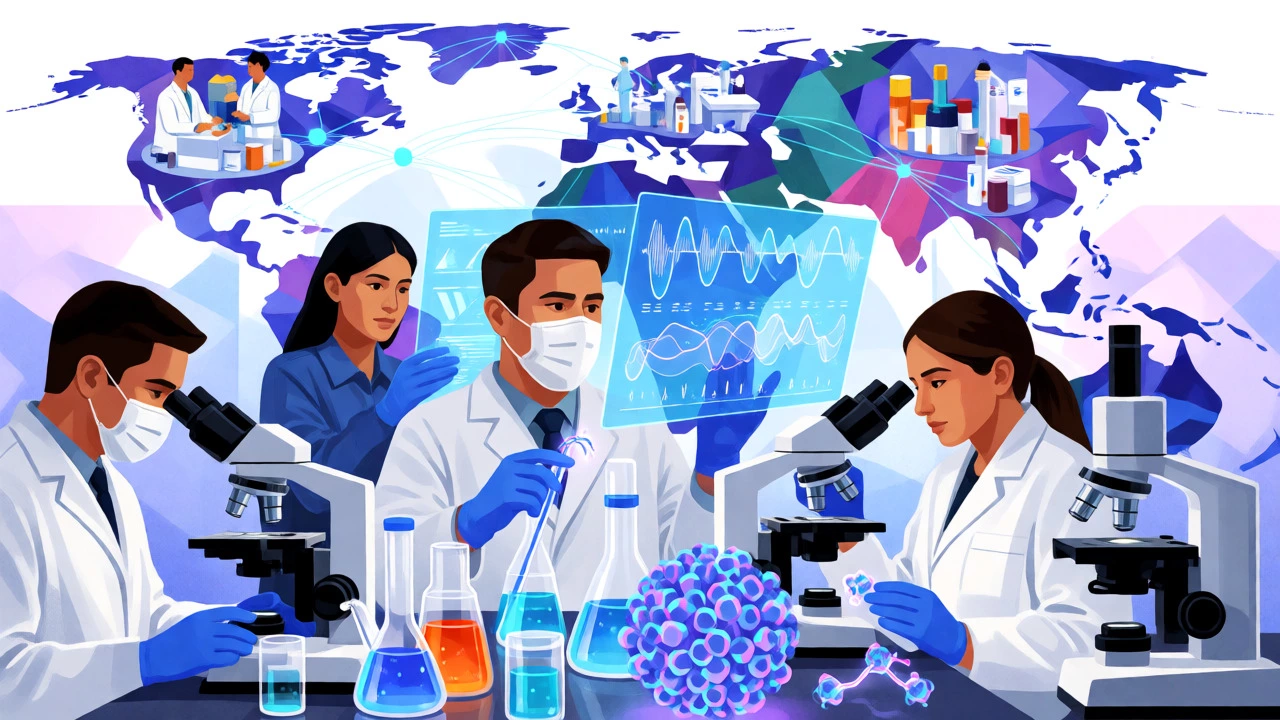
Developing a vaccine like the ones used for mRNA technology involves a massive chain of experts. It’s not just biologists in lab coats. Consider the journey from concept to injection:
- Virologists identify the target protein on the virus surface.
- Molecular Biologists design the mRNA sequence that codes for that protein.
- Lipid Chemists create the fatty nanoparticle shell that protects the fragile mRNA and helps it enter cells.
- Data Scientists run simulations to predict stability and immune response.
- Clinical Trial Coordinators manage thousands of human participants across global sites.
- Regulatory Affairs Specialists compile the evidence for agencies like the FDA or EMA.
If the lipid chemist fails to stabilize the molecule, the vaccine spoils before it reaches the patient. If the data scientist misses a signal in early trials, safety issues might be overlooked. This workflow demonstrates how transdisciplinary research integrates chemistry, biology, statistics, and logistics to produce a public health tool.
Example 4: Climate Change Mitigation Projects
Climate change isn’t just an environmental issue; it’s an economic and social one. Cities trying to reduce carbon footprints often form task forces that include diverse experts.
Take a project to install solar panels on low-income housing. An engineer calculates the energy output. An economist analyzes the cost-benefit ratio for residents. A sociologist studies whether people will actually maintain the panels. A policy advisor checks local zoning laws. If the engineer ignores the sociologist, the panels might get installed but never cleaned, leading to efficiency drops. If the economist ignores the engineer, the system might be too expensive to justify.
This type of interdisciplinary sustainability planning combines technical, financial, and human-centric perspectives. It ensures solutions are technically sound, financially viable, and socially acceptable.
Common Pitfalls in Collaboration
Just putting people in a room doesn’t guarantee good results. Hierarchies can silence junior voices. Jargon barriers can cause misunderstandings. For instance, a doctor might say “NPO” (nothing by mouth), while a nurse knows this means “no food or drink,” but a family member hears nothing and panics. Clear communication protocols are essential.
Another trap is role ambiguity. Who decides the final treatment plan? In some cultures, the doctor is the sole authority. In others, consensus is required. Successful teams define decision-making rights upfront. They also establish shared mental models-everyone understands the goal is patient well-being, not just departmental budgets.
How to Start Collaborating Across Fields
If you want to foster better interprofessional collaboration in your organization, start small. Don’t try to overhaul everything at once. Try these steps:
- Identify Overlaps: Find projects where two departments share a common goal but work separately.
- Create Shared Spaces: Whether physical meeting rooms or digital Slack channels, give teams a place to talk informally.
- Teach Basic Literacy: Have engineers learn basic business terms and marketers learn basic tech concepts. This reduces friction.
- Rotate Roles: Let team members shadow colleagues in other disciplines for a day. Empathy builds trust.
Remember, the goal isn’t to make everyone an expert in every field. It’s to make everyone an expert in communicating their field’s value to others.
What is the difference between multidisciplinary and interprofessional collaboration?
Multidisciplinary work involves professionals from different fields working side-by-side but often independently toward separate goals. Interprofessional collaboration goes deeper: it requires active integration of knowledge, joint decision-making, and shared responsibility for the outcome. In true interprofessional work, the lines between roles blur as teams co-create solutions.
Why is interprofessional collaboration important in healthcare?
It reduces medical errors, improves patient satisfaction, and lowers costs. Studies show that teams with strong communication skills have fewer adverse events. By leveraging the unique strengths of nurses, pharmacists, doctors, and therapists, healthcare providers can offer holistic care that addresses medical, emotional, and social needs simultaneously.
Can students practice interprofessional collaboration?
Yes, many universities now implement IPE (Interprofessional Education) programs. Medical, nursing, pharmacy, and social work students often participate in joint simulations or case studies. This prepares them for real-world workplace dynamics where they must collaborate immediately upon graduation.
What tools help remote interprofessional teams?
Digital platforms like Microsoft Teams, Zoom, and specialized EHR (Electronic Health Record) systems facilitate communication. Project management tools like Asana or Trello help track tasks across disciplines. However, technology only supports collaboration; it cannot replace clear protocols and mutual respect among team members.
Does interprofessional collaboration apply outside healthcare?
Absolutely. It is critical in engineering, business, education, and urban planning. Any complex problem requiring diverse expertise-such as launching a software product or designing a city park-benefits from cross-functional teams that integrate technical, user-experience, and financial perspectives.