Does McDonald's Use Scientific Management?
 Mar, 13 2026
Process Efficiency Calculator
McDonald's uses scientific management to save seconds on every task. Calculate how much time you could save by implementing similar principles in your workplace.
Your Efficiency Gains
When you walk into a McDonald’s, everything feels predictable. The fries are crispy. The burger assembly is quick. The drive-thru time rarely goes over three minutes. That’s not luck. It’s design. And behind that design is a system built on principles first laid out over 100 years ago - scientific management.
What Is Scientific Management?
Scientific management, also called Taylorism after its founder Frederick Winslow Taylor, isn’t about fancy tech or AI. It’s about breaking work into tiny, repeatable steps and measuring every second. Taylor studied factory workers in the early 1900s, timing how long it took them to shovel coal or lift iron bars. He found that small changes - like using the right tool, eliminating unnecessary motion, or training workers to do one thing perfectly - could boost output by 300%.
This wasn’t just theory. Factories that adopted his methods saw dramatic gains. But Taylorism had a dark side too: workers became cogs. They didn’t think. They just did. And that’s exactly what McDonald’s borrowed - not because it’s cruel, but because it works.
How McDonald’s Applied Taylor’s Ideas
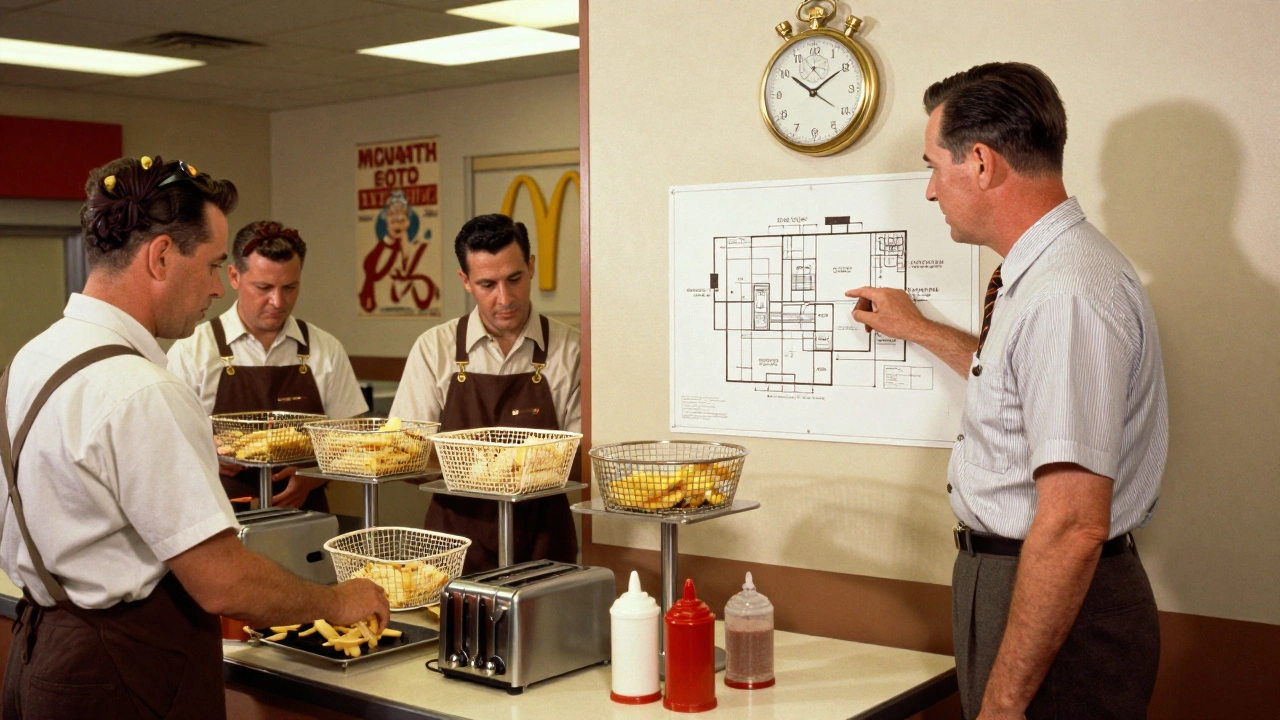
Ray Kroc, who turned McDonald’s into a global brand in the 1950s, didn’t invent the hamburger. He stole the system. He saw how the McDonald brothers’ San Bernardino restaurant operated: limited menu, standardized cooking times, assigned stations, and strict timing. He realized this wasn’t a restaurant - it was a production line.
Here’s how Taylorism shows up in every McDonald’s:
- Task specialization: One person fries, another assembles burgers, another takes orders. No one does it all.
- Time-motion studies: Every movement is measured. How long does it take to flip a patty? How many steps to grab a napkin? The system was designed to cut waste down to fractions of a second.
- Standardized tools: The fry basket, the bun toaster, the ketchup dispenser - all identical across 40,000+ locations. No room for variation.
- Training scripts: Employees don’t learn by doing. They follow scripts. "Would you like fries with that?" isn’t a suggestion. It’s a scripted line, tested for maximum upsell.
Even the layout of the kitchen is a scientific design. Workstations are arranged in a U-shape so workers don’t turn around. Ingredients are placed within 18 inches of where they’re used. A 2018 internal audit showed that changing the placement of a condiment tray by just six inches increased burger assembly speed by 7%.
Why It Works - And Why It’s Controversial
The result? McDonald’s serves over 69 million customers daily. That’s more people than the population of the United Kingdom. And it does it with minimal error. A 2022 study by the University of Chicago’s Booth School of Business found that McDonald’s has one of the lowest error rates in food service - just 0.8% of orders are wrong, compared to 3.5% at full-service restaurants.
But there’s a cost. Workers report high turnover. The job is repetitive. The pace is relentless. A 2023 survey of 12,000 U.S. crew members found that 68% said their role felt "mechanical," and 54% felt "like a robot." That’s not an accident. It’s the point.
Scientific management doesn’t care about job satisfaction. It cares about output. And McDonald’s has turned that into a global advantage.
The Hidden Science Behind the Scenes
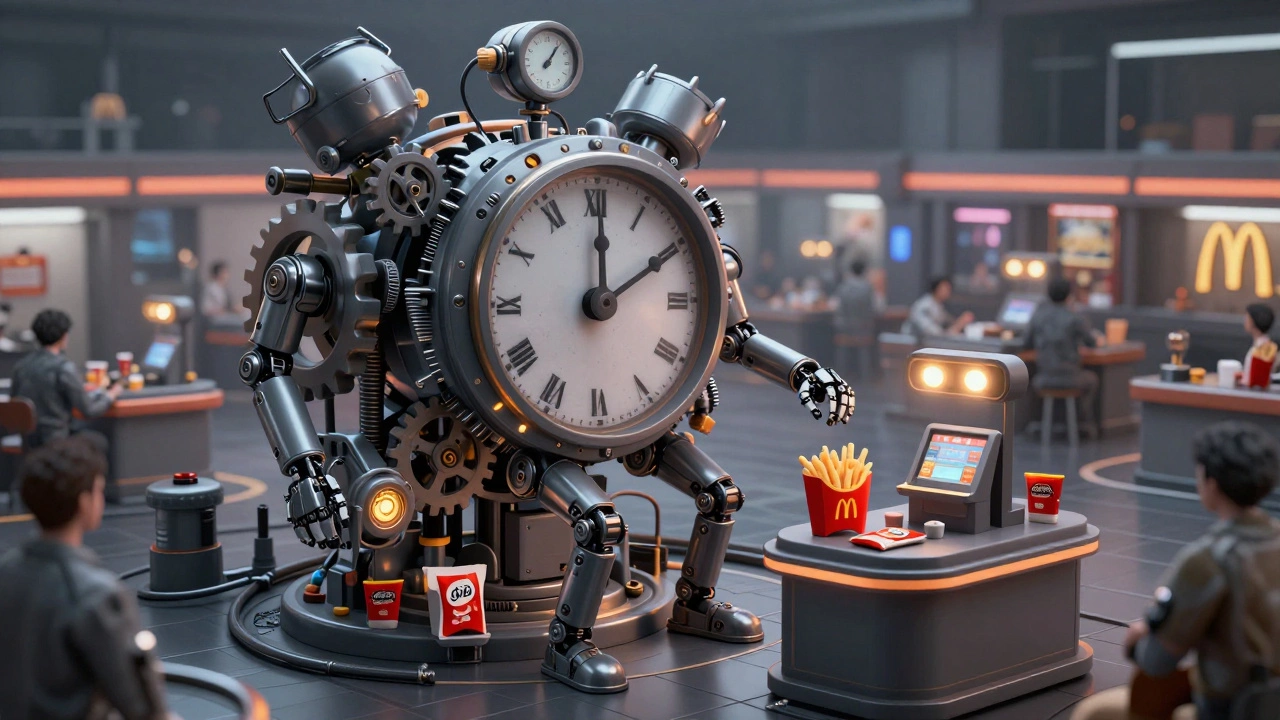
What most people don’t realize is that McDonald’s doesn’t just use Taylorism - it updated it. Today, it’s not just humans doing the work. Sensors monitor fryer oil temperature. AI predicts rush hours based on weather, traffic, and local events. Inventory systems auto-order supplies before they run out.
But the core remains the same: break it down, measure it, optimize it, repeat.
Take the Egg McMuffin. It was originally assembled by hand. Then McDonald’s tested 14 different assembly methods. They found that using a silicone mold to hold the egg in place while toasting cut prep time from 28 seconds to 11 seconds. That’s not innovation. That’s scientific management - with a modern twist.
Is This Still Relevant Today?
Some say Taylorism is outdated. That modern workers want meaning, not mindless repetition. But McDonald’s proves otherwise. It doesn’t need creativity. It needs consistency. And in a world where customers expect the same Big Mac in Tokyo, Toronto, or Liverpool - consistency is the ultimate competitive edge.
Even Amazon’s warehouses, Netflix’s content delivery, and Zara’s supply chain all use versions of the same system. The difference? McDonald’s was the first to apply it to food service - and still does it better than anyone.
What We Can Learn
You don’t need to run a fast-food chain to see the power of this approach. Whether you’re managing a small team, running a cafe, or organizing a volunteer group - breaking tasks into clear steps, measuring performance, and eliminating waste can transform results.
The lesson isn’t to treat people like machines. It’s to design systems so well that people don’t have to think hard to do their job right. McDonald’s didn’t succeed because it had cheap labor. It succeeded because it had a flawless system.
Scientific management isn’t about control. It’s about clarity. And in a messy, unpredictable world, that’s worth more than any trend or tech.
Is scientific management the same as modern automation?
No. Scientific management focuses on optimizing human work through standardization, timing, and task division. Automation replaces humans with machines. McDonald’s uses both: humans follow strict procedures, while sensors and software support those procedures. The system still relies on people - just in highly controlled ways.
Did Frederick Taylor ever visit McDonald’s?
No. Taylor died in 1915, decades before McDonald’s became a franchise. But Ray Kroc and his team studied Taylor’s writings closely. They didn’t need Taylor to visit - his principles were already in textbooks, factory manuals, and business schools. McDonald’s applied them to food service, not factories.
Why do some people criticize McDonald’s for using scientific management?
Critics say it dehumanizes workers by reducing them to cogs in a machine. Studies show high stress, low job satisfaction, and burnout in roles with rigid, repetitive tasks. While the system delivers efficiency, it often sacrifices worker well-being. That’s the trade-off: speed and consistency versus dignity and autonomy.
Are there any fast-food chains that don’t use scientific management?
Most do. Even "premium" chains like Chipotle or Shake Shack rely on standardized stations, timed cooking, and scripted interactions. The only exceptions are tiny, local spots with no franchise model - where the chef decides everything on the fly. But those can’t scale. To serve thousands daily, you need structure - and that’s scientific management.
Can scientific management be used in other industries?
Absolutely. Hospitals use it to reduce patient wait times. Airlines use it to turn planes around in 25 minutes. Even software teams use it - think Agile sprints and daily stand-ups. Any system that needs to repeat a process reliably can benefit. The key is measuring performance and removing guesswork.