Can I Learn Data Science on My Own? A Realistic Guide for Self-Taught Analysts
 Aug, 28 2026
Self-Taught Data Science Readiness & Timeline Estimator
Your Profile
Fill out the profile on the left to see your estimated timeline and next steps.
Estimated Time to Job-Ready
Based on 10 hrs/week
Next Priority Steps:
You see the job listings. You hear the buzzwords: data science is an interdisciplinary field that uses scientific methods, processes, algorithms, and systems to extract knowledge and insights from structured and unstructured data. It sounds lucrative, flexible, and intellectually stimulating. But then you look at the requirements. Master’s degrees in Statistics. Years of experience with Python. Advanced calculus. The barrier to entry feels like a brick wall.
Here is the uncomfortable truth: you absolutely can learn it on your own. Thousands of people have done it. But here is the other truth: most of them quit within six months because they treated it like a hobby instead of a rigorous discipline. If you are reading this, you are likely weighing the cost of a bootcamp or university degree against the freedom (and risk) of self-study. This guide breaks down exactly what it takes to go from zero to hireable without paying tuition fees.
The Reality Check: What "Self-Taught" Actually Means
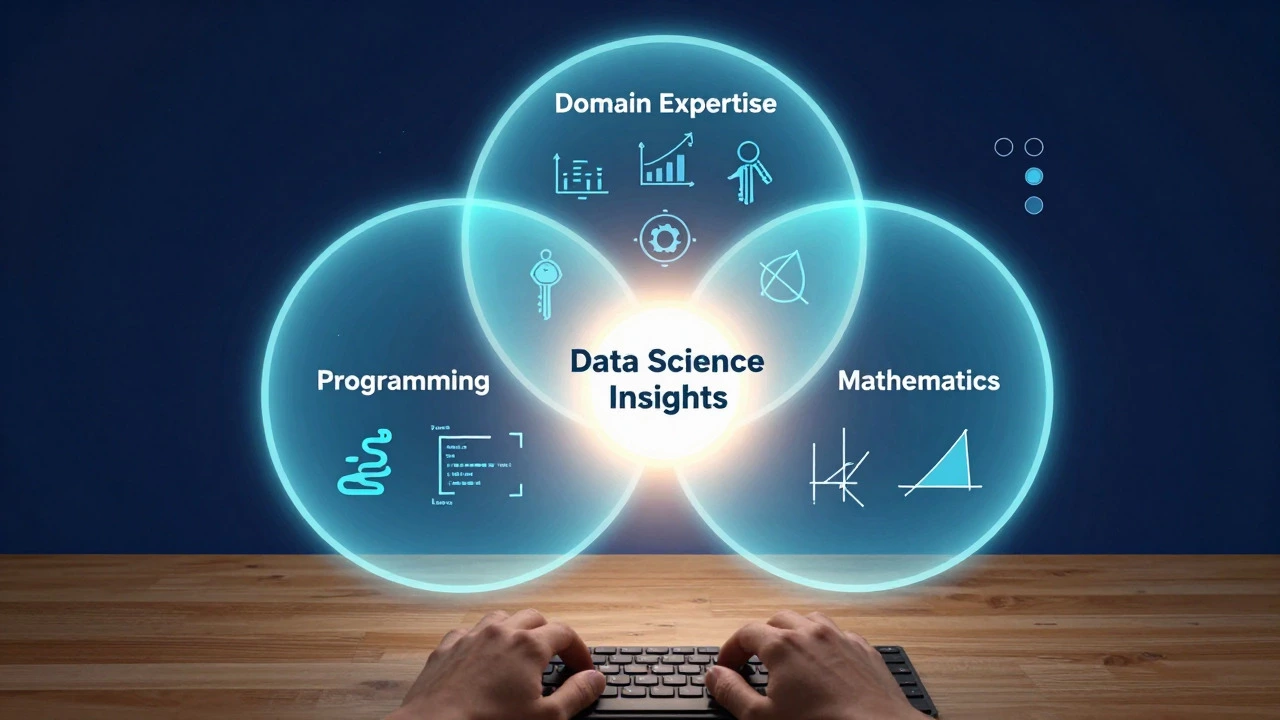
Before you download Anaconda or sign up for Coursera, you need to understand the scope. Data science isn't just one skill; it's a Venn diagram of three distinct areas: computer programming, mathematics/statistics, and domain expertise. When you study alone, you don't have a professor telling you which part of the diagram you're neglecting. You have to be your own curriculum director.
Most self-learners fail because they start with the fun stuff-building neural networks or visualizing data-and skip the boring foundations. They write code that runs but doesn't scale. They build models that predict well on training data but fail in production. To succeed, you must embrace the grind of foundational learning. This means spending weeks on linear algebra concepts before touching a machine learning library. It means understanding why a p-value matters before you care about accuracy scores.
Think of it like learning to cook. Anyone can follow a recipe for a soufflé. But if you want to open a restaurant, you need to understand heat transfer, food safety, and supply chain logistics. Self-taught data scientists who get hired are those who treat their learning like an apprenticeship, not a Netflix binge.
Step 1: Mastering the Tools of the Trade
If you pick only one programming language, make it Python. It is the dominant programming language in data science due to its readability and extensive ecosystem of libraries. Why Python? Because almost every major company uses it. R is still used in academia and specific statistical niches, but Python has won the industry war. Learning Python gives you access to Pandas, which is a software library written for the Python programming language for data manipulation and analysis. Pandas is where you will spend 60% of your time cleaning messy data.
Don't just watch tutorials. Type the code. Break it. Fix it. Here is a realistic timeline for the first three months:
- Month 1: Python Basics. Variables, loops, functions, and object-oriented programming. Don't worry about data yet. Just learn how to talk to the computer.
- Month 2: Data Manipulation. Learn NumPy for numerical operations and Pandas for handling tables. Practice loading CSV files, filtering rows, and merging datasets.
- Month 3: Visualization. Use Matplotlib and Seaborn to plot your findings. Can you explain a chart to someone who doesn't know what a histogram is?
SQL is the silent partner in this relationship. Many beginners ignore SQL, thinking Python can do everything. Wrong. Your company's data lives in a database, not in a CSV file on your laptop. You need to know how to query it. Learn JOINs, GROUP BY, and window functions. If you can pull data efficiently using SQL, you become immediately useful to any team.
Step 2: The Math You Actually Need (And What You Can Skip)
This is where most people panic. They think they need a PhD in Mathematics. You don't. You need practical statistics and enough linear algebra to understand how algorithms work under the hood.
Focus on these core concepts:
- Descriptive Statistics: Mean, median, mode, standard deviation. Know when to use each.
- Probability Distributions: Normal distribution, binomial distribution. Understand why outliers matter.
- Hypothesis Testing: A/B testing is everywhere in tech. You need to know if a result is statistically significant or just noise.
- Linear Algebra Basics: Vectors and matrices. You don't need to solve complex proofs by hand, but you should understand what matrix multiplication does in a neural network.
Skip the advanced calculus unless you plan to go into deep research. For applied data science roles, knowing how to interpret a regression coefficient is more valuable than deriving a Taylor series expansion. Resources like Khan Academy or StatQuest on YouTube are excellent for building intuition without getting bogged down in notation.
Building a Portfolio That Gets Noticed
A certificate proves you watched videos. A portfolio proves you can solve problems. Hiring managers in Liverpool, London, or New York don't care about your completion badges. They care about your GitHub repository. But not just any repository-a curated selection of projects that tell a story.
Stop doing the Titanic dataset. Everyone does the Titanic dataset. Instead, find data that interests you. Are you into football? Scrape Premier League stats and analyze player performance. Interested in local housing prices? Pull data from the UK Land Registry and build a price prediction model. The key is to show the full lifecycle of a project:
- Data Collection: Show how you got the data. Did you scrape it? Download it from Kaggle? Query an API?
- Cleaning: Document the mess. How many missing values did you handle? How did you deal with duplicates?
- Analysis: What questions did you ask? What did you find?
- Communication: Write a README file that explains your findings to a non-technical stakeholder. This is crucial. Data science is business storytelling with numbers.
Deploy one of your projects. Use Streamlit or Flask to create a simple web app where users can interact with your model. This shows you understand deployment, not just experimentation. It separates you from the thousands of learners who keep their work in Jupyter Notebooks no one else can run.
| Factor | Self-Taught Path | Bootcamp/Master's Degree |
|---|---|---|
| Cost | Low ($0 - $500/year) | High ($10k - $40k+) |
| Time Commitment | Flexible (6-18 months) | Rigid (3-12 months) |
| Networking | Harder (requires proactive effort) | Easier (built-in community) |
| Curriculum Structure | Self-directed (risk of gaps) | Structured (comprehensive coverage) |
| Credibility Signal | Portfolio-heavy | Diploma-heavy |
Navigating the Job Market Without a Degree
Let's address the elephant in the room: some companies still filter out candidates without a STEM degree. However, this trend is shifting rapidly. Startups and mid-sized tech firms prioritize skills over pedigree. Big legacy banks might still prefer formal education, but even they are opening up to technical assessments.
To bridge the gap, you need to network aggressively. Since you aren't in a classroom, you don't have classmates to refer you to jobs. Attend local meetups. In the UK, cities like Manchester, Leeds, and London have vibrant data communities. Online platforms like LinkedIn and Twitter (X) are also powerful. Engage with content creators. Comment on posts. Share your projects. Visibility leads to opportunities.
When applying, tailor your resume to highlight tools and outcomes. Instead of saying "Learned Python," say "Built a churn prediction model using Python and Scikit-Learn that identified 15% of at-risk customers." Quantify your impact. Even if the project was personal, frame it in business terms.

Common Pitfalls to Avoid
I've seen countless aspiring data scientists stumble on the same rocks. Here are the big ones:
- Tutorial Hell: Watching endless courses without building anything. You feel productive, but you aren't learning retention. Build something broken, then fix it.
- Ignoring Version Control: Git is not optional. If you don't know how to commit, push, and branch, you can't collaborate. Learn Git early.
- Over-Engineering: Trying to use a Deep Learning Neural Network for a problem that a simple Linear Regression could solve. Simplicity often wins in production.
- Neglecting Soft Skills: You can have the best model in the world, but if you can't explain why it matters to a marketing manager, it's useless. Practice presenting your findings.
Is It Worth the Effort?
Yes, but only if you enjoy solving puzzles. Data science is frustrating. You will spend hours debugging a single line of code. You will stare at a scatter plot wondering why it looks like random noise. But when you finally crack the pattern, when you turn raw chaos into actionable insight, it feels like magic.
The barrier to entry is lower than ever, but the bar for competence is higher. Companies don't need more people who can import Pandas. They need people who can think critically about data. If you are disciplined, curious, and willing to struggle through the math, you can absolutely learn data science on your own. The degree is just paper. The skill is real.
How long does it take to learn data science on my own?
For most people studying 10-15 hours a week, it takes 6 to 12 months to reach a junior-level competency. This includes mastering Python, SQL, basic statistics, and building 2-3 solid portfolio projects. Accelerated paths exist for those with prior coding experience, while complete beginners may need closer to 18 months.
Do I need a master's degree to get a data science job?
No, a master's degree is not strictly required, especially for junior and mid-level roles. Many employers value a strong portfolio and demonstrated technical skills over formal credentials. However, for specialized roles in AI research or senior positions in large corporations, a graduate degree can still be a significant advantage.
Which programming language is better for data science: Python or R?
Python is generally recommended for beginners and industry applications due to its versatility, ease of learning, and integration with web development and machine learning frameworks. R is powerful for statistical analysis and academic research. If you want the widest range of job opportunities, choose Python.
What are the best free resources for learning data science?
Kaggle provides datasets and micro-courses. FreeCodeCamp offers comprehensive Python and data analysis certifications. Andrew Ng's Machine Learning Specialization on Coursera (audit mode) is a gold standard for theory. Additionally, documentation for libraries like Pandas and Scikit-Learn is invaluable for practical reference.
Can I switch careers to data science without a technical background?
Yes, many successful data scientists come from fields like economics, biology, journalism, or psychology. Your domain knowledge is actually an asset, as it helps you ask better questions of the data. The key is to invest heavily in the technical fundamentals (coding and math) to complement your existing expertise.